“MUELLER MOMENTS,” PUNDITS, AND TRUMP’S VERY BAD DAY

Anyone focusing on substance over style could see that Robert Mueller’s testimony gave Donald Trump a very bad day. Many in the media share the blame for any public perception to the contrary. Stephen Colbert called them out:
The numerous critics of Mueller’s appearance might consider how directors make a movie. For hundreds of hours over many weeks, they film individual scenes. The director then works with editors — slicing and splicing to create a coherent motion picture. Their goal is to create a finished product that will entertain an audience for a couple of hours. The final movie includes only the good stuff. If it contained all of the rough footage, no one would watch it.

For more than five hours on July 24, viewers saw rough footage as the House began the process of creating the most important documentary in American history. But buried in those hours of testimony was some important stuff — including riveting “Mueller moments” that refuted Trump’s favorite lies.

The Truth About Trump’s Key Talking Points

For example, at the outset, Mueller confirmed that Trump’s central rhetorical talking points — “No Collusion, No Obstruction, Total Exoneration” — are lies. Without hesitation, he refuted each of them:
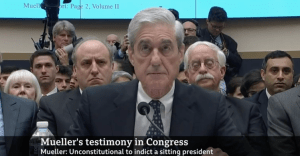
He similarly dispatched “Witch Hunt” and “Hoax”:

But those moments didn’t gain as much media traction as Mueller’s demeanor. So Trump continues undaunted — repeating the lies. Three days after Mueller’s testimony, he strung them all together yet again in a July 27 tweet:

The Truth About Collusion

Likewise, when Trump claims that Mueller found “no collusion,” most Americans believe it means that Mueller cleared Trump and his campaign of accepting Russia’s help to win the 2016 election. But this exchange between Mueller and House Intelligence Committee chairman Adam Schiff (D-CA) made clear that the Trump campaign did exactly that:

SCHIFF: Russia committed federal crimes in order to help Donald Trump?

MUELLER: When you’re talking about computer crimes in the charge…

SCHIFF: Yes.

MUELLER: … in our case, absolutely.

SCHIFF: The Trump campaign officials built their strategy – their messaging strategy around those stolen documents?

MUELLER: Generally that’s true.

SCHIFF: And then they lied to cover it up.

MUELLER: Generally, that’s true.

The sequence came at the end of Schiff’s first round of questioning. Take four minutes and watch all of it:

The Truth About Obstruction

Regarding obstruction of justice, Democratic members of the Judiciary Committee focused on just a few of Trump’s obstructive efforts that Mueller’s report detailed:

— Trump’s direction to then-White House counsel Don McGahn to fire Mueller,

— Trump’s subsequent efforts to get McGahn to deny that he had issued such an order,

— Trump’s efforts through former campaign manager Corey Lewandowski to get then-Attorney General Jeff Sessions (who had recused himself from the Mueller investigation) to curtail Mueller’s probe, and

— Trump’s repeated efforts to dangle pardons to Mike Flynn, Paul Manafort, and Michael Cohen.

As Mueller confirmed stunning facts and findings that Trump tried to interfere with the investigation, no Republican on the committee disputed any of them. Rather than focus on Mueller’s alarming message, most media pundits critiqued the style of the messenger.

The Truth About Russian Interference

Mueller’s opening statement before the House Judiciary Committee emphasized the gravity of Russia’s election interference — and then he repeated those concerns verbatim to the House Intelligence Committee:

“[O]ver the course of my career I have seen a number of challenges to our democracy. The Russian government’s efforts to interfere in our election is among the most serious….”

In response to Rep. Will Hurd’s (R-TX) questions, Mueller added: “They’re doing it as we sit here. And they expect to do it during the next campaign.”

Yet the next day, Senate Majority Leader Mitch McConnell (R-KY) led efforts to block two bills that would strengthen election security. One would require campaigns to alert the FBI and Federal Election Commission about foreign offers of assistance. The other would allow the US Senate’s sergeant-at-arms to offer voluntary cyber assistance for personal devices and accounts of senators and staff.

The Truth Should Matter

The testimony of eyewitnesses will help the many scenes in Mueller’s report coalesce into a digestible narrative. But it will take time. For example, in June 1973, Richard Nixon’s former White House counsel John Dean first testified to the Senate Watergate Committee about a “cancer on the Presidency,” but it still took more than a year for the House to vote articles of impeachment.

What happens next depends on the House of Representatives issuing subpoenas and the courts enforcing them. It depends on the media focusing on depth rather than sound bites and valuing substance over style. And it depends on the public’s patience and attention span. In the end, truth can prevail if it is seen and heard.

 

FOR DEMOCRATS, WEDNESDAY IS BIG; WHAT TO LOOK FOR FROM ROBERT MUELLER

[This post first appeared at Dan Rather’s News & Guts on July 23, 2019:]

Here’s the key fact about special counsel Robert Mueller’s appearances before two congressional committees on Wednesday: Most Americans haven’t read his report. They will be hearing for the first time what he knows about the Trump campaign’s involvement in Russian election interference with the 2016 presidential election. And they will be hearing for the first time about obstruction by Trump and others to prevent Mueller from knowing even more.

Until now, the heads of America’s body politic have been filled with Trump’s false sound bites: “No Collusion, No Obstruction, Total Exoneration.” Mueller’s appearances are the Democrats’ chance — perhaps their final chance — to replace those lies with facts and truth.

Early Signs Of Winners And Losers: Keeping It Simple

For Democrats, success will take the form of a simple, coherent story. That requires a narrative outlining nothing more than what Mueller’s report already says. And no legal jargon.

After Mueller sought guidance from the Justice Department, the deputy attorney general’s office told him to “remain within the boundaries” of his public report and May 29 statement. That’s fine. Mueller need go no farther to produce the story that Democrats should be seeking to convey anyway.

For Republicans, success means muddying the waters and encouraging Mueller’s silence in response to Democrats’ questions. If Democrats grandstand with sound bites for use in their 2020 re-election campaign ads, they will be helping Trump and the GOP in that mission.

Look For Competing Narratives: Collusion

The House Judiciary Committee will spend three hours quizzing Mueller on obstruction. Then the House Intelligence Committee will tackle his conclusions on Russian interference. But look for the Judiciary Committee to set the stage briefly with some context before diving into Mueller’s findings on obstruction. That requires asking Mueller to read a few pertinent passages from his report:

  • Russia engaged in a “sweeping and systematic” operation to help Trump win the 2016 election;
  • “[T]he Russian government perceived it would benefit from a Trump presidency and worked to secure that outcome”; and
  • “[T]he Campaign expected that it would benefit electorally from information stolen and released through Russian efforts.” [Vol. I, pp. 1-2]

Democrats can then neutralize Trump’s “No Collusion” lie by juxtaposing it against Mueller’s report. He made no such a finding. In fact, he didn’t even consider “collusion” because, as a legal concept, the term relates only to antitrust law.

The format of alternating questioning periods between Democratic and Republican committee members provides Trump’s congressional allies with an opportunity to intersperse distractions. Look for them to pull out shiny objects relating to the origins of the Russia investigation, FISA warrants, text messages between Peter Strzok and Lisa Page, and alleged political bias by members of Mueller’s team. None of that affects the evidence that Mueller, a lifelong Republican, found or the conclusions that he reported. But that’s all the GOP has, so they will go with it.

Look For Competing Narratives: Obstruction

The Judiciary Committee’s main narrative should include a series of questions that encourage Mueller to explain why obstruction matters to federal investigators, as he did in his May 29, 2019 press appearance:

“When a subject of an investigation obstructs that investigation or lies to investigators, it strikes at the core of their government’s effort to find the truth and hold wrongdoers accountable.”

Committee members should then ask Mueller these questions:

Must an attempt to obstruct justice succeed to be illegal? Mueller’s report already says no. He can read that passage aloud. [Vol. II, pp. 11-12]

Does obstruction require an underlying crime that the perpetrator is trying to obstruct? Again, Mueller’s report already says no. He can read that too. [Vol. II, p. 157]

Did Mueller find attempts to obstruct the government’s effort to find the truth in connection with Russian election interference? His report already provides the answer, and the Democrats apparently plan to focus on this sample:

  • Trump’s direction to the former White House counsel Don McGahn to fire Mueller and then publicly lie about it;
  • Trump’s request that Corey Lewandowski, his former campaign chief, ask Attorney General Jeff Sessions to reassert control of the investigation and limit its scope; and
  • Possible witness tampering to discourage two aides, Paul Manafort and Michael Cohen, from cooperating with investigators. For example, Trump dangled a pardon in front of former campaign manager Paul Manafort. Thereafter, Manafort changed his story and breached an agreement to cooperate with the government. [Vol. II, pp. 127-128]

For each episode, look for Democrats to develop a simple narrative by asking Mueller to quote from the various witness statements in his report. Democrats can then neutralize Trump’s “No Obstruction” lie by asking Mueller if, in fact, he had made such a finding. He didn’t. The natural follow-up similarly disposes of Trump’s “Total Exoneration” lie. For both, Mueller can conclude by reading aloud this passage:

“[I]f we had confidence after a thorough investigation of the facts that the President clearly did not commit obstruction of justice, we would so state. Based on the facts and the applicable legal standards, however, we are unable to reach that judgment.”

And then this one:

“Accordingly, while this report does not conclude that the President committed a crime, it also does not exonerate him.” [Vol. 2, p. 2]

Then It’s On To The House Intelligence Committee

Look for the Democrats on the House Intelligence Committee to revisit the larger themes:

  • Russia interfered in the 2016 election and wanted Trump to win. Mueller should be asked to explain Russia’s “systematic and sweeping” operation. It will be difficult to get him talking, but on this subject he might be willing to do so and they should try.
  • The Trump campaign embraced Russia’s help. Mueller should describe his evidence that the campaign welcomed Russian assistance.
  • There were numerous links between the Trump campaign and Russia. That requires Mueller to name names and their positions in the campaign, all of which are in the report.

The narrative could also dovetail with obstruction. In addition to the major episodes that the Judiciary Committee is expected to cover, the following specific items could provide additional color:

  • Trump refused to let Mueller interview him and limited the scope of written questions to “certain Russia-related topics.” [Vol. II, p. C-1]
  • After receiving Trump’s written responses, Mueller told Trump’s lawyers that the answers were insufficient in several respects. On 30 occasions, Trump said he did not “recall or remember” or have an “independent recollection” of the information Mueller requested. [Vol. I, p. C-1]
  • When Mueller followed-up, seeking an “in-person interview, limited to certain topics,” Trump refused. [Vol. II, pp. C-1-2]
  • Donald Trump Jr. refused to let Mueller interview him on any subject, including the June 9, 2016 Trump Tower meeting with Russians promising “dirt” on Hillary Clinton. [Vol. I, p. 117]
  • Individuals associated with the Trump campaign “lied to investigators about Campaign contacts with Russia and have taken other actions to interfere with the investigation.” [Vol. I, p. 191]
  • As former national security adviser Mike Flynn faced criminal investigation, Trump’s attorneys conveyed to his attorneys Trump’s continuing support. [Vol. II, pp. 120-122]. Trump is still fueling speculationthat he’ll pardon Flynn, and Flynn’s formerly cooperative relationship with the government pursuant to his guilty plea deal has deteriorated.
  • Trump advisers Steve Bannon and Erik Prince exchanged dozens of text messages about a Jan. 11, 2017 meeting in the Seychelles involving Russians, but those messages mysteriously disappeared. (Vol. I, p. 156)

Above All: Listen To Mueller

Mueller is reportedly planning to give an opening statement. If he reiterates the themes of his report and May 29 statement, he will be sending this message to Congress and the American people: He found evidence of wrongdoing, but his conspiracy investigation crashed into Trump’s wall of obstruction. What Mueller refers to as the constitutional process for moving forward lies with the House of Representatives, not him or Attorney General William Barr.

Listen for that message, and ignore the distractions that Trump’s congressional defenders offer along the way.

BEHIND ACOSTA’S RESIGNATION: UNTANGLING JEFFREY EPSTEIN’S TANGLED WEB: HIGH-POWERED LAWYERS, TRUMP, AND A PERSONAL SAFE

[This post first appeared at Dan Rather’s News & Guts on July 21, 2019]

In 2006, Jeffrey Epstein faced serious criminal charges related to sex abuse of minor girls. He tapped Jay Lefkowitz, a nationally prominent commercial litigator at one of the nation’s top law firms, to be a key point person in dealing with then-US Attorney Alex Acosta. Lefkowitz is not a criminal defense lawyer. But he and Acosta shared an earlier connection that may have made him a uniquely valuable member of Epstein’s team: the Kirkland & Ellis law firm.

From 1995 to 1997, Acosta had been an associate in Kirkland’s Washington DC office, where Lefkowitz was and still is a partner. The fact that Lefkowitz and Acosta were once colleagues at the same law firm doesn’t mean either of them did anything wrong when they were on opposite sides of the Epstein case.

Attorney General William Barr has a Kirkland connection too. He was of counsel to the firm in 2009, and then again from 2017 until 2019. He acknowledged that it could affect his role in the Epstein case:

Jan. 15, 2019: At Barr’s confirmation hearing, Sen. Ben Sasse (R-NE) asks him whether he will follow-up on the Miami Herald’s recent investigative reporting on Epstein’s “sweetheart” plea deal. Barr says he has been advised to recuse himself from matters involving his former firm, Kirkland & Ellis. “I need to sort out exactly what my role can be,” he adds.

February 2019: The Justice Department’s office of professional responsibility opens an investigation “into allegations that Department attorneys may have committed professional misconduct in the manner in which the Epstein criminal matter was resolved.” Barr recuses himself from that investigation.

Later that month, a Florida federal court rules that Acosta’s office violated federal law by failing to inform Epstein’s victims about the negotiations not to prosecute him. The court concludes: “Epstein’s counsel was aware that the Office was deliberately keeping the NPA [non-prosecution agreement] secret from the victims and, indeed, had sought assurances to that effect.“ (The events leading to that conclusion are described in Part I of this series.)

July 2, 2019: A federal grand jury in New York indicts Epstein for sex trafficking that involves victims as young as 14. Three days later, the FBI executes a search warrant at his New York townhouse and discovers a cache of photos, some of which are in a locked safe that also contains CDs with labels such as “Girl pics nude.” The safe also contains $70,000 in cash, 48 loose diamonds, and an Austrian passport with his photo and a fake name.

Barr does not recuse himself from the New York case.

Lurking in the Background: Trump

1992: At Trump’s request, a Florida-based businessman arranges an exclusive “calendar girl” competition at Trump’s Mar-a-Lago Club. The participants are 28 women and only two men — Trump and Epstein. (NBC found a tape in its archives of the Trump and Epstein dancing with cheerleaders at Mar-a-Lago in November 1992.)

VIDEO CLIP: https://www.nbcnews.com/news/us-news/tape-shows-donald-trump-jeffrey-epstein-discussing-women-1992-party-n1030686

2002: Donald Trump tells New York Magazine, “I’ve known Jeff for fifteen years. Terrific guy. He’s a lot of fun to be with. It is even said that he likes beautiful women as much as I do, and many of them are on the younger side. No doubt about it – Jeffrey enjoys his social life.”

July 9, 2019: Trump comments on the Epstein situation:

VIDEO CLIP: https://twitter.com/joshtpm/status/1148634240441098240

July 12, 2019: Acosta resigns as Secretary of Labor. Standing next to him, Trump says, “He doesn’t have to do this.” Trump adds that he “was not a fan of Jeffrey Epstein” and kicked him out of Mar-a-Lago: “It shows you one thing — that I have good taste.”

Acosta Lost His Battle Against the Facts

At his July 10, 2019 press conference, Acosta cast himself as a hero for not letting Epstein “walk.” He applauded New York prosecutors for pursuing the latest charges against Epstein. But in that case, Epstein’s lawyers are using unusual language in the NPA to argue that the government resolved all sex-related charges that any US attorney in every federal jurisdiction could ever file against him for offenses through September 2007, including the New York charges that Acosta is now championing publicly.

Acosta told reporters that the current controversy arose because “facts are being overlooked.” His real problem was the narrative resulting from close attention to some very bad ones. And now he’s out of a job.

A Curious Footnote

According to reporting by The Daily Beast, Trump’s transition team had asked Acosta if the Epstein case would cause any problems for his confirmation as labor secretary. He said that he had cut the deal with one of Epstein’s attorneys because he’d been told to “back off” — that Epstein was above his pay grade: “I was told Epstein ‘belonged to intelligence’ and to leave it alone.”

At his July 10 press conference, a reporter asked him whether he was ever told that Epstein was an “intelligence asset of some sort.” Acosta dissembled:

VIDEO CLIP: https://twitter.com/joshtpm/status/1149037094653898752

Which takes us back to the photos, cash, diamonds, and the Austrian passport that the FBI found in Epstein’s safe. At his July 15 bail hearing, federal prosecutors cited the passport among many reasons that Epstein posed a serious flight risk and should not be released pending trial.

The following day, his attorneys wrote to the judge, “[I]t expired 32 years ago. And the government offers nothing to suggest — and certainly no evidence — that Epstein ever used it.”

Federal prosecutors responded, “In fact, the passport contains numerous ingress and egress stamps, including stamps that reflect use of the passport to enter France, Spain, the United Kingdom, and Saudi Arabia in the 1980s.”

“The Government further notes that the defendant’s submission does not address how defendant obtained the foreign passport and, more concerning, the defendant still has not disclosed to the Court whether he is a citizen or legal resident of a country other than the United States.”

There’s much more to the Jeffrey Epstein story. It continues in the next installment of this series. Part I is available here.


ICE DEPORTATION RAIDS AND RACIST TWEETS AS DISTRACTIONS: TRUMP-RUSSIA TIMELINE UPDATE THROUGH JULY 15, 2019

Over time, Trump’s announced date for his ICE deportation raids to round up immigrants has changed in curious ways. Look at the timeline:

  • May-June: The media report that special counsel Robert Mueller is negotiating with House leaders about appearing before Congress.
  • June 17: Trump reveals that the raids would begin on June 23. Trump’s tweet announcing the raids surprises even ICE, which is charged with executing them.
  • June 22: Mueller’s agreement to testify still is not set. Trump delays the raids for what he says will be two weeksJuly 7. His nonsensical reason: to give Democrats in Congress a chance to come up with a solution to the mess he created at the southern border.
  • June 25: Rep. Jerry Nadler (D-NY), chairman of the House Judiciary Committee, announces that Mueller’s will appear and testify publicly on July 17.
  • July 6: As Trump’s initial two-week deadline of July 7 approaches, it morphs into an undefined “fairly soon.”
  • July 12: With Mueller set to testify on July 17, Trump announces that the raids will start on Sunday, July 14.

Whatever else may have motivated Trump, the raids were always a surefire way to dominate the news cycle and reduce whatever coverage Mueller might receive. Perhaps it was just a coincidence. But mastering the center ring of the media circus is Trump’s great strength.

Beware of What Comes Next

After Trump confirmed the raids on July 12, Nadler announced that Mueller’s congressional appearance would be delayed until July 24. As it turned out, the ICE raids were a bust. So on Monday, July 15, Trump launched racist tweets against four congresswomen. All of this is read meat for Trump’s base. But it also draws attention away from Mueller’s upcoming testimony on July 24.

Here’s my prediction: even more sensational distractions lie ahead. Do not underestimate the lengths to which Trump will go in avoiding public attention to — and a more complete understanding of — his Trump-Russia problems. He is using every tool that he and Attorney General William Barr can find to protect him.

And as Trump now likes to say, under Article 2 of the Constitution, those tools are formidable. He’s referring to Sections 1, 2 and 3. Section 4 provides for impeachment. The House controls that tool.

Here’s a complete list of the latest updates to the Trump-Russia Timeline at Dan Rather’s News & Guts and at Just Security:

BETWEEN JUNE 2015 AND NOVEMBER 2016: Russian Twitter Accounts Back Trump, Trump’s Poll Numbers Improve (revision of previous entry)

MAY 13, 2019: Barr Orders Another Review of Trump-Russia Investigation’s Origins (revision of previous entry)

JULY 2, 2019: Trump Tweets: Mueller Must Stick to His Report, As He Said He Would

JULY 4, 2019: Amash Leaves GOP; Trump Tweets ‘No Collusion, No Obstruction’ 

JULY 5, 2019: Donaldson Confirms Accuracy of Her Notes; White House Blocks Donaldson’s Efforts to Answering 212 Questions 

JULY 5, 2019: Trump Retweets Attacks on Mueller Investigation’s Origins, Impeachment

JULY 8, 2019: Trump Tweets: Mueller Appointment ‘Fundamentally Illegal’, ‘Witch Hunt’

JULY 8, 2019: Barr Says Mueller Appearance Will Be a ‘Public Spectacle’, Will Block Efforts to Subpoena Mueller’s Team Members

JULY 9, 2019: Sater Testifies Before House Intelligence Committee; Committee Slams Him for Being Uncooperative

JULY 9, 2019: Trump Retweets About Mueller Testimony as ‘Public Spectacle’

JULY 9, 2019: Flynn Won’t Testify in Suit Against His Former Business Partner

JULY 9, 2019: Trump Tweets Hannity Clips on Flynn, ‘Plot’ to ‘Frame Trump’; ‘Steele (FAKE) Story’

JULY 10, 2019: Trump Tweets and Retweets: ‘Dems Witch Hunt Continues’

JULY 11, 2019: House Judiciary Committee Subpoenas 12 People; Trump Lashes Out

JULY 12, 2019: Mueller Testimony Delayed

JULY 12-13, 2019: Trump Tweets and Retweets About Mueller, Clinton, ‘Witch Hunt’

BEHIND ACOSTA’S RESIGNATION: UNTANGLING JEFFREY EPSTEIN’S TANGLED WEB – PART I

[This post first appeared at Dan Rather’s News & Guts on July 15, 2019]

Alex Acosta is no longer Secretary of Labor, but Jeffrey Epstein’s cloud will never leave him.

From 1999 to 2007, Epstein lured dozens of girls — some as young as 14 — to his Palm Beach residence where he and friends sexually abused them. After a Palm Beach County grand jury indicted him on charges relating to one of his minor victims, Epstein signed a non-prosecution agreement (NPA) with the US attorney’s office for the southern district of Florida. The agreement immunized him from federal charges relating to all of Epstein’s other victims. At the time, Acosta was in charge of that office.

By the time the NPA was finalized, Acosta already knew that the Epstein case involved dozens more young girls. He was nevertheless personally involved in negotiations with Epstein’s attorneys that resolved all charges with these key points:

  • In return for pleading guilty to one state count of solicitation of prostitution and one count of soliciting minors to engage in prostitution, Epstein got a light sentence and complete immunity from federal prosecution. He also had to register as a sex offender.
  • Any “potential co-conspirators” also got immunity.
  • The agreement would remain confidential.

Only the dogged reporting of The Miami Herald’s Julie K. Brown, kept Epstein’s deal from becoming just another untold story about America’s special system of criminal justice for the rich. Instead, Epstein faces a new round of sex trafficking charges brought by the US attorney for Manhattan.

The legal trigger for new scrutiny of the 2007 NPA is the Crime Victims’ Rights Act (2004), which became law when Acosta was assistant attorney general in charge of the civil rights division for President George W. Bush. The law requires that a prosecutor who decides not to prosecute a sex offender must notify all known victims. The purpose of the law is to protect victims’ rights and ensure their involvement in the criminal justice process. In Epstein’s case, that didn’t happen in time to stop the deal.

At a July 10, 2019 press conference, Acosta defended the NPA. “Facts are being overlooked,” he complained. So let’s look at them.

The Crime Scandal

1999-2007: Epstein sexually abuses more than 30 minor girls at his Palm Beach mansion and other residences, according to a federal court’s later findings.

2005-2006: After a complaint from the parents of a 14-year-old girl that Epstein had sexually abused her, Palm Beach County police identify approximately 20 minor girl victims and ask the FBI to investigate. As a potential federal case, it comes under the jurisdiction of US attorney for the southern district of Florida, Alex Acosta.

2006: A Florida state grand jury indicts Epstein on a state charge of soliciting prostitution. It involves only one girl and does not disclose that she is a minor. Epstein hires a legal defense team that eventually includes Harvard Law Professor Alan Dershowitz, as well as Kirkland & Ellis partners Ken Starr and Jay Lefkowitz.

May 2007: Prosecutors in Acosta’s office draft a 53-page indictment identifying 12 of Epstein’s victims.

The Plea Agreement Scandal

Sept. 24, 2007: After prosecutors in Acosta’s office exchange multiple drafts with Epstein’s attorneys, Epstein signs the NPA. But he doesn’t appear before the state court to enter a plea pursuant to that agreement until June 30, 2008. In the interim, Acosta and prosecutors in his office negotiate with Epstein’s attorneys — including Starr and Lefkowitz — over the substance and timing of a victim notification letter. Epstein’s attorneys also seek review of the case at a “higher level” within the Justice Department to determine whether federal prosecution is appropriate at all.

Oct. 12, 2007: Lefkowitz and Acosta meet for breakfast. Lefkowitz follows up with a letter to Acosta stating, “I also want to thank you for the commitment you made to me during our October 12 meeting in which you … assured me that your Office would not … contact any of the identified individuals, potential witnesses, or potential civil claimants and their respective counsel in this matter.”

Nov. 29, 2007: After a prosecutor in Acosta’s office informs Lefkowitz that the office has a statutory obligation to notify Epstein’s victims about the plea deal, Lefkowitz sends Acosta a letter objecting to a proposed victim notification letter. He states that no letter should be sent to the victims before Epstein enters his plea or has been sentenced. Lefkowitz also says that the victims should not be invited to the state sentencing or encouraged to contact law enforcement officials.

Jan. 10, 2008: The FBI sends letters to Epstein’s victims stating, “This case is currently under investigation. This can be a lengthy process and we request your continued patience while we conduct a thorough investigation.” The letters don’t mention that the NPA will bar Acosta’s office from prosecuting Epstein federally.

 June 30, 2008: Federal prosecutors had identified 31 individuals “whom it was prepared to name in an indictment” as Epstein’s victims and the deputy attorney general had determined that federal prosecution of Epstein was appropriate. Pursuant to the NPA, he pleads guilty to two state charges: one count of solicitation of prostitution and one count of solicitation of prostitution with a minor under the age of 18.

Epstein then serves a 13-month sentence in a private wing of a Palm Beach jail and is allowed to leave 12 hours a day, six days a week, to work out of a nearby office.

Why did Acosta let this happen?

That’s the subject of Part II.


TRUMP’S CENSUS FIGHT CONTINUES: A ‘CONTRIVED’ PRETEXT AND A CREDIBILITY CRISIS FOR HIS LAWYERS

[The following post first appeared at Dan Rather’s News & Guts on July 6, 2019]

Trump’s handpicked Solicitor General, Noel Francisco, has a problem. After a New York federal court barred inclusion of a citizenship question on the 2020 census survey, he told the US Supreme Court repeatedly that June 30, 2019, was a firm deadline for printing the survey.

The Court believed him. For the first time in 15 years, it took the extraordinary step of bypassing an intermediate appellate court to expedite consideration of Trump’s case.

On July 3, Trump made Francisco look like a liar. By July 5, he looked even worse.

Why It Matters

The US Constitution requires a census of the entire US population (not just citizens) every 10 years as the basis for allocating the number of seats that each state receives in the US House of Representatives (and electoral votes in presidential elections). Those allocations remain in place for the subsequent decade. The census also determines how the federal government distributes billions in federal funds to states and local communities. The survey goes to 100% of the nation’s households.

Asking survey respondents about their citizenship would discourage some from responding to it at all. For example, including the question in the 2020 census would result in an estimated undercount of 6 million Hispanics — or about 12 percent of the US Hispanic population. According to a recent analysis from Harvard’s Shorenstein Center and The Washington Post, the House impact would benefit Alabama, Minnesota, Ohio, and Montana at the expense of California, Arizona, and Texas. “Similar changes would hit state and local districts across the country when they are redrawn using the same data,” the Post reports.

On March 28, 2017, the Census Bureau (part of the Commerce Department) told Congress that — as in prior years — the 2020 census survey would not include a citizenship question.

Distorting the Process

Then Trump politicized what has always been a non-political exercise. The timeline tells the tale.

Spring 2017: Secretary of Commerce Wilbur Ross discusses with Trump adviser Steve Bannon and Attorney General Jeff Sessions the addition of a citizenship question to the upcoming 2020 census survey. At the time, Jody Hunt is Sessions’ chief of staff. (Special counsel Robert Mueller’s 2019 report cites Hunt and his notes frequently, including Trump’s reaction to Mueller’s appointment in May 2017: “Oh my God, this is terrible. This is the end of my presidency. I’m fucked.”)

May 2: Ross sends an email to Commerce Department officials, stating, “I am mystified why nothing have [sic] been done in response to my months old request that we include the citizenship question. Why not?”

Ross can’t just add the citizenship question himself. He needs a rationale.

Dec. 12: After trying unsuccessfully to get the Justice Department and other federal agencies to seek citizenship information through the 2020 survey, a Justice Department official finally sends such a request to the Census Bureau. The stated justification is to assist in Voting Rights Act enforcement.

Jan. 20, 2018: The Census Bureau’s chief scientist recommends against including the requested citizenship question because it “is very costly” and “harms the quality of the census count.” He notes that the five-year American Community Survey already gathers better citizenship information more efficiently.

Mar. 19: The Trump campaign and the Republican National Committee tell supporters that Trump wants a citizenship question on the census survey.

Mar. 20: Ross appears before a House subcommittee where Rep. Grace Meng (D-NY) asks, “Has the president or anyone in the White House discussed with you or anyone on your team about adding the citizenship question?” Ross answers, “I am not aware of any such.” Two days later, he tells another House committee that the Justice Department “initiated the request” for a citizenship question, omitting the extensive email trail proving otherwise.

Apr. 3, 2018: New York state sues to remove the citizenship question from the survey. Additional lawsuits follow.

Jan. 15, 2019: Trump loses the New York case, and the court bars the citizenship question from the survey.

Final Resolution Required “by the End of June 2019”

Jan. 22, 2019: Solicitor General Francisco asks the Supreme Court to bypass the appeals court and hear the case. Francisco argues that the government must finalize the census questionnaire for printing by the end of June 2019. In subsequent filings, Francisco invokes the June 30 deadline repeatedly.

Feb. 15: The Supreme Court agrees— for the first time since 2004 — to bypass the appeals court and hear the New York case directly.

“Contrived”

June 27: The Supreme Court rules on the appeal. Saying that it expedited the case based on Francisco’s claims that “the census questionnaire needed to be finalized for printing by the end of June 2019,” the Court then doubts Ross’s veracity:

“The evidence tells a story that does not match the explanation that the Secretary gave for his decision. In the Secretary’s telling, Commerce was simply acting on a routine data request from another agency. Yet the materials before us indicate that Commerce went to great lengths to elicit the request from DOJ (or any other willing agency)… [T]he sole stated reason seems to have been contrived.”

July 2: Ross issues this statement: “The Census Bureau has started the process of printing the decennial questionnaires without the question.”

The same day, Justice Department attorneys tell a Maryland federal judge in a separate case the same thing: printing the form without a citizenship question is underway.

The “June 30 Deadline” Evaporates

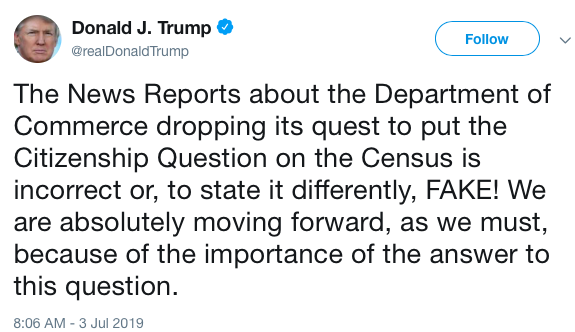
July 3: Trump tweets that press reports about the citizenship question not appearing on the census form are “FAKE”:

The Maryland judge sees Trump’s tweet and convenes an emergency conference call to find out what’s going on. On the call, Justice Department attorneys scramble: “[T]his is a very fluid situation which we are trying to get our arms around,” the lead DOJ attorney tells the judge. He knew nothing about the government’s new position until Trump’s tweet.

Then his boss, Assistant Attorney General for the Civil Division (and Sessions’ former chief of staff) Jody Hunt, chimes in: “We at the Justice Department have been instructed to examine whether there is a path forward, consistent with the Supreme Court’s decision, that would allow us to include the citizenship question on the census.”

Sensitive to the urgency of the situation, the court orders the government to report back to him by 2:00 pm on Friday, July 5, on how it intends to proceed. The lead Justice Department attorney asks for a delay: “[G]iven that tomorrow is the Fourth of July and the difficulty of assembling people from all over the place, is it possible that we could do this on Monday?”

Judge: “No… If you were Facebook and an attorney for Facebook told me one thing, and then I read a press release from Mark Zuckerberg telling me something else, I would be demanding that Mark Zuckerberg appear in court with you the next time because I would be saying I don’t think you speak for your client anymore. “

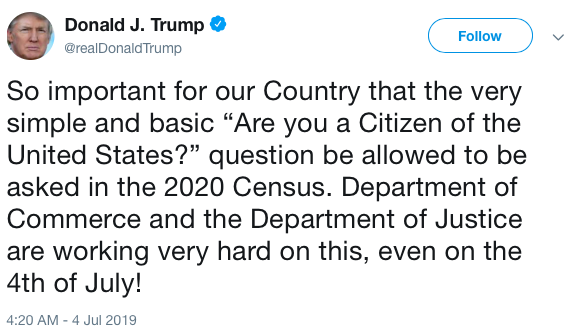
July 4: Trump proves the judge’s point. Only Trump speaks for Trump:

July 5: The Justice Department tells the Maryland judge that DOJ and the Commerce Department are still evaluating whether there’s a way to include the citizenship question on the 2020 survey. Among the options under consideration: having Ross articulate yet another rationale for its inclusion. That would start a brand new round of litigation on the issue. Meanwhile, “the Department of Commerce and Census Bureau currently are enjoined from printing a census questionnaire that includes a citizenship question.”

What about the June 30 printing deadline? The government’s July 5 submission conspicuously omits any mention of it.

Trump is punting. Noel Francisco is the ball —and so, perhaps, is the very integrity of the census itself.

Steven J. Harper is a regular contributor to News & Guts and the creator/curator of the Trump-Russia Timeline. He’s an attorney, adjunct professor at Northwestern University Law School, and author of four books, including Crossing Hoffa — A Teamster’s Story (Chicago Tribune “Best Book of the Year”) and The Lawyer Bubble — A Profession in Crisis.He blogs at The Belly of the Beast. Follow him on Twitter (@StevenJHarper1).

TRUMP REVEAL: THE RUSSIA JOKE’S ON US — TRUMP-RUSSIA TIMELINE UPDATE THROUGH JULY 1, 2019

[This post first appeared on July 2, 2019, at Dan Rather’s News & Guts.]

As Donald Trump departed for the G-20 summit, a reporter asked him if he planned to bring up 2020 election meddling with Vladimir Putin.

“What I say to him is none of your business,” Trump retorted.

VIDEO LINK: https://twitter.com/ABC/status/1143950963692019712

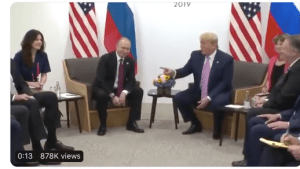
Actually, it’s every American’s business. The next day, as the two leaders sat together in Osaka, a different reporter asked Trump if he would tell Putin not to meddle in the upcoming US election.

“Of course, I will,” he replied. Trump turned to Putin, smiled, and said, “Don’t meddle in the election.” Playfully, he wagged a finger in the air and repeated the line, as if it were all a big joke. Putin chuckled.

VIDEO LINK: https://twitter.com/NBCNews/status/1144477684166094848

Among those who weren’t amused: Director of National Security Dan Coats, FBI Director Christopher Wray, and special counsel Robert Mueller (who may have the last laugh when he testifies on July 17).

Putin’s Choice

The Trump-Russia Timeline demonstrates why no American voter should brush off Russia’s ongoing election interference — and why Trump did.

JAN. 6, 2017: The US intelligence community issues the unclassified version of its report: “We assess Russian President Vladimir Putin ordered an influence campaign in 2016 aimed at the US presidential election. Russia’s goals were to undermine public faith in the US democratic process, denigrate Secretary Clinton, and harm her electability and potential presidency. We further assess Putin and the Russian Government developed a clear preference for President-elect Trump. We have high confidence in these judgments.”

JUL. 13, 2018: Coats says that the persistent danger of Russian cyberattacks is akin to the warnings of stepped-up terror threats ahead of the Sept. 11 attacks: “The warning lights are blinking red again… Russia has been the most aggressive foreign actor. No question… These actions are persistent, they are pervasive, and they are meant to undermine America’s democracy.”

VIDEO LINK: https://www.c-span.org/video/?c4740341/director-coats-the-lights-blinking-red

AUG. 2, 2018: Coats and Wray appear together at the White House daily press briefing and discuss Russia’s ongoing cyberattacks. “Russia attempted to interfere with the last election,” Wray says, “and continues to engage in malign influence operations to this day.” Coats adds, “We acknowledge the threat. It is real. It is continuing… In addition to that, it goes beyond the elections. It goes to Russia’s intent to undermine our democratic values, drive a wedge between our allies, and do a number of other nefarious things.”

JAN. 29-30, 2019: The US intelligence community submits its annual “Worldwide Threat Assessment” to Congress: “We assess that Russia poses a cyber espionage, influence, and attack threat to the United States and our allies. Moscow continues to be a highly capable and effective adversary, integrating cyber espionage, attack, and influence operations to achieve its political and military objectives.” [Emphasis in original] Russia then plays prominently in the section titled “ONLINE INFLUENCE OPERATIONS AND ELECTION INTERFERENCE.”

MARCH 2019: Mueller’s report is unequivocal: “[T]he investigation established that the Russian government perceived it would benefit from a Trump presidency and worked to secure that outcome, and that the Campaign expected it would benefit electorally from information stolen and released through Russian efforts….” [Vol. I, pp. 1-2] It describes Russia’s attack as “sweeping and systematic.”

MAY 29, 2019: Speaking for the first time about his investigation, Mueller emphasizes his concern about Russia: “I will close by reiterating the central allegation of our indictments, that there were multiple, systematic efforts to interfere in our election. And that allegation deserves the attention of every American.”

VIDEO LINK: https://www.c-span.org/video/?461196-1/special-counsel-robert-mueller-doj-policy-prohibited-indictment-president

Jimmy Carter Weighs In

The same day that Trump joked with Putin, historian Jon Meacham moderated a discussion with former President Jimmy Carter at the annual Carter Center donor retreat. Since 1989, the Center has served as official observer to 107 elections in 39 countries. Meacham asked him about Russia.

“There is no doubt that the Russians did interfere in the election,” Carter replied. “And I think the interference, though not yet quantified, if fully investigated would show that Trump didn’t actually win the election in 2016. He lost the election and he was put into office because the Russians interfered on his behalf.”

Carter went on to call Trump an “illegitimate president.”

VIDEO LINK: https://www.c-span.org/video/?c4805083/carter-calls-trump-illegitimate-president

Mueller Comes Next

In 2016, Trump lost the popular vote by almost 3 million ballots. But he eked out an Electoral College victory based on a combined total of 77,744 votes in three states. Recent polls show him trailing virtually all of his potential 2020 Democratic rivals.

On July 17, Robert Mueller has an opportunity to describe publicly how Putin helped orchestrate Trump’s first presidential win. At the G-20 summit, Trump solicited an encore from Putin. He also invited other foreign adversaries to join the effort.

No joke.

Here’s a complete list of the latest updates to the Trump-Russia Timeline at Dan Rather’s News & Guts and at Just Security:

JUNE 24, 2019: Trump Equivocates on Wray

JUNE 24, 2019: House Reiterates Demand For Info on Notes of Trump/Putin Meetings

JUNE 25, 2019: Mueller To Testify on July 17; Trump Responds: ‘Presidential Harassment’

JUNE 26, 2019: Trump Lashes Out About Mueller’s Upcoming House Appearances

JUNE 26, 2019: Trump and Putin To Meet In Japan; Trump Blasts Democrats on Mueller

JUNE 27, 2019: Manafort Pleads Not Guilty To NY State Charges

JUNE 28, 2019: Trump Laughs As He Tells Putin Election: ‘Don’t Meddle in the Election’; Putin Invites Trump to 2020 Russian ‘Victory Parade’

JUNE 28, 2019: Carter Calls Trump ‘Illegitimate’

JUNE 28, 2019: Trump Tweets: ‘Phony Witch Hunt’

TRUMP MUZZLES HICKS: TRUMP-RUSSIA TIMELINE UPDATE THROUGH JUNE 24, 2019

Hope Hicks testified, sort of. Trump’s White House lawyers wouldn’t let her answer any questions from the House Judiciary Committee relating to her time in the White House — not even the location of her office.

Strange look for the “most transparent president in US history.”

But she did say that the Republican National Committee is paying her legal fees. Hicks also said that since leaving the White House, she has spoken to Trump “somewhere between 5 and 10 times”– most recently in April.

Here’s a complete list of the latest updates to the Trump-Russia Timeline at Dan Rather’s News & Guts and at Just Security:

JULY 7, 2016: Page Gives a Lecture in Russia (revision of previous entry)

NOV. 2, 2017: Page Testifies Before House Intelligence Committee (revision of previous entry)

MAY 21, 2019: House Judiciary Committee Subpoenas Hicks, Donaldson (revision of previous entry)

JUNE 17, 2019: Manafort Headed For NY State Prison System Until DOJ Intervenes

JUNE 17, 2019: Trump Tweets: ‘No Collusion, No Obstruction!’

JUNE 19, 2019: Hicks Testifies; White House Limits Testimony

JUNE 19, 2019: Trump Tweets: ‘Dems Want Do-Over’, Clinton Email Destruction Is ‘Real Obstruction’, ‘DEMOCRAT CONGRESSIONAL HEARINGS ARE #RIGGED’, ‘Phony Witch Hunt’

JUNE 19, 2019: Deutsche Bank Facing Criminal Investigation

JUNE 21, 2019: Trump Tweets ‘Russia Collusion Hoax’

HOPE HICKS’ TRANSCRIPT IN CONTEXT: WHY TRUMP FEARS HER

[This post first appeared on June 21, 2019, at Dan Rather’s News & Guts.]

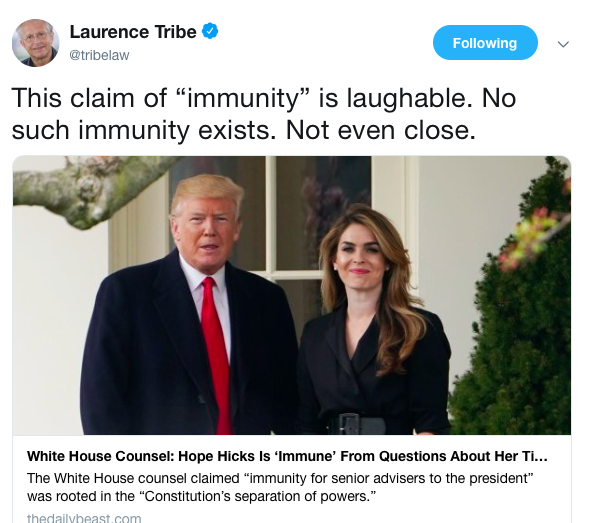
On June 18, White House counsel Pat Cipollone told Congress that former presidential aide Hope Hicks was “absolutely immune” from testifying about her work for Trump at the White House.

Laurence Tribe, pre-eminent constitutional scholar and Harvard law professor, found the claim “laughable”:

Preet Bharara, former US Attorney for the Southern District of New York, likewise ridiculed it:

View video: https://twitter.com/CNNSitRoom/status/1141479007734644737

On June 19, White House lawyers showed up at Hicks’ closed interview and asserted Cipollone’s objection. She followed their instruction and refused to answer — 155 times. Afterward, House Judiciary Committee member Rep. Ted Lieu (D-CA) said, “We’re watching obstruction of justice in action.”

Here’s an example of what Lieu was talking about:

“Q: In the White House, where is your office located?”

“White House Lawyer: We’ll object to that.” (Tr. p. 86)

Transparency and television coverage are not Trump’s friends — or Cipollone’s — or Hicks’s. Mueller’s report and the Trump-Russia Timeline reveal why Trump is blocking testimony and resisting public hearings.

Trump-Russia Campaign Contacts

On Nov. 10, 2016 — two days after the election — Russia’s Deputy Foreign Minister Sergei Ryabkov said that the Kremlin maintained contact with Trump’s “immediate entourage” throughout the campaign. The same day, Vladimir Putin’s personal spokesman, Dmitry Peskov, said Russian experts were in contact with some members of Trump’s staff during the campaign.

Immediately, Hicks contradicted them:

“We are not aware of any campaign representatives that were in touch with any foreign entities before yesterday, when Mr. Trump spoke with many world leaders.” She then denied any contacts between the campaign and Russia: “It never happened. There was no communication between the campaign and any foreign entity during the campaign.” [Mueller Report, Vol. II, p. 21]

That wasn’t true. More than 75 pages of Mueller’s report outline “Russian Government Links To And Contacts With The Trump Campaign.” The more than 120 contacts included Jared Kushner, Paul Manafort, Donald Trump Jr., Michael Cohen, Jeff Sessions, George Papadopoulos, and Carter Page. (Vol. I, pp. 66-144; Tr. p. 153)

Obstruction

Hicks’ name appeared in Mueller’s report more than 180 times. At key moments in Trump’s effort to obstruct justice, she was there. Hicks has already told Mueller about them, but televised hearings would shine a public spotlight on the episodes.

  • Trump fury over Sessions’ recusal and Mueller’s appointment

MARCH 5, 2017: After Attorney General Jeff Sessions recused himself from the Russia investigation, Hicks witnessed Trump’s anger (although she’s not clear on the dates). (Vol. II, p. 51, fn. 304) When Trump learned about Mueller’s appointment on May 17, she saw his ire again — only worse. (Vol. II, p. 79)

  • Trump fired James Comey

MAY 6-7, 2017: Trump tried to cover-up his motives for firing FBI Director James Comey, but then told Russia’s foreign minister and ambassador his real reason: to remove the pressure of the Russia investigation. Hicks witnessed key moments in the episode.(Vol. II, p. 71, fn. 470)

  • Trump lied about the Trump Tower Meeting

JULY 8-9, 2017: The New York Times was breaking an explosive story: Jared Kushner, Paul Manafort, and Donald Trump Jr. had met on June 9, 2016, with Russians promising “dirt” on Hillary Clinton.” Trump personally formulated his son’s false statement to the press. Hicks was at the center of the action. (Vol. II, pp. 100-104)

  • Trump tried to limit Mueller’s investigation

JULY 19, 2017: Trump dictated a message that he wanted Corey Lewandowski to give then-Attorney General Jeff Sessions. He proposed a public statement limiting Mueller’s investigation to future elections only. Hicks typed it up for Lewandowski. (Vol. II, pp. 91-94, fn. 625)

  • Trump pressured McGahn to lie for him

JAN. 26, 2018: Trump wanted then-White House counsel Don McGahn to lie about The New York Times’ breaking story that Trump had ordered McGahn to fire Mueller. McGahn refused. Hicks was in the loop. (Vol. II, p. 114)

When House Judiciary committee members directed Hicks to pages in Mueller’s report relating to those episodes, White House lawyers objected, and she refused to answer questions about them. (Tr. pp. 202-207)

End Game

The Republican National Committee is paying Hicks’ legal fees. (Tr. pp. 225-226) Since leaving the White House, she has spoken to Trump “somewhere between 5 and 10 times,” most recently in April. (Tr. p. 126)

The White House’s objection does not prevent Hicks from answering Congress’ questions. That’s her decision, but it’s now become her problem. Because if the courts reject the “congressional immunity” objection, her continued silence will lead to contempt penalties that she alone will bear — not Trump, Cipollone, or the RNC. At that point, she’ll face another decision.

This is the latest in a series of posts by Steven J. Harper on the Mueller report.

TRUMP STONEWALLS AND CONFESSES: TRUMP-RUSSIA TIMELINE UPDATE THROUGH JUNE 17, 2019

Call it multitasking. While Trump continues to stonewall Congress on everything relating to the Russia investigation, he appears on national television and confesses: Would he accept help from a foreign government to win an election? You bet.

It’s not really a surprise. In 2016, he did. Just ask Robert Mueller: “ABC’s Trump Interview Shows The Power Of Television.”

Here’s a complete list of the latest updates to the Trump-Russia Timeline at Dan Rather’s News & Guts and at Just Security:

JUNE 3, 2019: House Schedules Vote to Hold Barr and McGahn in Contempt While Pursuing Alternatives; Judiciary Committee Schedules Hearings on Mueller’s Findings (revision of previous entry)

JUNE 10, 2019: Trump Tweets About John Dean’s House Appearance, ‘Phony Witch Hunt’

JUNE 10, 2019: Dean Testifies Before House Judiciary Committee

JUNE 11, 2019: Trump Continues Attack on House Judiciary Committee Hearings on Mueller Report: ‘Witch Hunt’, ‘No Collusion’, ‘PRESIDENTIAL HARASSMENT’

JUNE 11, 2019: House Authorizes Judiciary Committee to Enforce Barr and McGahn Subpoenas

JUNE 12, 2019: Trump Tweets and Retweets: ‘Phony And Never Ending Witch Hunt’ 

JUNE 12, 2019: Schiff Reiterates That FBI Has Not Briefed Congress on Counterintelligence Investigations Since Comey’s Firing

JUNE 12, 2019: Don Jr. Testifies Before Senate Intelligence Committee

JUNE 12, 2019: Justice Department Will Investigate CIA

JUNE 12-14, 2019: Trump Says Wray is Wrong: Trump Would Accept Foreign Help to Win Election; FEC Chair Responds: ‘It’s Illegal’; Trump Tries Clean-Up

JUNE 13, 2019: Trump Tweets About Flynn’s New Lawyer, Mueller Report, Barr, Impeachment, Stephanopoulos Interview

JUNE 13, 2019: House Intelligence Committee Subpoenas Flynn and Gates

JUNE 13, 2019: Trump Announces Sarah Sanders’ Departure

JUNE 13-14: Blackburn Blocks Legislation on Foreign Election Interference; Trump Tweets Praise

JUNE 14, 2019: Trump Says McGahn is Lying or Confused

JUNE 14, 2019: Trump Tweets “Witch Hunt Hoax’

JUNE 14-15, 2019: Trump Tweets and Retweets About Russia Investigation: ‘Coup Update’, Mueller Report ‘A Lying Hit Job on Trump’, Blames Obama, ‘May Be The Biggest Political Crime In The History Of The US’, John Dean Is ‘A Prop’, ‘Greatest Presidential Harassment Of All Time’

JUNE 15, 2019: NY Times Reports on US Digital Incursions Into Russia’s Power Grid; Trump Calls Report ‘Virtual Act Of Treason’

JUNE 16, 2019: Trump Tweets About Steele Dossier, Impeachment

ABC’s TRUMP INTERVIEW SHOWS THE POWER OF TELEVISION

[This post first appeared on June 16, 2019, at Dan Rather’s News & Guts.]

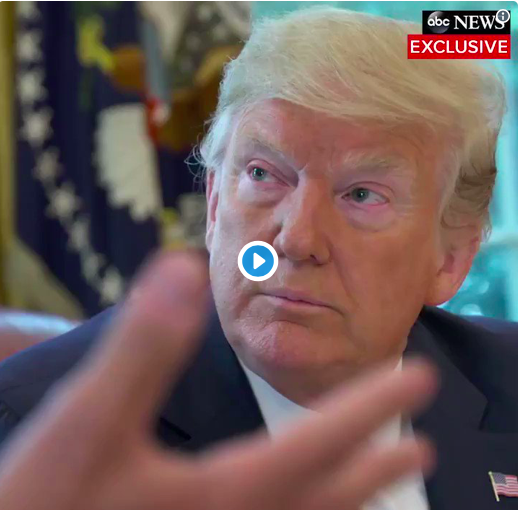
When ABC’s George Stephanopoulos asked Donald Trump if he would accept a foreign government’s help to win an election, Trump answered, “I think I’d take it.” Of course he would. The Mueller report demonstrates that his 2016 campaign actually did:

“[T]he investigation established that the Russian government perceived it would benefit from a Trump presidency and worked to secure that outcome, and that the Campaign expected it would benefit electorally from information stolen and released through Russian efforts….” (Vol. I, p. 5)

But Trump’s words became headlines because a 90-second television clip is more powerful than the accumulated evidence in a 448-page report that few people will read:

WATCH VIDEO: https://twitter.com/ABCPolitics/status/1138975286702346241

Like every US intelligence agency, Mueller concluded that the facts pointed in one direction: Putin wanted Trump to win and the Trump campaign embraced Russia’s assistance. And Mueller’s facts are stubborn things:

APR. 18, 2016: Russia has hacked Clinton campaign manager John Podesta’s computer, gained access to Democratic (DNC and DCCC) networks, and is stealing DNC and DCCC documents. (Vol. I, pp. 4, 37-38)

APR. 19: A Russian internet troll farm purchases its first social media ads explicitly endorsing Trump for president — support that continues beyond Election Day. (Vol. I, pp. 25-26)

APR. 26:  In London, a Russian intermediary tells Trump adviser George Papadopoulos that Russia has “dirt” on Clinton in the form of thousands of emails. Papadopoulos’ Russia-related communications with top campaign officials continue throughout the spring and summer. (Vol. I, pp. 5-6, 86-92)

JUNE 3: Donald Trump Jr. receives Russia’s offer “to provide the Trump campaign with some official documents and information that would incriminate Hillary…[as] part of Russia and its government’s support for Mr. Trump….” Within minutes, Don Jr. responds: “[I]f it’s what you say, I love it especially later in the summer.” (Vol. I, pp. 112-117)

JUNE 9: At Trump Tower in New York, Don Jr., Jared Kushner, and Paul Manafort meet secretly with three Russians, including a lawyer with Kremlin ties. (Vol. I, pp. 112, 117)

JULY 22: Three days before the Democratic National Convention begins, WikiLeaks disseminates the first batch of stolen Democratic emails that it received from Russian intelligence officers. (Vol. I, pp. 44-46)

JULY 27: At a press conference, Trump says, “Russia, if you’re listening, I hope you’re able to find the 30,000 emails that are missing. I think you will probably be rewarded mightily by our press.” (Vol. I, p. 49)

WATCH VIDEO: https://twitter.com/cspan/status/758320094619381760?lang=en

Less than five hours later, Russian intelligence officers target for the first time Clinton’s personal office. (Vol. I, p. 49)

SUMMER/FALL: The Trump campaign is “planning a press strategy, a communications campaign, and messaging based on the possible release of Clinton emails by WikiLeaks.” (Vol. I, p. 54)

Several pages in Mueller’s report detailing “The Trump Campaign and the Dissemination of Hacked Emails” are heavily redacted. (Vol. I., pp. 51-59)

Call the FBI?

Stephanopoulos reminded Trump that FBI Director Christopher Wray warned candidates to report offers of foreign assistance to the FBI. The Trump campaign never did.

“The FBI director is wrong,” Trump said. “[I]f you go talk honestly to congressmen, they all do it, they always have. And that’s the way it is. It’s called oppo research.”

Actually, it’s called a felony. In a rebuke to Trump, Ellen Weintraub, chair of the Federal Election Commission, tweeted, “I would not have thought that I needed to say this.” Then her attached official statement began, “Let me make something 100% clear to the American public and anyone running for office: It is illegal for any person to solicit, accept, or receive anything of value from a foreign national in connection with a US election.”

The next morning, Trump called into Fox & Friends and tried to walk back his admissions: “Of course you have to look at [“dirt” from a foreign government] because if you don’t look at it you’re not going to know if it’s bad. If I thought anything was incorrect or badly stated I’d report to the FBI or law enforcement, absolutely.” Using Weintraub’s words, Trump’s nonsensical approach would still leave him “on the wrong end of a federal investigation.”

About That Counterintelligence Probe

As Trump invites foreign interference, he stonewalls Congress’ demands for a briefing on the FBI’s counterintelligence probe, which Mueller’s report does not address. Taken together, Trump’s actions heighten a key counterintelligence concern: Whether Putin’s help with Trump’s 2016 campaign or Trump’s business ties to Russia have already compromised him.

In 1788, Alexander Hamilton understood that the “most deadly adversaries of republican government” come “chiefly from the desire in foreign powers to gain an improper ascendant in our councils. How could they better gratify this, than by raising a creature of their own to the chief magistracy of the Union?” (Federalist No. 68)

Hamilton posed a rhetorical question. In 2016, Trump made it real. As the 2020 election approaches, he has made it urgent.

This is the tenth in a series of posts by Steven J. Harper on the Mueller report. The first nine installments are available here, here, here, here, here, here, here, here, and here.

LORDY, THERE ARE TAPES! TRUMP-RUSSIA TIMELINE UPDATE THROUGH JUNE 10, 2019

Damning words on a page are one thing. Hearing those words from the mouth of the person speaking them moves the public’s attention to a whole new level. This voicemail from Trump’s attorney, John Dowd, is just one piece of evidence in special counsel Robert Mueller’s report on Trump’s obstruction of justice: https://soundcloud.com/kadhim-shubber/john-dowd-call-to-robert-kelner

Imagine what might happen if the public saw and heard live testimony from the participants involved in Trump’s wrongdoing. Trump and his defenders have. And that’s why they don’t want any of those witnesses appearing before the House Judiciary Committee.

Even Attorney General William Barr wouldn’t be able to spin Trump out of that mess.

Here’s a complete list of the latest updates to the Trump-Russia Timeline at Dan Rather’s News & Guts and at Just Security:

SOMETIME BETWEEN NOV. 8 and NOV. 24, 2016: Kushner and Flynn Meet With Kislyak

REVISED: NOV. 22-23, 2017: Flynn Withdraws from Joint Defense Agreement with Trump; Trump’s Lawyer Presses (revision of previous entry)

APR. 19, 2018: Feds File Criminal Complaint Against Nader

MAY 31, 2019: Justice Department Defies Judge’s Order, Complies With Separate Order to Release Transcript of Call to Flynn; Judge Acquiesces (revision of previous entry)

MAY 31, 2019: Stone Aide Produces Documents and Testifies

JUNE 3, 2019: House Schedules Vote to Hold Barr and McGahn in Contempt While Pursuing Alternatives; Judiciary Committee Schedules Hearings on Mueller’s Findings

JUNE 4, 2019: White House Directs Donaldson and Hicks Not to Produce Certain Documents in Response to House Subpoena; Hicks Agrees to Produce 2016 Campaign Documents

JUNE 5, 2019: Trump Attacks Democrats: ‘No Collusion Witch Hunt…Now Want a Do-Over’

JUNE 6, 2019: Public Hears Dowd’s Nov. 22, 2017 Voicemail to Flynn’s Lawyer

JUNE 6, 2019: Flynn Fires Lawyers, Hires New Counsel

JUNE 6, 2019: Trump Attacks Mueller Report

JUNE 7, 2019: Trump Quotes Hannity: ‘Mueller’s Report Was Pure, Political Garbage’; Tweets Clips of Meadows and Starr From Hannity’s TV Program; ‘Nervous Nancy Pelosi Is A Disgrace… No Collusion – Investigate The Investigators’ 

JUNE 7, 2019: McConnell Continues to Block Election Protection Legislation

JUNE 9, 2019: Trump Attacks Dems: ’13 Angry Democrat Trump Haters…No Collusion… Mueller Report Was A Disaster For Them…They Want a Redo or Do-Over…Bringing in @CNN Sleazebag Attorney John Dean’


TRUMP’S NEW ROY COHN? BARR GOES ALL-IN FOR THE PRESIDENT

[This post first appeared on June 9, 2019, at Dan Rather’s News & Guts.]

“Where’s my Roy Cohn?” Trump yelled in frustration. Attorney General Jeff Sessions had recused himself from the Russia investigation and was no longer able to protect him. (Mueller Report, Vol. II, pp. 50, 110) He may have found him, again.

Roy Who?

From 1974 until shortly before his death in 1986, Cohn represented Trump. But in the early 1950s, he was Sen. Joseph McCarthy’s (R-WI) hatchet man. Their unfounded attacks on “communist sympathizers” ruined lives.

Fellow Republicans in Congress remained silent accomplices until televised hearings accelerated McCarthy’s demise. Sixty-five years ago today — on June 9, 1954 — attorney Joseph Welch’s response to his ad hominem attack on a young associate in Welch’s law firm resonated throughout the country:

“Until this moment, Senator, I think I never really gauged your cruelty or your recklessness… Have you no sense of decency, sir, at long last? Have you left no sense of decency?”

Here’s the video: https://www.youtube.com/watch?v=oc6Yo3A7CC8

The audience erupted in applause. McCarthy and Cohn had crossed a line that GOP leaders could no longer ignore. Except for Rep. Justin Amash (R-MI), the 21st century iteration of McCarthy’s party has acknowledged no such line for Trump. But in Attorney General William Barr, Trump apparently has found his Roy Cohn, as recent Trump-Russia Timeline entries reveal.

Step 1: Barr Undermines Mueller

MAR. 5, 2019: Special counsel ROBERT MUELLER tells Barr and Rod Rosenstein that his report will not determine whether Trump obstructed justice.

MAR. 22: MUELLER’s report to Barr outlines serious evidence against Trump, but explains that charging him with a crime was never an option. Under the Constitution and a longstanding Justice Department opinion, it’s Congress’ job to address a sitting president’s misconduct. (Vol. II, pp. 1-2)

MAR. 24: BARR sends Congress a letter excerpting phrases from Mueller’s yet-to-be-released report. According to Barr, Trump did not obstruct justice because the facts are simply insufficient to establish the crime. In a single line, he dismisses constitutional concerns and the prior Justice Department opinion as irrelevant.

But Mueller’s report actually says that if the facts showed “that the President clearly did not commit of obstruction of justice, we would so state.” (Vol. II, pp. 1-2) Mueller’s report does not so state. And more than 1,000 former federal prosecutors who served during Republican and Democratic administrations have signed a joint letter stating that, for anyone other than a sitting president, the facts in Mueller’s report would “result in multiple felony charges for obstruction of justice.”

MAY 29: MUELLER issues his first public statement since his appointment as special counsel. He reiterates that the Constitution and Justice Department policy prevented him from indicting a sitting president, but the facts prevented him from exonerating Trump.

MAY 31: BARR gives a folksy television interview during which he throws Mueller under the bus: “The [Justice Department] opinion says you cannot indict a president while he is in office, but [Mueller] could’ve reached a decision as to whether it was criminal activity….”

Yet it was precisely the prospect of a criminal accusation without a subsequent process for potential vindication that Mueller viewed as triggering constitutional and fairness concerns. (Vol. II, pp. 1-2)

Barr adds, “[W]e didn’t agree with the legal analysis — a lot of the legal analysis in the report. It did not reflect the views of the department. It was the views of a particular lawyer or lawyers and so we applied what we thought was the right law….”

One member of Mueller’s team, Deputy Solicitor General Michael Dreeben, is among the nation’s top constitutional criminal lawyers. Barr has yet to explain what Dreeben and Mueller got wrong, what “right” law Barr and Rosenstein applied, or what legal reasoning led them to exonerate Trump where Mueller reported that the facts made exoneration impossible.

Step 2: “Investigate the Investigation”

In the same interview, Barr discusses a long time Trump distraction: investigating the origins of the Trump counterintelligence probe. Echoing McCarthy-Cohn tactics, he offers no factual support and relies on ambiguity and innuendo to cast a sinister shadow:

  • “[T]he use of foreign intelligence capabilities and counterintelligence capabilities against an American political campaign to me is unprecedented and it’s a serious red line that’s been crossed.”
  • “Counterintelligence activities that were directed at the Trump campaign were not done in the normal course and not through the normal procedures….”
  • “I have not gotten answers that are, well, satisfactory, and in fact probably have more questions, and that some of the facts that–that I’ve learned don’t hang together with the official explanations of what happened.”
  • “I think the activities were undertaken by a small group at the top… It was done by the executives at the senior level. Out of headquarters….”

Barr chastises journalists for not amplifying Trump’s “investigate the investigation” narrative: “[T]he media doesn’t seem to think that it’s worth looking into. They’re supposed to be the watchdogs of, you know, our civil liberties.”

Step 3: All-In And No Regrets

Finally, Barr suggests that Trump’s critics are the norm-busters, not Trump:

“I think one of the ironies today is that people are saying that it’s President Trump that’s shredding our institutions. I really see no evidence of that…. [C]hanging the norms on the grounds that we have to stop this president, that is where the shredding of our norms and our institutions is occurring.”

Asked about defending Trump personally at the expense of his own reputation and his duties as the nation’s attorney general, Barr says he doesn’t care:

“[E]veryone dies and…I don’t believe in the Homeric idea that you know, immortality comes by, you know, having odes sung about you over the centuries, you know?”

It’s true. Everyone dies. Roy Cohn died in disgrace after being disbarred. Donald Trump is the only one singing odes to him.

This is the ninth in a series of posts by Steven J. Harper on the Mueller report. The first eight installments are available here, here, here, here, here, here, here, and here.

IRONY IS DEAD: TRUMP-RUSSIA TIMELINE UPATE THROUGH JUNE 3, 2019

Keep a critical eye on William Barr — Trump’s newest and most effective hatchet man. In his CBS interview on May 31, he actually said this:

“I think one of the ironies today is that people are saying that it’s President Trump that’s shredding our institutions. I really see no evidence of that…. [B]asically throwing everything at him and you know, really changing the norms on the grounds that we have to stop this president, that is where the shredding of our norms and our institutions is occurring.”

And this:

“[R]epublics have fallen because of Praetorian Guard mentality where government officials get very arrogant, they identify the national interest with their own political preferences and they feel that anyone who has a different opinion, you know, is somehow an enemy of the state.”

So Barr is worried that Trump’s critics are the norm-busters, not Trump. And he has a special concern about leaders who label critics “enemies of the state.”

Irony is dead. In its place Barr is inserting something very dangerous.

Here’s a complete list of the latest updates to the Trump-Russia Timeline at Dan Rather’s News & Guts and at Just Security:

MAR. 5, 2019: Mueller Tells Barr That His Report Will Include Executive Summaries, Says He Won’t Make Determination on Obstruction (revision of previous entry)

REVISED: MAY 27, 2019: Trump Tweets: ‘Impeach For What’, Dems ‘Only Want A Do-Over’, ‘Statements By Agents Investigating Trump Could Well Be Treason’ (revision of previous entry)

MAY 29, 2019: Mueller Makes First Public Statement Since Issuing Report

MAY 29, 2019: Trump Tweets: ‘Nothing Changes’, ‘WITCH HUNT’; Retweets Attacks on DOJ and FBI, Sanders’ WH Spins Mueller Statement: ‘No Collusion, No Conspiracy, No Obstruction

MAY 30, 2019: Trump Tweets: ‘Highly Conflicted Robert Mueller Would Have Brought Charges If He Had ANYTHING’; Trump Campaign ‘Clearly Did Not Conspire Or Collude’; Attacks Comey and Brennan; ‘ ‘Shame on Robert Mueller’; CASE CLOSED’

MAY 30, 2019: Trump Tweets ‘I Had Nothing To Do With Russia Helping Me To Get Elected’, ‘Presidential Harassment’; Then Backtracks

MAY 31, 2019: Trump Tweets Mueller’s Investigation Was ‘Political Hit Job’

MAY 31, 2019: Barr Changes Story on Mueller; Discusses Investigating the Investigation and the People Who Did It; Defends Trump

MAY 31, 2019: Justice Department Defies Judge’s Order, Complies With Separate Order to Release Transcript of Call to Flynn

JUNE 1, 2019: Trump Tweets That Flood Is Departing; ‘NO COLLUISON, NO OBSTRUCTION’, ‘THE TRUTH! The Witch Hunt Is Dead’

JUNE 2, 2019: Trump Tweets ‘NO COLLUSION, NO OBSTRUCTION, NO NOTHING’, ‘Greatest Witch Hunt In American History’


TEN EASY PIECES: TRANSLATING ROBERT MUELLER’S LEGALESE

[This post first appeared on June 2, 2019, at Dan Rather’s News & Guts.]

On May 29, special counsel Robert Mueller made his first and, he hopes, last comments on the investigation culminating in his report. “We chose those words carefully and the work speaks for itself,” he said.

Those words cover 448 pages. They may speak to fellow lawyers, including me. But they’re not reaching a general public suffering from Trump fatigue, bombarded with disinformation, and accustomed to processing what they see and hear in tweets and sound bites. If Mueller had stated his views in lay terms, he could have led with this headline: There’s plenty of evidence that Trump is a criminal. But I can’t indict him, so the House of Representatives must decide what to do next.

Translated into readily understandable English, here’s the rest of Mueller’s message:

  1. Forget what my boss, William Barr, told you about my report. I wanted Barr to use summaries that I’d prepared. Instead, he wrote his own misleading one, released it to the public, and sat on my report for a month.
  2. Anyone saying that I found “No Collusion” is lying. (Vol. I, p. 2, Vol. II, p. 2)
  3. Russia attacked the US presidential election to help Trump win. (Vol. I, p. 1)
  4. Trump’s campaign embraced Russia’s effort and publicly denied the truth — that it had multiple contacts with Russia. (Vol. I, pp. 5-7, 66-173; Vol. II, pp. 15-23)
  5. Anyone saying that I found “No Obstruction” is lying. (Vol. II, p. 2)
  6. Trump made it more difficult to discover the truth. As a result, I don’t know the whole story about Trump and Russia. Neither does Congress or the public. (Vol. I, p. 10)
  7. Because of existing Justice Department policy, I couldn’t even consider charging Trump with a crime. The Constitution specifies the process for dealing with presidential wrongdoing: impeachment — not me or Barr. (Vol. II, pp. 1-2)
  8. I haven’t written or said anything publicly about the counterintelligence aspect of my investigation. Congress and the public still don’t know if Putin has compromising information on Trump or others close to him. (Vol. I, p. 13)
  9. My investigation was never a “Witch Hunt” or a “Hoax.” Many former Trump campaign officials are now behind bars; others face pending cases. (Vol. II, App. D)
  10. Despite Trump’s persistent assertions to the contrary, Russian election interference was and is real; it should trouble every American patriot. (Mueller’s 5/29/2019 Statement, final sentence)

Mueller’s parting message to the House of Representatives: I’ve done my job. In accordance with the nation’s founding document, it’s time for you to do yours.

IS HE THE MOST DANGEROUS PERSON IN AMERICA?

[This post first appeared on May 27, 2019, at Dan Rather’s News & Guts]

The most dangerous person in America may not be Donald Trump. Attorney General William Barr has used his formidable legal skills to promote and weaponize Trump’s lies. Last week, Trump vested Barr with unprecedented power to wreak even more havoc on the truth. And it may make Barr the most dangerous person in the country, as recent additions to the Trump-Russia Timeline demonstrate.

Barr Now Controls Public Access to Key Facts

Mar. 24, 2019: Barr’s letter to Congress (and the public) uses misleading excerpts of sentence fragments from special counsel Robert Mueller’s report to declare Trump “not guilty” of obstructing justice. Barr’s deception fuels Trump’s “no collusion/no obstruction” lies about Mueller’s conclusions.

Apr. 9: Mueller’s report is still unavailable to Congress and the public. Testifying before a House committee, Barr says he doesn’t know the basis for news reports that members of Mueller’s team are unhappy with his Mar. 24 summary. He doesn’t disclose Mueller’s Mar. 27 letter complaining to Barr about the summary; Congress and the public are unaware of it.

Apr. 18: The release of a redacted version of Mueller’s report reveals that Barr misled Congress and the public about its findings and conclusions. Within a month, more than 900 former federal prosecutors who served under both Republican and Democratic administrations sign an open letter saying that, but for the fact that Trump is president, he would be facing “multiple felony charges for obstruction of justice” based on the facts in Mueller’s report.

Apr. 30: The Washington Post publishes Mueller’s Mar. 27 letter to Barr, which memorializes Mueller’s concern that Barr’s summary “did not fully capture the context, nature, and substance of this Office’s work and conclusions.” The result, Mueller wrote, “is public confusion about critical aspects of the investigation.” ThePost awards Barr “Three Pinocchios” for misleading Congress in early April.

May 23: At Barr’s urging, Trump gives him unprecedented power over the entire US intelligence community’s most closely guarded secrets and orders all agencies to cooperate with him. In connection with the origins of the Trump-Russia investigation, Barr gains the unprecedented power to pick and choose which secret documents to declassify. But he can also select which documents not to declassify. That means he has complete control over what the public sees, hears, and believes about how the probe began. The discredited suggestion that the FBI was “spying” on his campaign began as a baseless Trump distraction from the investigation itself. In Barr’s hands, it’s now a potent weapon against Trump’s enemies.

Will Truth Survive? 

Mueller’s report already answers the question Barr now revisits: How did the Trump-Russia investigation begin?

“On May 6, 2016, 10 days after…meeting with [Joseph] Mifsud, [Trump campaign adviser George] Papadopoulos suggested to a representative of a foreign government that the Trump Campaign had received indications from the Russian government that it could assist the Campaign through the anonymous release of information that would be damaging to Hillary Clinton. fn 465.”

“fn 465: This information is contained in the FBI case-opening document and related materials… The foreign government conveyed this information to the US government on July 26, 2016, a few days after WikiLeaks’s release of Clinton-related emails. The FBI opened its investigation of potential coordination between Russia and the Trump Campaign a few days later based on that information.” (Vol. I. p. 89)

None of that matters now. Barr is already reinforcing Trump’s lie that the investigation began as an effort to “spy” on his campaign. Although Trump’s chosen FBI director, Christopher Wray, has rejected that Trump talking point, Barr has embraced the word “spy” and Trump loves it. Barr’s willingness to perpetuate this and other false narratives — including the incorrect claim that Mueller found “no collusion” between Russia and the Trump campaign — makes Barr’s power over information all the more dangerous.

End Game?

On the day of Trump’s unprecedented delegation of power to Barr, Trump made comments that too many have dismissed as his typical bombastic rhetoric. But often that rhetoric is merely testing public reaction and morphs into troubling reality.

During a press conference at which he asked staffers to deny press reports that he’d become unhinged the previous day at a meeting with House Majority Leader Nancy Pelosi (D-CA) and Senate Minority Leader Chuck Schumer (D-NY), Trump said that some people were guilty of treason.

Asked to name them, Trump added, “I think a number of people. They have unsuccessfully tried to take down the wrong person. If you look at [James] Comey, if you look at [Andrew] McCabe, if you look at probably people higher than that, if you look at [Peter] Strzok, if you look at his lover, Lisa Page, his wonderful lover.”

Later that evening, Corey Lewandowski — who remains a close Trump confidant— appeared on Fox News. He said that former Vice President Joe Biden was behind the Steele Dossier and that Comey, McCabe, Strzok, and Page will all be on trial by March or April of 2020.

Treason is a capital offense. Trump wants more than just to investigate career law enforcement officers who were simply doing their jobs in 2016. He wants to execute them. And he has William Barr shaping the public’s view of his prosecutions.

This is the seventh in a series of posts by Steven J. Harperon the Mueller report. The first six installments are available here, here, here, here, here, and here. Steve is the creator and curator of the Trump-Russia Timeline appearing at Dan Rather’s News & Guts and at Just Security. He’s an attorney, adjunct professor at Northwestern University Law School, and author of four books, including Crossing Hoffa — A Teamster’s Story (Chicago Tribune “Best Book of the Year”) and The Lawyer Bubble — A Profession in Crisis.He blogs at The Belly of the Beast. Follow him on Twitter (@StevenJHarper1).

IS WILLIAM BARR THE MOST DANGEROUS PERSON IN AMERICA? TRUMP-RUSSIA TIMELINE UPDATE THROUGH MAY 27, 2019

Trump talks “treason” in describing career Justice Department officials involved in the Trump-Russia investigation. As Trump’s crusade against the truth continues, Attorney General William Barr is poised to lead the charge. My latest post at Dan Rather’s News & Guts takes a closer look at disturbing developments.

Here’s a complete list of the latest updates to the Trump-Russia Timeline at Dan Rather’s News & Guts and at Just Security:

SOMETIME DURING THE WEEK OF MAY 20, 2019: Giuliani Seeks Information on Democrats From Ukrainian

MAY 20, 2019: White House Tells McGahn Not to Honor Congressional Subpoena 

MAY 20, 2019: House Intelligence Committee Releases Cohen Transcripts

MAY 20, 2019: GOP ‘Freedom Caucus’ Condemns Amash

MAY 20-21, 2019: Judge Rejects Trump’s Effort to Block Accountants From Producing His Tax Returns; Trump Appeals

MAY 21, 2019: McGahn Refuses to Appear Before House Judiciary Committee

MAY 21, 2019: House Judiciary Committee Subpoenas Hicks, McDonald

MAY 21, 2019: Trump Attacks ’18 Angry Trump-Hating Democrats’; Tweets ‘NO COLLUSION and NO OBSTRUCTION!’, Democrats Want ‘DO OVER’, ‘Fishing Expedition’

MAY 22, 2019: Trump Tweets ‘Illegally Started Investigation’, ‘NO COLLUSION’, ‘DO OVER’ – ‘Witch Hunt’, ‘PRESIDENTIAL HARASSMENT’, ‘ILLEGAL Witch Hunt’, Democrats’ ‘Wild Goose Chases’; Retweets Numerous Others

MAY 22, 2019: Justice Department Agrees to Produce Unredacted Mueller Materials to House

MAY 22, 2019: Trump Demands End of Investigation Before He’ll Legislate With Congress, Then Tweets About It

MAY 22, 2019: Another Judge Rejects Trump Attempt to Block Subpoena Seeking His Financial Records; NY Legislature Approves Bill to Allow Congress to Obtain Trump’s Financial Records

MAY 22, 2019: Deutsche Bank Blames ‘Software Glitch’ for Failure to Report Suspicious Transactions

MAY 23, 2019: Trump Continues Twitter Attack on Democrats: Doctored Video of Pelosi, ‘Re-Do of Mueller Report’, ‘Fishing Expedition’, Intelligence Agencies Used Against Him, ‘NO COLLUSION, NO OBSTRUCTION’

MAY 23, 2019: New Federal Charges Against Assange 

MAY 23, 2019: Trump Calls ‘Treason’ on Comey, McCabe, Strzok, Lisa Page, and ‘A Number of People’; Lewandowski Says They’ll Be On Trial in 2020

MAY 23, 2019: Trump Authorizes Barr to Declassify Documents As He Investigates Origins of Russia Probe

MAY 24, 2019: Trump Tweets About Impeachment, ‘No Collusion and No Obstruction’, ‘Dems Are Just Looking for Trouble and a Do-Over’; Retweets Attacks on Democrats 

MAY 25, 2019: Trump Attacks Warner on Twitter

MAY 26, 2019: Trump Wants Apology

MAY 27, 2019: Trump Tweets: ‘Impeach For What’, Dems “Only Want A Do-Over’

LAWYERS CROSSING A DANGEROUS LINE: TRUMP-RUSSIA TIMELINE UPDATE THROUGH MAY 20, 2019

Trump continues to stonewall Congress, confuse the public, and undermine the rule of law. Unfortunately, in Attorney General William Barr, Trump has now found his Roy Cohn to help. Along with White House counsel Pat Cipollone, Barr is writing one of the legal profession’s saddest chapters.

The media are starting to take note. From The Guardian on May 20, 2019:

“Each new controversial memo or opinion feeds a running debate about where, exactly, assertive lawyering ends and malpractice begins. But while those debates spin on, entire ethical continents below are shifting, the critics warn, in an ominous drift away from previous legal norms. The question in play is whether there is a line past which lawyering for Trump means joining a historic assault on the justice system itself.

“Trump administration lawyers are at risk of neglecting a higher, sworn duty, said Steven J Harper, a professor and lawyer who has written on the topic for the American Bar Association.

“‘It goes beyond, I think, particular rules of professional responsibility,’ Harper said. ‘I think it goes to far more important things, like respect for the rule of law, respect for the constitution and the duty that all lawyers have to prevent a president from making the justice system a host species for his personal agenda.

“‘I think people really don’t realize the role lawyers can play,’ Harper continued. ‘Because ultimately, in order to co-opt the legal system, you need to have the help of insiders from within the legal system to do it. And so far Trump has put together a team that has, I think, in very large measure enabled him to do that.’”

“The president has tried to use the justice department to go after his political rivals before, as when he said in the spring of 2018 that he wanted prosecutions of Hillary Clinton and the former FBI director James Comey, only to be reportedly rebuffed by McGahn, then White House counsel.

“But Trump appears to have found his man in Barr, said Walter Shaub, a former director of the Office of Government Ethics and a senior adviser to Citizens for Responsibility and Ethics in Washington (Crew).

“’I think it’s extremely troubling that Barr has now assigned a handpicked investigator to look into the investigation run by his own agency,’ Shaub said. ‘They have an inspector general for a reason, and the inspector general for the Department of Justice is one of the most respected inspectors general that there is, or ever has been. There’s no reason not to rely on him if you’re looking for the truth.’

***

“What motivates the lawyers who prop up Trump’s project? ‘Maybe it’s just the intoxication of power,’ said Harper. ‘Or maybe it’s something as simple as human nature, and how it relates to ambition and greed. I don’t know, but it’s really dangerous stuff.’”

**********************************************************************************

Here’s a complete list of the latest updates to the Trump-Russia Timeline at Dan Rather’s News & Guts and at Just Security:

NOV. 8, 2016: Election Day Troubles (revision of previous entry)

BEFORE AND AFTER DEC. 1, 2017: Person ‘Connected to’ Congress Tries to Influence Flynn’s Cooperation with Mueller

APR. 3, 2018: Flynn Sends Gaetz a Message: ‘Keep the Pressure On’

MAR. 5, 2019: Mueller Tells Barr That His Report Will Include Executive Summaries

MAR. 14 – MAY 3, 2019: Trump’s Lawyers Receive Letters From Schiff, Trump’s Lawyers Resist Schiff’s Document Requests

APR. 8, 2019: Senate Intelligence Committee Subpoenas Don Jr.

APR. 18, 2019: Barr Says ‘No Collusion’, Not Bothered By ‘Spinning’ Mueller Report Before Its Release (revision of previous entry)

MAY 12, 2019: Trump Tweets Attack FBI, ‘Russian Hoax’, Burr; Says Barr is ‘Willing to Lead the Battle’; Condemns ‘Treasonous Hoax’, Democrats Requests for Documents and Witnesses; Wants Wray to Admit to ‘Spying’ on Trump Campaign (revision of previous entry)

MAY 12, 2019: Trump Attacks FBI Director Wray: ‘The FBI Has No Leadership’; Claims Attempted ‘Illegal Coup’

MAY 13, 2019: Trump Blasts ‘Attack Strategy of Harass’ Against Barr

MAY 13, 2019: Sweden Reopens Assange’s Rape Case

MAY 13, 2019: Barr Orders Another Review of Trump-Russia Investigation’s Origins

MAY 13, 2019: Gates Still Cooperating

MAY 13, 2019: Court Receives Certain Unredacted Pages of Mueller’s Report

MAY 12-14, 2019: Graham’s Advice to Don Jr.: ‘Ignore the Subpoena’, ‘Plead the Fifth’; Don Jr. Agrees to Testify

MAY 14, 2019: Florida Governor Says Russian Hackers Had Penetrated Two Florida County Voter Databases in 2016

JUSTIN AMASH READ MUELLER’S REPORT: THAT’S ALL IT TOOK

[This post first appeared on May 19, 2019, at Dan Rather’s News & Guts]

In the final passages of his report, special counsel Robert Mueller cited the Supreme Court case of US v. Nixon for the “fundamental principle of our government” that no person — including the president — “is so high that he is above the law.” (Vol. II, pp. 180-181) Donald Trump is attacking that principle, and Attorney General William Barr and White House counsel Pat Cipollone are helping him. One — and so far only one — Republican in Congress, Rep. Justin Amash (R-MI), is pushing back.

Mueller Defers to Congress

Mueller found “substantial evidence” that Trump had obstructed justice. But he concluded that existing Department of Justice policy prevented the indictment of a sitting president. So when Mueller wrote that Trump was not above the law, what mechanism of accountability did he have in mind?

The answer is on the first page of his report’s second volume: “the constitutional processes for addressing presidential misconduct.” He was looking at you, House of Representatives — and he made that point repeatedly:

  • “Congress has authority to prohibit a President’s corrupt use of his authority in order to protect the integrity of the administration of justice.” (Vol. II, p. 8)
  • “The conclusion that Congress may apply the obstruction laws to the President’s corrupt exercise of the powers of office accords with our constitutional system of checks and balances and the principle that no person is above the law.” (Vol. II, p. 8)
  • “Article II of the Constitution does not categorically and permanently immunize the President from potential liability for the conduct that we investigated. Rather, our analysis led us to conclude that the obstruction-of-justice statutes can validly prohibit a President’s corrupt efforts to use his official powers to curtail, end, or interfere with an investigation.” (Vol. II, pp. 159-160)
  • “[W]e concluded that Congress can validly regulate the President’s exercise of official duties to prohibit actions motivated by a corrupt intent to obstruct justice.“ (Vol. II, p. 169)

But on the way to Congress, Mueller’s report encountered William Barr. 

Barr Confuses the Public

Mueller realized that most Americans wouldn’t read his 448-page report. As the Trump-Russia Timeline reveals, he prepared summaries of his work and conclusions for public consumption. When Barr ignored those summaries, Mueller expressed his displeasure:

MAR. 5: Mueller tells Barr that the “introductions and executive summaries of our two-volume report accurately summarize this Office’s work and conclusions.”

MAR. 22: Mueller submits his 448-page report.

MAR. 24: In the early afternoon on Mar. 24, Mueller reminds Barr that his report includes introductions and summaries written specifically for public consumption. But Barr ignores them and sends Congress his own four-page summary that excerpts misleading sentence fragments from Mueller’s report.

MAR. 25: Mueller sends Barr a letter (not yet publicly available) complaining that Barr’s purported summary paints a misleading picture.

MAR. 27: Mueller sends Barr another letter: “The summary letter the Department sent to Congress and released to the public late in the afternoon of March 24 did not fully capture the content, nature, and substance of this Office’s work and conclusions. We communicated that concern to the Department on the morning of March 25. There is now public confusion about critical aspects of the results of our investigations.”

APR. 18: At a press conference two hours before releasing a redacted version of Mueller’s report, Barr says, “As [Trump] said from the beginning, there was in fact no collusion.” He then repeats Trump’s “no collusion” catchphrase four more times. But Mueller made no such determination.

MAY 2: Barr’s initial spin endures because few people have read Mueller’s report. According to a CNN poll, three percent said they have read “all” of the report; ten percent have read “some”; eight percent have read “a little.” Three-quarters have read none of it.

Trump Stonewalls and Worse

Witnesses testifying in televised hearings would undermine Barr’s spin and bring Mueller’s report to life, just as they contributed to the death of Richard Nixon’s presidency. So Trump is stonewalling — trying to block key witnesses, including former White House counsel Don McGahn, from congressional appearances — while simultaneously pushing a distracting counter-narrative: investigate the investigators.

APR. 24:Trump says, “We’re fighting all the subpoenas.”

MAY 2: After Barr refuses to appear before the House Judiciary Committee, Trump tells Fox News that no other current or former White House officials will appear either: “They’ve testified for many hours, all of them. I would say, it’s done.”

MAY 15: White House counsel Pat Cipollone — who is supposed to represent the office of the presidency, not Trump personally — calls for an end to the House Judiciary Committee’s investigation. He labels it an attempted “do-over” of Mueller’s work and refuses to produce any requested documents relating to 81 present and former White House staffers.

MAY 17: In an interview with Fox News, Barr discusses his new inquiry into the origins of the FBI’s counterintelligence investigation of Trump (which Congress and the public still haven’t seen): “I’ve been trying to get answers to questions and I found that a lot of the answers have been inadequate,” he says. “And I’ve also found that some of the explanations I’ve gotten don’t hang together.” In an earlier interview with The Wall Street Journal published the same day, Barr uses Trump’s inflammatory rhetoric, saying, “Government power was used to spy on American citizens.”

Amash Stands Up For Constitutional Democracy

MAY 18: Rep. Justin Amash’s (R-MI) Twitter thread on the implications of the Mueller report begins with these principal conclusions:

“1. Attorney General Barr has deliberately misrepresented Mueller’s report.

“2. President Trump has engaged in impeachable conduct.

“3. Partisanship has eroded our system of checks and balances.

“4. Few members of Congress have read the report.”

Trump, Barr, and Cipollone seek to put Trump above the law — rarified air reserved for British kings prior to the Magna Carta, dictators around the world, and strongmen throughout history. Like Mueller, Amash understands that only Congress stands in their way. He put country over party, so now he’s Trump’s target.

This is the sixth in a series of posts by Steven J. Harper on the Mueller report. The first five installments are available here,here, here, here, and here. He is the creator and curator of the Trump-Russia Timeline appearing at Dan Rather’s News & Guts and at Just Security.


McCONNELL SAYS “CASE CLOSED”; MUELLER DISAGREES

[This post first appeared on May 13, 2019 at Dan Rather’s News & Guts]

From the Senate floor on May 7, Majority Leader Mitch McConnell (R-KY) told his colleagues to pack up their Trump-Russia investigation bags and go home: “The special counsel’s finding is clear: case closed.”

Robert Mueller disagrees. For starters, he didn’t exonerate Trump. But he concluded that, under Justice Department policy, indicting Trump wasn’t an option either. Rather, Mueller deferred to Congress in dealing with the misconduct of a sitting president — and examples of such misconduct pervade the report.

Mueller also identified five obstacles that keep the case against Trump open because they hindered the investigation. Those obstacles may have prevented the development of criminal cases beyond the 37 Trump-Russia players he charged. In Mueller’s own words, here they are:

#1: Some witnesses, including Trump, refused to talk

“Some individuals invoked their Fifth Amendment right against compelled self-incrimination….” (Vol. I, p. 10)

“We also sought a voluntary interview with the President. After more than a year of discussion, the President declined to be interviewed.” (Vol. II, p. 13)

“[Donald] Trump Jr.…declined to be voluntarily interviewed by the Office….” (Vol. I, p. 117)

#2: Some evidence was beyond Mueller’s reach:

“[T]he Office [of Special Counsel] faced practical limits on its ability to access relevant evidence as well — numerous witnesses and subjects lived abroad, and documents were held outside the United States.” (Vol. I, p. 10)

#3: Some witnesses lied to investigators:

“[T]he investigation established that several individuals affiliated with the Trump Campaign lied to the Office, and to Congress, about their interactions with Russian-affiliated individuals and related matters. Those lies materially impaired the investigation of Russian election interference. The Office charged some of those lies as violations of the federal false-statements statute.” (Vol. I, p. 9; emphasis supplied)

“Even when individuals testified or agreed to be interviewed, they sometimes provided information that was false or incomplete….” (Vol. I. p. 10; emphasis supplied)

#4: Some witnesses destroyed evidence:

“Further, the Office learned that some of the individuals we interviewed or whose conduct we investigated — including some associated with the Trump Campaign — deleted relevant communications or communicated during the relevant period using applications that feature encryption or that do not provide for long-term retention of data or communications records. In such cases, the Office was not able to corroborate witness statements through comparison to contemporaneous communications or fully question witnesses about statements that appeared inconsistent with other known facts.” (Vol. I, p. 10; emphasis supplied)

#5: Some witnesses obstructed justice and got away with it:

Mueller applied a criminal standard —“proof beyond a reasonable doubt” — in deciding not to charge members of the Trump campaign with conspiracy or obstruction. But along the way, many of them frustrated his search for the truth:

“[A]lthough the evidence of contacts between Campaign officials and Russia-affiliated individuals may not have been sufficient to establish or sustain criminal charges, several US persons connected to the Campaign made false statements about those contacts and took other steps to obstruct the Office’s investigation and those of Congress.” (Vol. I, p. 180; emphasis supplied)

Why Lie and Obstruct? Mueller Suggested Answers

“As described in Volume I, the evidence uncovered in the investigation did notestablishthat the President or those close to him were involved in the charged Russian computer-hacking or active-measure conspiracies, or that the President otherwise had an unlawful relationship with any Russian official. But the evidence does indicate that a thorough FBI investigation would uncover facts about the campaign and the President personally that the President could have understood to be crimes or that would give rise to personal and political concerns.” (Vol. II, p. 76; emphasis supplied)

The Counterintelligence Probe

The released report does not include the results of Mueller’s counterintelligence probe, which involves the nation’s security. This could include details of Trump’s financial dealings, as well as information about Putin’s potential leverage over Trump and his associates. As Mueller developed that evidence, it went to the FBI.

But that’s not all: “[T]he FBI also embedded personnel at the Office who did not work on the Special Counsel’s investigation, but whose purpose was to review the results of the investigation and to send — in writing — summaries of foreign intelligence and counterintelligence information to FBIHQ and FBI Field Offices. Those communications and other correspondence between the Office and the FBI contain information derived from the investigation, not all of which is contained in this Volume.” (Vol. I, p. 13)

One More Thing

Mueller’s report also lists 12 redacted criminal matters that he referred to other federal prosecutors. Congress and the public don’t know anything about their subject matter or status.

The special counsel’s role in the investigation may be concluding, but the Trump-Russia case isn’t closed. Congress and the FBI have the task of completing the job that Mueller began. As Yogi Berra said: “It ain’t over till it’s over.”

This is the fifth in a series of posts by Steven J. Harper, creator and curator of the Trump-Russia Timeline,  on the Mueller Report. The first four installments are available here, here, here, and here.

TRUMP-RUSSIA TIMELINE UPDATE THROUGH MAY 13, 2019

Trump wants the story to disappear. Even with an attorney general who acts as if he is Trump’s personal defense attorney, it won’t. There are too many holes in his ship of state. FBI Director Christopher Wray accounts for the latest ones.

Wray has been off-message for a while. He has warned repeatedly about Russian interference in US elections. He denied the Trump-Barr assertion that the FBI had “spied” on the 2016 Trump campaign. He rejected the notion that special counsel Robert Mueller was engaged in a “Witch Hunt” or participating in a “Russian Hoax.” And he now has at his disposal the results of Mueller’s counterintelligence probe — which Congress and the public haven’t seen. To Trump, all of that makes him dangerous.

Trump’s next move? It always starts with a tweet. Wray got his first one on May 12:

So how do you suppose this one ends? No differently from his predecessors James Comey and Andrew McCabe, I suspect.

Here’s the latest update to the Trump-Russia Timeline at Dan Rather’s News & Guts and at Just Security.

1985-1986: Trump Loses Millions 

1991: Trump Is Deep in Debt (revision of previous entry)

MID-APRIL 2019: Senate Intelligence Committee Subpoenas Don Jr.

APR. 19, 2019: Trump Asks McGahn to Deny Obstruction

APR. 19, 2019: Trump Twitter Rampage Continues as He Attacks McGahn’s ‘Notes’, Threatens to ‘Bring Justice to Some Very Sick and Dangerous People Who Have Committed Serious Crimes, Perhaps Even Spying or Treason’ (revision of previous entry)

MAY 6, 2019: Cohen Reports to Prison

MAY 6, 2019: Trump Late on Magnitsky Act Sanctions

MAY 6, 2019: Former Federal Prosecutors: If Trump Weren’t The President, He Would Have Been Charged With Obstruction of Justice

MAY 7, 2019: White House Instructs McGahn Not to Comply With Congressional Subpoena

MAY 7, 2019: Wray Tells Congress: No Evidence of Spying on Trump Campaign

MAY 7, 2019: McConnell: Trump-Russia ‘Case Closed’, Defends Barr

MAY 8, 2019: Trump Tweets: McConnell Says ‘Case Closed’; Attacks Democrats and Defends Barr; FBI ‘Tried to Sabotage’ Trump Campaign’; ‘Fake Dossier’; ‘TREASONOUS HOAX’

MAY 8, 2019: House Judiciary Committee Holds Barr in Contempt; House Intelligence Committee Subpoenas Unredacted Mueller Report

MAY 7-10, 2019: US Ambassador to Ukraine Recalled; Giuliani Seeks Ukrainian Help for Trump’s 2020 Election, Then Abandons Trip

MAY 9, 2019: Trump Attacks Comey

MAY 11, 2019: Trump Retweets Defend Barr, Attack Democrats, GOP Sen. Burr for Approving Don Jr. Subpoena, Clinton, Ohr, Comey; Tweets ‘No Collusion, No Obstruction, No Crime’, Attacks McGahn

TRUMP-RUSSIA TIMELINE UPDATE THROUGH MAY 6, 2019

Sometimes the biggest stories don’t receive the attention they deserve. Couple Trump’s May 3, 2019 call to Putin with the previous week’s revelations about Russians able to change US voter roll data in, at least, Florida. As I explain here, the result is a dangerous brew for democracy: imperiled votes and a president who doesn’t care: “Can Russian Hackers Steal Votes? Does Trump Even Care?”

Here’s the latest update to the Trump-Russia Timeline at Dan Rather’s News & Guts and at Just Security.

SEPT. 15, 2016: Undercover FBI Investigator Wants To Meet With Papadopoulos 

MAR. 25, 2019: Mueller Sends Barr 1stLetter With Executive Summaries and Redactions

MAR. 27-28, 2019: Mueller Complains to Barr About Mar. 24 Summary of Mueller’s Report

APR. 9, 2019: Barr: ‘I Don’t Know’ What Reports About Mueller Team’s Dissatisfaction With Barr’s Mar. 24 Letter Are Referencing

APR. 10, 2019: Barr Says He Doesn’t Know if Mueller Supports His Conclusion; Thinks ‘Spying Did Occur’ on Trump Campaign, Then Backtracks; Blames ‘Upper Echelon’ Leaders at FBI; Refuses to Answer Whether White House Has Seen Mueller’s Report; Nadler Responds (revision of previous entry)

APR. 19, 2019: White House Complains About Mueller Report

APR. 29, 2019: Trump Recasts Mueller Report/Barr Summary

APR. 29, 2019: Rosenstein Submits Resignation Letter

APR. 30, 2019: House Intelligence Committee Refers Prince to Justice Department

MAY 1, 2019: After Revelation of Mueller’s Letter to Barr, Trump Attacks Obama, Reiterates ‘NO COLLUSION, NO OBSTRUCTION’

MAY 1, 2019: Barr Appears Before Senate Judiciary Committee: ‘I Didn’t Exonerate’ Trump

MAY 1, 2019: After Barr’s Senate Testimony, Trump Attack Continues: ‘The Collusion Delusion is OVER’, ‘The Mueller Witch Hunt is Completely OVER’

MAY 1-2, 2019: Assange Jailed in London; Continues to Fight Extradition to US

MAY 2, 2019: Trump Continues Twitter Assault on Russia Investigation and Democrats

MAY 2, 2019: Barr Refuses to Appear Before House Judiciary Committee

MAY 2-3, 2019: NY Times Reports on September 2016 Meeting Between Undercover FBI Investigator and Papadopoulos; Trump Tweets: ‘Worse Than Watergate’ 

MAY 3, 2019: Trump Speaks With Putin, Then Tweets They Discussed ‘Witch Hunt’ and ‘Russian Hoax’

MAY 4, 2019: Trump Tweets ‘Russia Collusion Delusion’, Putin Phone Call

MAY 5, 2019: Trump Tweets: ‘Mueller Should Not Testify’, Attacks Democrats, ‘Collusion Delusion’; Retweets Attacks on ‘Deep State’, Obama, Clinton, ‘Should Have 2 Years Added to His 1stTerm’, ‘Witch Hunt Is Over But We Will Never Forget’

MAY 6, 2019: Trump Tweets: ‘No High Crimes and Misdemeanours,’ No Collusion, No Conspiracy, No Obstruction, ALL THE CRIMES ARE ON THE OTHER SIDE… The Tables Are Turning’

CAN RUSSIAN HACKERS STEAL VOTES? DOES TRUMP EVEN CARE?

[This post first appeared on May 4, 2019 at Dan Rather’s News & Guts]

This is the fourth in a series of posts by Steven J. Harper, creator and curator of the Trump-Russia Timeline, on the Mueller Report. The first three installments are available here, here, and here.

It’s just one sentence in special counsel Robert Mueller’s report, but it packs a powerful punch. In 2016, Russian intelligence penetrated a Florida voting system: “We understand the FBI believes that this operation enabled the GRU to gain access to the network of at least one Florida county government.” (Vol. I, p. 51) Sen. Marco Rubio (R-FL) then followed up with the revelation that Russian hackers were “in a position” to change voter roll data in his state.

On Apr. 26, 2019, FBI Director Christopher Wray sounded a similar alarm. “We recognize that our adversaries are going to keep adapting and upping their game,” he said. “So we are very much viewing 2018 as just kind of a dress rehearsal for the big show in 2020.”

Hardly anyone noticed. On Saturday, Apr. 27, 2019, The New York Times reported both stories on page A18. The Washington Post covered the Florida system penetration; News & Guts reported Wray’s warningThe Wall Street Journal didn’t mention either story.

The President’s Job: Defending “Against Enemies Foreign and Domestic”

The Trump-Russia Timeline reveals a pattern of Russian attacks on state voting systems far more ominous than hacking into candidates’ computers and promoting divisive social media campaigns. Trump’s refusal to shine a spotlight on the attacks — or to criticize Putin at all — remains one of the most dangerous aspects of the Trump-Russia story.

NOV. 8, 2016: On Election Day, voters in many states experience difficulties at the polls. At a North Carolina polling station, for example, poll workers tell dozens of would-be voters that they are ineligible to vote and turn them away, even though some have current registration cards.

It turns out that Russian hackers had targeted election systems in at least 21 states and successfully penetrated many of them, including Alaska, Arizona, California, Florida, Illinois, Texas and Wisconsin. Among the victims is VR Systems, an outside vendor that operated voting systems in North Carolina and seven other states. The GRU had also gained access to the network of at least one Florida county government and put Russia “in a position” to change voter roll data there.

FEB. 27, 2018: Adm. Mike Rogers, Trump’s then-director of the National Security Agency and chief of the US Cyber Command, tells the Senate Armed Service Committee that Trump hasn’t granted him the authority to disrupt Russian election hacking operations where they originate.

MAR. 1, 2018: Trump’s nominee to replace Rogers testifies at his confirmation hearing that Russia, China, and other countries do not expect a significant US response to their cyber attacks.

MAR. 6, 2018: Director of National Intelligence Dan Coats tells the Senate Armed Services Committee that the Trump administration lacks a “coherent strategy” for dealing with Russian election interference.

JUL. 13, 2018: Coats says that the persistent danger of Russian cyberattacks is akin to the warnings of stepped-up terror threats ahead of the Sept. 11 attacks: “The warning lights are blinking red again… These actions are persistent, they are pervasive and they are meant to undermine America’s democracy.”

AUG. 2, 2018: Coats and Wray appear together at the White House daily press briefing and discuss efforts to defend against Russia’s ongoing attacks on American elections. “Russia attempted to interfere with the last election,” Wray says, “and continues to engage in malign influence operations to this day.”

AUG. 8, 2018: Sen. Bill Nelson (D-FL), who is seeking re-election in November, says that Russians have already successfully attacked some of Florida’s voter registration systems. After the election, a recount shows that Nelson loses the race by 10,000 votes out of more than 8 million cast (or .125%).

JAN. 29-30, 2019: The US intelligence community’s annual “Worldwide Threat Assessment” to Congress states, “Russia in 2016 and unidentified actors as recently as 2018 have already conducted cyber activity that has targeted US election infrastructure….”

Trump’s Motivated Reasoning

MAY 3, 2019: Trump calls Putin and they speak for more than an hour. They discuss Mueller’s report, and Trump later tweets that they talked about the “Russian Hoax.” Asked later if he told Putin not to interfere in the 2020 election, Trump says, “We didn’t discuss that.”

Trump could confront Putin and provide full-throated support for Wray, Coats, and others seeking to preserve democracy. But out of 136 million votes cast in 2016, he won by a combined total of 77,000 votes (0.6%) in three states that tipped the Electoral College victory to him. At least two — Pennsylvania and Wisconsin — have subsequently been confirmed as targets of Russian voter election system attacks. Perhaps that explains Trump’s behavior.

On Apr. 24, Dan Rather tweeted:

The story of whatever is happening to votes in Florida — and perhaps elsewhere — might qualify.


TRUMP-RUSSIA TIMELINE UPDATE THROUGH APR. 29, 2019

As William Barr dominates the Trump-Russia headlines, other important things are happening. Here are the latest updates to the Trump-Russia Timeline:

AUG. 2, 2016: Kilimnik Meets with Manafort, Discusses Ukraine Plan (revision of previous entry)

NOV. 8, 2016: Election Day Troubles (revision of previous entry)

AUG. 8, 2018: Russians Have Hacked Florida’s Voter Registration Systems, Says Sen. Bill Nelson; FBI Believes Russia Penetrated a Florida Voter Network (revision of previous entry)

SEPT. 23, 2018: Rosenstein Assures Trump: ‘I Can Land the Plane”

APR. 7, 2019: Nielsen Resigns

APR. 22, 2019: Trump Attacks Continue on Obama, Mueller Report Witnesses, ‘PRESIDENTIAL HARRASSMENT’

APR. 23, 2019: Trump Remains on the Offensive

APR. 23-24, 2019: Trump Vows to Resist Congressional Subpoenas for All Witnesses

APR. 24, 2019: Putin Continues Moves Against Ukraine

APR. 24, 2019: Trump Twitter Frenzy Continues: Obama Administration Spying, “I DID NOTHING WRONG’, ‘No Collusion, No Obstruction’, ‘Rigged System – WE WILL DRAIN THE SWAMP’

APR. 25, 2019: Trump Attacks McGahn, Mueller, ‘No Collusion, No Obstruction,’ Strzok, Democrats, McCabe, Baker, Page, Comey, ‘Collusion Delusion’

APR. 25-26, 2019: Rosenstein Praises Trump, Criticizes Obama and Comey; The Washington Post Publishes Unflattering Story About Him 

APR. 26, 2019: Trump: ‘I Never Told McGahn to Fire Mueller’

APR. 26, 2019: Trump Tweets: ‘NO C OR O!’

APR. 26, 2019: Wray Warns of Russian Election Interference in 2020

APR. 26, 2019: Butina Sentenced

THE ROLE OF LAWYERS IN THE TRUMP ERA

My interview on the role of lawyers in the Trump era appears here (scroll down to podcast #25): https://attorneysearchgroup.com/podcasts/

In light of William Barr’s performance yesterday, it’s timely.


NO OBSTRUCTION? NO WAY

[This post first appeared on May 1, 2019 at Dan Rather’s News & Guts]

This is the third in a series of posts by Steven J. Harper, creator and curator of the Trump-Russia Timeline, on the Mueller Report. The first two installments are available here and here.

Start with these undisputed facts: A foreign adversary launched a sophisticated attack aimed at helping Donald Trump win the presidency. His campaign welcomed the help and he won. His chosen deputy attorney general then appointed a special counsel to investigate the attack. Repeatedly and often successfully, Trump tried to undermine that investigation.

That’s not a narrative of innocence. It’s the narrative of obstruction that seeks to hinder proof of potential underlying crimes. So not only is Trump’s claim of “no obstruction” false, but his previous actions also further undermine ongoing claims of “no collusion” and “total exoneration.”

Special counsel Robert Mueller’s evidence would have put anyone other than a sitting president in handcuffs. Mueller acknowledges the possibility that after Trump leaves office, it still might.

The Facts

The obstruction volume of Mueller’s report opens with “The Campaign’s response to reports about Russian support for Trump,” which summarizes the Trump team’s repeated lies about its interactions with Russia. Ten categories of evidence then document Trump’s efforts to interfere with investigations into those contacts.

“Conduct involving FBI Director Comey and Michael Flynn”: The FBI caught Trump’s national security adviser lying about his Russia contacts and he resigned. Trump then pressured Comey to “let Flynn go.”

“The President’s reaction to the Russia investigation”: Trump pressured Attorney General Jeff Sessions to “unrecuse” himself from the investigation. He asked the directors of national intelligence and the CIA to help dispel suggestions that Trump had connections to Russian election interference. And he pushed Comey to “lift the cloud” of the investigation by publicly exonerating Trump.

“The President’s termination of Comey”: Trump lied to the public about his reasons for firing Comey, but then privately told Russians in the Oval Office that he “faced great pressure because of Russia” (which Comey’s firing had “taken off”). Eventually, he admitted on national television that his motivation was “this thing with Trump and Russia.”

“The appointment of a Special Counsel and the efforts to remove him”When Sessions told Trump about Mueller’s appointment, “the President slumped back in his chair and said, ‘Oh my God. This is terrible. This is the end of my Presidency. I’m fucked.’” He blamed Sessions for not protecting him, began a relentless public and private campaign to undermine the investigation, and asked White House counsel Don McGahn to have Mueller removed.

“Efforts to curtail the special counsel’s investigation”: Trump told former campaign manager Corey Lewandowski to tell Sessions that he should limit Mueller’s probe to investigating future elections. Then Trump told chief of staff Reince Priebus to obtain Sessions’ resignation.

“Efforts to prevent public disclosure of evidence”: Trump directed aides not to publicly disclose emails about the June 9, 2016 Trump Tower meeting between senior campaign officials and Russians. The emails promised derogatory information on Hillary Clinton as “part of Russia and its government’s support for Mr. Trump.” When the press broke the story in early July 2017, Trump dictated Donald Trump Jr.’s misleading response about the meeting’s purpose. Trump’s personal lawyer denied that Trump played any role in drafting the statement.

“Further efforts to have the Attorney General take control of the investigation”: Repeatedly, Trump asked Sessions to “unrecuse” himself from the Russia investigation and to “take a look” at investigating Clinton.

“Efforts to have McGahn deny that the President had ordered him to have the Special Counsel removed”: Following accurate news reports that Trump had told McGahn to have Mueller removed, Trump told McGahn to deny the story.

“Conduct towards Flynn, Manafort and [Redacted]“: Following Flynn’s resignation, the FBI continued to investigate his activities, and Trump asked advisers to encourage Flynn to “stay strong.” After Flynn began cooperating with investigators and withdrew from a joint defense agreement with Trump, Trump’s lawyer pressed for information anyway. Flynn’s lawyers properly refused. In response, Trump’s lawyer said he would make sure Trump knew Flynn’s actions reflected “hostility” toward Trump. Separately, while Manafort’s jury was deliberating, Trump publicly said Manafort was being treated unfairly, praised him, and dangled the prospect of a pardon. (Mueller’s discussion of Trump’s conduct toward a third person — likely Roger Stone— is redacted because it involves an ongoing Justice Department matter.)

“Conduct involving Michael Cohen”: When Cohen lied to Congress about Trump’s involvement in Trump Tower Moscow negotiations during the 2016 campaign, Trump praised him. But when Cohen began cooperating with the government, Trump publicly called him a “rat” and suggested that Cohen’s family members had committed crimes.

So why isn’t Trump awaiting trial? The answer is that Mueller didn’t think indicting Trump was an option.

No “Traditional Prosecutorial Judgment”

For reasons that have nothing to do with Trump’s false self-proclamation of exoneration, Mueller did not allow himself even to consider whether Trump had committed a crime:

“[W]e determined not to apply an approach that could potentially result in a judgment that the President committed crimes.” (emphasis supplied)

Instead, Mueller deferred to the Office of Legal Counsel (OLC) finding that a sitting president is not subject to indictment. But as Mueller explains, “The OLC opinion also recognizes that a President does not have immunity after he leaves office.” So Trump is not out of the prosecutorial woods forever.

“No Person Is Above the Law”

Mueller conducted “a thorough factual investigation in order to preserve the evidence when memories were fresh and documentary materials were available.” If that evidence had cleared Trump, Mueller ‘s team would have said so. But it didn’t:

“[I]f we had confidence after a thorough investigation of the facts that the President clearly did not commit obstruction of justice, we would so state. Based on the facts and the applicable legal standards, however, we are unable to reach that judgment… Accordingly, while this report does not conclude that the President committed a crime, it also does not exonerate him.”

Ultimately, Mueller’s report is really a referral to Congress for further action based on its role in “addressing presidential misconduct”:

 “[W]e concluded that Congress has authority to prohibit a President’s corrupt use of his authority in order to protect the integrity of the administration of justice.”

“The conclusion that Congress may apply the obstruction laws to the President’s corrupt exercise of the powers of office accords with our constitutional system of checks and balances and the principle that no person is above the law.”

But regardless of what House Democrats do next, the Trump/GOP strategy is set: Falsely claim “no collusion,” “no obstruction,” and “exoneration” — and attack anyone who says otherwise. Trump survives on lies, intimidation, and the culture they create. And that may be the most important lesson of Mueller’s investigation.

NO COLLUSION? THEY’RE WRONG

[This post first appeared on Apr. 24, 2019 at Dan Rather’s News & Guts]

This is the second in a series of posts by Steven J. Harper, creator and curator of the Trump-Russia Timeline, on the Mueller Report.

Trump and his defenders claim that special counsel Robert Mueller found “No Collusion.” They’re wrong.

The executive summary of Mueller’s report includes a section highlighting evidence of the Trump campaign’s interactions with the Russians, who wanted to help him win the election. Among the items:

Deal for Trump Tower Moscow: 2015 …The Trump Organization pursued the project through at least June 2016….”

“Dirt” on Clinton from Russia: Spring 2016. Campaign foreign policy advisor George Papadopoulos made early contact with Joseph Mifsud, [who] told Papadopoulos that the Russian government had ‘dirt’ on Hillary Clinton in the form of thousands of emails.”

June 9, 2016 Trump Tower Meeting Offers Russian Support: Summer 2016. …[A] Russian lawyer met with senior Trump Campaign officials Donald Trump Jr., Jared Kushner, and campaign chairman Paul Manafort to deliver what the email proposing the meeting had described as ‘official documents and information that would incriminate Hillary.’ The materials were offered to Trump Jr. as ‘part of Russia and its government’s support for Mr. Trump.’”

WikiLeaks and US Polling Data for Russia: “On July 22, 2016, WikiLeaks posted thousands of internal DNC documents revealing information about the Clinton Campaign. Within days, there was public reporting that US intelligence agencies had ‘high confidence’ that the Russian government was behind the theft of emails and documents from the DNC.”

Ukraine “Peace Plan”: “[O]n August 2, 2016, Trump campaign chairman Paul Manafort met in New York City with his long-time business associate Konstantin Kilimnik, who the FBI assesses to have ties to Russian intelligence.” Kilimnik delivered a peace plan for Ukraine that was a “backdoor” way for Russia to control part of eastern Ukraine. The two men also discussed Manafort’s strategy for winning Democratic votes in Midwestern states. Before and after their August meeting, Manafort shared polling data with Kilimnik.

Access Hollywood Tapes, WikiLeaks, and US Intelligence Community Warning on Russian Interference: Fall 2016. On October 7, 2016, the media released video of candidate Trump speaking in graphic terms about women years earlier, which was considered damaging to his candidacy. Less than an hour later, WikiLeaks made its second release: thousands of John Podesta’s emails that had been stolen by the GRU [Russian Intelligence] in late March 2016… That same day, October 7, the Department of Homeland Security and the Office of the Director of National Intelligence issued a joint public statement ‘that the Russian Government directed the recent compromises of e-mails from US persons and institutions, including from US political organizations.’ Those ‘thefts’ and the ‘disclosures’ of the hacked materials through online platforms such as WikiLeaks, the statement continued, ‘are intended to interfere with the US election process.’”

Putin’s Full-Court Press: Post-election 2016Immediately after the November 8 election, Russian government officials and prominent Russian businessmen began trying to make inroads into the new administration. The most senior levels of the Russian government encouraged these efforts. The Russian Embassy made contact hours after the election to congratulate the President-Elect and to arrange a call with President Putin. Several Russian businessmen picked up the effort from there.”

So why didn’t Mueller bring criminal charges against members of the Trump campaign?

How Much Evidence Is Enough?

Mueller’s explained his decision not to prosecute in the final phrase of this sentence:

“[W]hile the investigation identified numerous links between individuals with ties to the Russian government and individuals associated with the Trump Campaign, the evidence was not sufficient to support criminal charges.” (emphasis supplied)

That wasn’t a proclamation of innocence. It was Mueller’s prosecutorial judgment that there was not enough admissible evidence to prove guilt “beyond a reasonable doubt” at trial. Justice Department guidelines required him to apply that standard.

But it also didn’t mean that the evidence was insufficient to remove a president who was unfit for office because, for example, his campaign, “expected it would benefit electorally from information stolen and released through Russian efforts” — which Mueller said he couldprove:

“Although the investigation establishedthat the Russian government perceived it would benefit from a Trump presidency and worked to secure that outcome, and that the Campaign expected it would benefit electorally from information stolen and released through Russian efforts, the investigation did not establish that members of the Trump Campaign conspired or coordinated with the Russian government in its election interference activities.” (emphasis supplied)

Conspiracy v. Collusion

During his Apr. 18 press conference, Attorney General William Barr said repeatedly that Mueller had confirmed Trump’s “No Collusion” mantra. The truth is that Mueller expressly excluded collusion from his analysis:

“In evaluating whether evidence about collective action of multiple individuals constituted a crime, we applied the framework of conspiracy law, not the concept of collusion.”

Mueller added that collusive behavior doesn’t necessarily satisfy the legal prerequisites for a criminal conspiracy, which “requires more than the two parties taking actions that were informed by or responsive to the other’s actions or interests.” Declining to prosecute collusive behavior doesn’t equal a finding of “No Collusion.”

Spinning The “No Collusion” Bridge Too Far

At first, Trump liked Barr’s spin. But then Mueller’s actual report caught up with both of them. The truth won’t stop Trump from repeating the “No Collusion” lie. But his tweets now reveal that even he doesn’t believe it:

Trump’s last tweet is right in one respect: Regardless of the descriptive term, what Russia and the Trump campaign did during the 2016 election should never happen again.

THE MUELLER REPORT: TRUMP-RUSSIA TIMELINE UPDATE THROUGH APR. 21, 2019

To get past Trump’s false spin about the Mueller Report, take a look a the new Apr. 18, 2019 entry in the Trump-Russia Timeline: “Redacted Mueller Report Released.”

And if you think Attorney General William Barr is working for the people of the United States rather than as Trump’s personal Mueller Report spinner, take a look at the Apr. 18, 2019 entry: “Barr Not Bothered By ‘Spinning’ Mueller Report Before Its Release”

Here are the latest updates to the Trump-Russia Timeline at Dan Rather’s News & Guts and at Just Security:

APR. 17, 2019: Trump Tweets About Steele, ‘Witch Hunt’, ‘Dirty Cops’, ‘Crooked Hillary and the DNC’

APR. 18, 2019: Trump Tweetstorm As Barr Holds Press Conference and Releases Redacted Mueller Report

APR. 18, 2019: Barr Not Bothered By ‘Spinning’ Mueller Report Before Its Release

APR. 18, 2019: Redacted Mueller Report Released

APR. 19, 2019: Trump Twitter Rampage Continues As He Threatens To ‘Bring Justice To Some Very Sick And Dangerous People Who Have Committed Serious Crimes, Perhaps Even Spying Or Treason’

APR. 19, 2019: House Subpoenas Unredacted Mueller Report

APR. 19, 2019: Prosecutors Seek 18-Month Prison Term for Butina

APR. 20, 2019: Trump Continues to Spin Mueller Report’s Conclusions

APR. 21, 2019: Trump Twitter Rampage Continues

THE BEAT GOES ON: TRUMP-RUSSIA TIMELINE UPDATE THROUGH APR. 15, 2019

Here are the latest updates to the Trump-Russia Timeline at Dan Rather’s News & Guts and at Just Security (another update that includes the Mueller Report is in coming later this week):

AUG. 16, 2017: Rohrabacher Echoes Assange: Russia Didn’t Hack Election (revision of previous entry)

MAR. 6, 2018: Assange Charged in Sealed Indictment

APR. 5-8, 2019: Trump Continues Attack on Democrats, Russia ‘Hoax’, ‘Fraudulent Russian Witch Hunt’, ‘Treasonous Acts’, ‘Mueller’s Team of 13 Trump Haters & Angry Democrats’, Nadler (revision of previous entry)

APR. 9, 2019: Trump Attacks Nadler

APR. 9, 2019: Barr Refuses to Answer Whether He’s Spoken to WH About Mueller Report

APR. 10, 2019: Trump Continues Pivot Attacking Clinton Email Investigation, Blasts Russia Investigation as ‘Phony & Treasonous Hoax’

APR. 10, 2019: Barr Says He Thinks ‘Spying Did Occur’ on Trump Campaign, Then Backtracks; Blames ‘Upper Echelon’ Leaders at FBI; Refuses to Answer Whether White House Has Seen Mueller’s Report; Nadler Responds

APR. 11, 2019: Assange Arrested; Trump Says ‘I Know Nothing About WikiLeaks’

APR. 11, 2019: Craig Indicted

APR. 11, 2019: Trump Tweets About Barr’s ‘Spying’ Comments; Retweets Rosenstein’s Defense of Barr Summary

APR. 12, 2019: Trump Tweets and Retweets About Mueller, New York Times and Washington Post Coverage of Craig Indictment, ‘Spying’ on Campaign

APR. 12, 2019: Patten Sentenced to Probation

APR. 13, 2019: Trump Attacks Democrats Over Mueller Report, ‘Crooked Hillary, DNC and Dirty Cops’

APR. 14, 2019: Trump Quotes WSJ Op-Ed Attacking Democrats

APR. 15, 2019: Trump Tweets: ‘No Collusion, No Obstruction, INVESTIGATE THE INVESTIGATORS, THEY SPIED ON MY CAMPAIGN, 18 Angry Democrats, Dirty Cops, Crooked Hillary’

APR. 16, 2019: Trump Attacks Trump-Russia Probe: ‘No Collusion – No Obstruction’


THE MUELLER REPORT: NOT EXONERATED – Part 1 – Spinning Excerpts

[This post first appeared on Apr. 18, 2019 at Dan Rather’s News & Guts]

This is the first in a series of posts by Steven J. Harper, creator and curator of the Trump-Russia Timeline, on the Mueller Report.

It will take time to digest special counsel Robert Mueller’s redacted report. But this much is already clear: Beware of Attorney General William Barr’s partial sentences that have become the basis for unwarranted spin about Trump’s “exoneration.”

Conspiracy

On potential criminal conspiracy charges against the Trump Campaign, Barr’s Mar. 24, 2019 letter lifted these words for his “summary” of special counsel Robert Mueller’s report:

“[T]he investigation did not establish that members of the Trump Campaign conspired or coordinated with the Russian government in its election interference activities.”

Now add the lead-in that Barr omitted that provides context for his excerpt (which is in italics):

Although the investigation established that the Russian government perceived it would benefit from a Trump presidency and worked to secure that outcome, and that the Campaign expected it would benefit electorally from information stolen and released through Russian efforts, the investigation did not establish that members of the Trump Campaign conspired or coordinated with the Russian government in its election interference activities.”(Vol. I, p. 5)

Obstruction

With respect to obstruction of justice, Barr’s excerpting was even more egregious. In his letter to Congress, he wrote that Mueller did not make a “traditional prosecutorial judgment.” But he didn’t reveal the reasons, which included a prior Official of Legal Counsel opinion that a sitting president may not be prosecuted.

Quoting Mueller selectively, Barr concluded: “[W]hile this report does not conclude that the President committed a crime, it also does not exonerate him.”

In its entirety, the paragraph reads as follows (Barr’s excerpt in italics):

“Fourth, if we had confidence after a thorough investigation of the facts that the President clearly did not commit obstruction of justice, we would so state. Based on the facts and the applicable legal standards, however, we are unable to reach that judgment. The evidence we obtained about the President’s actions and intent presents difficult issues that prevent us from conclusively determining that no criminal conduct occurred. Accordingly, while this report does not conclude that the President committed a crime, it also does not exonerate him.” (Vol. II, p. 2)

There’s more to come, including the critical distinction between a criminal investigation into the crime of conspiracy and the counterintelligence inquiry into collusion. Meanwhile, ignore claims that Mueller exonerated Trump. He didn’t. Not by a lot.