TRUMP MUZZLES HICKS: TRUMP-RUSSIA TIMELINE UPDATE THROUGH JUNE 24, 2019

Hope Hicks testified, sort of. Trump’s White House lawyers wouldn’t let her answer any questions from the House Judiciary Committee relating to her time in the White House — not even the location of her office.

Strange look for the “most transparent president in US history.”

But she did say that the Republican National Committee is paying her legal fees. Hicks also said that since leaving the White House, she has spoken to Trump “somewhere between 5 and 10 times”– most recently in April.

Here’s a complete list of the latest updates to the Trump-Russia Timeline at Dan Rather’s News & Guts and at Just Security:

JULY 7, 2016: Page Gives a Lecture in Russia (revision of previous entry)

NOV. 2, 2017: Page Testifies Before House Intelligence Committee (revision of previous entry)

MAY 21, 2019: House Judiciary Committee Subpoenas Hicks, Donaldson (revision of previous entry)

JUNE 17, 2019: Manafort Headed For NY State Prison System Until DOJ Intervenes

JUNE 17, 2019: Trump Tweets: ‘No Collusion, No Obstruction!’

JUNE 19, 2019: Hicks Testifies; White House Limits Testimony

JUNE 19, 2019: Trump Tweets: ‘Dems Want Do-Over’, Clinton Email Destruction Is ‘Real Obstruction’, ‘DEMOCRAT CONGRESSIONAL HEARINGS ARE #RIGGED’, ‘Phony Witch Hunt’

JUNE 19, 2019: Deutsche Bank Facing Criminal Investigation

JUNE 21, 2019: Trump Tweets ‘Russia Collusion Hoax’

HOPE HICKS’ TRANSCRIPT IN CONTEXT: WHY TRUMP FEARS HER

[This post first appeared on June 21, 2019, at Dan Rather’s News & Guts.]

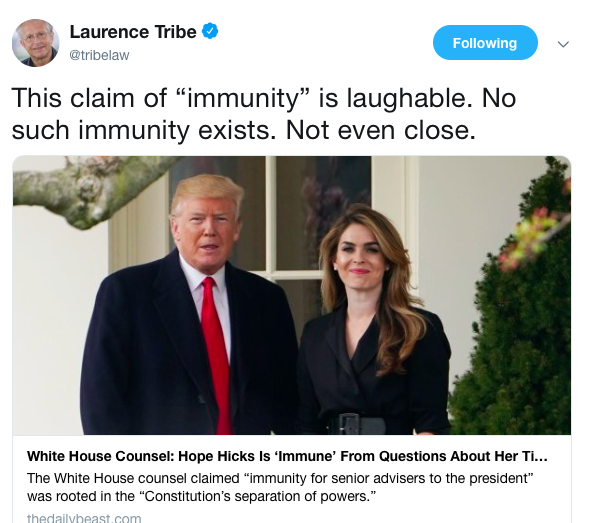
On June 18, White House counsel Pat Cipollone told Congress that former presidential aide Hope Hicks was “absolutely immune” from testifying about her work for Trump at the White House.

Laurence Tribe, pre-eminent constitutional scholar and Harvard law professor, found the claim “laughable”:

Preet Bharara, former US Attorney for the Southern District of New York, likewise ridiculed it:

View video: https://twitter.com/CNNSitRoom/status/1141479007734644737

On June 19, White House lawyers showed up at Hicks’ closed interview and asserted Cipollone’s objection. She followed their instruction and refused to answer — 155 times. Afterward, House Judiciary Committee member Rep. Ted Lieu (D-CA) said, “We’re watching obstruction of justice in action.”

Here’s an example of what Lieu was talking about:

“Q: In the White House, where is your office located?”

“White House Lawyer: We’ll object to that.” (Tr. p. 86)

Transparency and television coverage are not Trump’s friends — or Cipollone’s — or Hicks’s. Mueller’s report and the Trump-Russia Timeline reveal why Trump is blocking testimony and resisting public hearings.

Trump-Russia Campaign Contacts

On Nov. 10, 2016 — two days after the election — Russia’s Deputy Foreign Minister Sergei Ryabkov said that the Kremlin maintained contact with Trump’s “immediate entourage” throughout the campaign. The same day, Vladimir Putin’s personal spokesman, Dmitry Peskov, said Russian experts were in contact with some members of Trump’s staff during the campaign.

Immediately, Hicks contradicted them:

“We are not aware of any campaign representatives that were in touch with any foreign entities before yesterday, when Mr. Trump spoke with many world leaders.” She then denied any contacts between the campaign and Russia: “It never happened. There was no communication between the campaign and any foreign entity during the campaign.” [Mueller Report, Vol. II, p. 21]

That wasn’t true. More than 75 pages of Mueller’s report outline “Russian Government Links To And Contacts With The Trump Campaign.” The more than 120 contacts included Jared Kushner, Paul Manafort, Donald Trump Jr., Michael Cohen, Jeff Sessions, George Papadopoulos, and Carter Page. (Vol. I, pp. 66-144; Tr. p. 153)

Obstruction

Hicks’ name appeared in Mueller’s report more than 180 times. At key moments in Trump’s effort to obstruct justice, she was there. Hicks has already told Mueller about them, but televised hearings would shine a public spotlight on the episodes.

  • Trump fury over Sessions’ recusal and Mueller’s appointment

MARCH 5, 2017: After Attorney General Jeff Sessions recused himself from the Russia investigation, Hicks witnessed Trump’s anger (although she’s not clear on the dates). (Vol. II, p. 51, fn. 304) When Trump learned about Mueller’s appointment on May 17, she saw his ire again — only worse. (Vol. II, p. 79)

  • Trump fired James Comey

MAY 6-7, 2017: Trump tried to cover-up his motives for firing FBI Director James Comey, but then told Russia’s foreign minister and ambassador his real reason: to remove the pressure of the Russia investigation. Hicks witnessed key moments in the episode.(Vol. II, p. 71, fn. 470)

  • Trump lied about the Trump Tower Meeting

JULY 8-9, 2017: The New York Times was breaking an explosive story: Jared Kushner, Paul Manafort, and Donald Trump Jr. had met on June 9, 2016, with Russians promising “dirt” on Hillary Clinton.” Trump personally formulated his son’s false statement to the press. Hicks was at the center of the action. (Vol. II, pp. 100-104)

  • Trump tried to limit Mueller’s investigation

JULY 19, 2017: Trump dictated a message that he wanted Corey Lewandowski to give then-Attorney General Jeff Sessions. He proposed a public statement limiting Mueller’s investigation to future elections only. Hicks typed it up for Lewandowski. (Vol. II, pp. 91-94, fn. 625)

  • Trump pressured McGahn to lie for him

JAN. 26, 2018: Trump wanted then-White House counsel Don McGahn to lie about The New York Times’ breaking story that Trump had ordered McGahn to fire Mueller. McGahn refused. Hicks was in the loop. (Vol. II, p. 114)

When House Judiciary committee members directed Hicks to pages in Mueller’s report relating to those episodes, White House lawyers objected, and she refused to answer questions about them. (Tr. pp. 202-207)

End Game

The Republican National Committee is paying Hicks’ legal fees. (Tr. pp. 225-226) Since leaving the White House, she has spoken to Trump “somewhere between 5 and 10 times,” most recently in April. (Tr. p. 126)

The White House’s objection does not prevent Hicks from answering Congress’ questions. That’s her decision, but it’s now become her problem. Because if the courts reject the “congressional immunity” objection, her continued silence will lead to contempt penalties that she alone will bear — not Trump, Cipollone, or the RNC. At that point, she’ll face another decision.

This is the latest in a series of posts by Steven J. Harper on the Mueller report.

TRUMP STONEWALLS AND CONFESSES: TRUMP-RUSSIA TIMELINE UPDATE THROUGH JUNE 17, 2019

Call it multitasking. While Trump continues to stonewall Congress on everything relating to the Russia investigation, he appears on national television and confesses: Would he accept help from a foreign government to win an election? You bet.

It’s not really a surprise. In 2016, he did. Just ask Robert Mueller: “ABC’s Trump Interview Shows The Power Of Television.”

Here’s a complete list of the latest updates to the Trump-Russia Timeline at Dan Rather’s News & Guts and at Just Security:

JUNE 3, 2019: House Schedules Vote to Hold Barr and McGahn in Contempt While Pursuing Alternatives; Judiciary Committee Schedules Hearings on Mueller’s Findings (revision of previous entry)

JUNE 10, 2019: Trump Tweets About John Dean’s House Appearance, ‘Phony Witch Hunt’

JUNE 10, 2019: Dean Testifies Before House Judiciary Committee

JUNE 11, 2019: Trump Continues Attack on House Judiciary Committee Hearings on Mueller Report: ‘Witch Hunt’, ‘No Collusion’, ‘PRESIDENTIAL HARASSMENT’

JUNE 11, 2019: House Authorizes Judiciary Committee to Enforce Barr and McGahn Subpoenas

JUNE 12, 2019: Trump Tweets and Retweets: ‘Phony And Never Ending Witch Hunt’ 

JUNE 12, 2019: Schiff Reiterates That FBI Has Not Briefed Congress on Counterintelligence Investigations Since Comey’s Firing

JUNE 12, 2019: Don Jr. Testifies Before Senate Intelligence Committee

JUNE 12, 2019: Justice Department Will Investigate CIA

JUNE 12-14, 2019: Trump Says Wray is Wrong: Trump Would Accept Foreign Help to Win Election; FEC Chair Responds: ‘It’s Illegal’; Trump Tries Clean-Up

JUNE 13, 2019: Trump Tweets About Flynn’s New Lawyer, Mueller Report, Barr, Impeachment, Stephanopoulos Interview

JUNE 13, 2019: House Intelligence Committee Subpoenas Flynn and Gates

JUNE 13, 2019: Trump Announces Sarah Sanders’ Departure

JUNE 13-14: Blackburn Blocks Legislation on Foreign Election Interference; Trump Tweets Praise

JUNE 14, 2019: Trump Says McGahn is Lying or Confused

JUNE 14, 2019: Trump Tweets “Witch Hunt Hoax’

JUNE 14-15, 2019: Trump Tweets and Retweets About Russia Investigation: ‘Coup Update’, Mueller Report ‘A Lying Hit Job on Trump’, Blames Obama, ‘May Be The Biggest Political Crime In The History Of The US’, John Dean Is ‘A Prop’, ‘Greatest Presidential Harassment Of All Time’

JUNE 15, 2019: NY Times Reports on US Digital Incursions Into Russia’s Power Grid; Trump Calls Report ‘Virtual Act Of Treason’

JUNE 16, 2019: Trump Tweets About Steele Dossier, Impeachment

ABC’s TRUMP INTERVIEW SHOWS THE POWER OF TELEVISION

[This post first appeared on June 16, 2019, at Dan Rather’s News & Guts.]

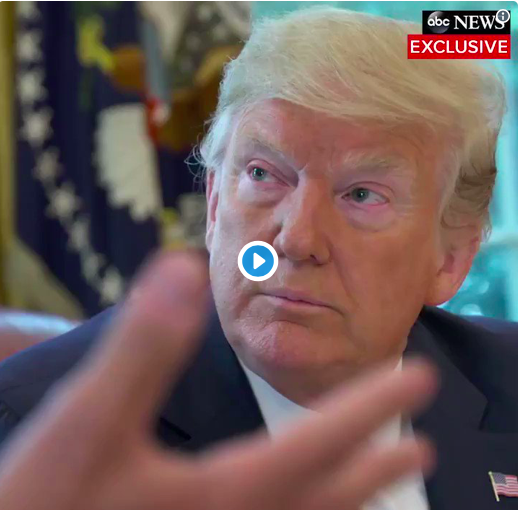
When ABC’s George Stephanopoulos asked Donald Trump if he would accept a foreign government’s help to win an election, Trump answered, “I think I’d take it.” Of course he would. The Mueller report demonstrates that his 2016 campaign actually did:

“[T]he investigation established that the Russian government perceived it would benefit from a Trump presidency and worked to secure that outcome, and that the Campaign expected it would benefit electorally from information stolen and released through Russian efforts….” (Vol. I, p. 5)

But Trump’s words became headlines because a 90-second television clip is more powerful than the accumulated evidence in a 448-page report that few people will read:

WATCH VIDEO: https://twitter.com/ABCPolitics/status/1138975286702346241

Like every US intelligence agency, Mueller concluded that the facts pointed in one direction: Putin wanted Trump to win and the Trump campaign embraced Russia’s assistance. And Mueller’s facts are stubborn things:

APR. 18, 2016: Russia has hacked Clinton campaign manager John Podesta’s computer, gained access to Democratic (DNC and DCCC) networks, and is stealing DNC and DCCC documents. (Vol. I, pp. 4, 37-38)

APR. 19: A Russian internet troll farm purchases its first social media ads explicitly endorsing Trump for president — support that continues beyond Election Day. (Vol. I, pp. 25-26)

APR. 26:  In London, a Russian intermediary tells Trump adviser George Papadopoulos that Russia has “dirt” on Clinton in the form of thousands of emails. Papadopoulos’ Russia-related communications with top campaign officials continue throughout the spring and summer. (Vol. I, pp. 5-6, 86-92)

JUNE 3: Donald Trump Jr. receives Russia’s offer “to provide the Trump campaign with some official documents and information that would incriminate Hillary…[as] part of Russia and its government’s support for Mr. Trump….” Within minutes, Don Jr. responds: “[I]f it’s what you say, I love it especially later in the summer.” (Vol. I, pp. 112-117)

JUNE 9: At Trump Tower in New York, Don Jr., Jared Kushner, and Paul Manafort meet secretly with three Russians, including a lawyer with Kremlin ties. (Vol. I, pp. 112, 117)

JULY 22: Three days before the Democratic National Convention begins, WikiLeaks disseminates the first batch of stolen Democratic emails that it received from Russian intelligence officers. (Vol. I, pp. 44-46)

JULY 27: At a press conference, Trump says, “Russia, if you’re listening, I hope you’re able to find the 30,000 emails that are missing. I think you will probably be rewarded mightily by our press.” (Vol. I, p. 49)

WATCH VIDEO: https://twitter.com/cspan/status/758320094619381760?lang=en

Less than five hours later, Russian intelligence officers target for the first time Clinton’s personal office. (Vol. I, p. 49)

SUMMER/FALL: The Trump campaign is “planning a press strategy, a communications campaign, and messaging based on the possible release of Clinton emails by WikiLeaks.” (Vol. I, p. 54)

Several pages in Mueller’s report detailing “The Trump Campaign and the Dissemination of Hacked Emails” are heavily redacted. (Vol. I., pp. 51-59)

Call the FBI?

Stephanopoulos reminded Trump that FBI Director Christopher Wray warned candidates to report offers of foreign assistance to the FBI. The Trump campaign never did.

“The FBI director is wrong,” Trump said. “[I]f you go talk honestly to congressmen, they all do it, they always have. And that’s the way it is. It’s called oppo research.”

Actually, it’s called a felony. In a rebuke to Trump, Ellen Weintraub, chair of the Federal Election Commission, tweeted, “I would not have thought that I needed to say this.” Then her attached official statement began, “Let me make something 100% clear to the American public and anyone running for office: It is illegal for any person to solicit, accept, or receive anything of value from a foreign national in connection with a US election.”

The next morning, Trump called into Fox & Friends and tried to walk back his admissions: “Of course you have to look at [“dirt” from a foreign government] because if you don’t look at it you’re not going to know if it’s bad. If I thought anything was incorrect or badly stated I’d report to the FBI or law enforcement, absolutely.” Using Weintraub’s words, Trump’s nonsensical approach would still leave him “on the wrong end of a federal investigation.”

About That Counterintelligence Probe

As Trump invites foreign interference, he stonewalls Congress’ demands for a briefing on the FBI’s counterintelligence probe, which Mueller’s report does not address. Taken together, Trump’s actions heighten a key counterintelligence concern: Whether Putin’s help with Trump’s 2016 campaign or Trump’s business ties to Russia have already compromised him.

In 1788, Alexander Hamilton understood that the “most deadly adversaries of republican government” come “chiefly from the desire in foreign powers to gain an improper ascendant in our councils. How could they better gratify this, than by raising a creature of their own to the chief magistracy of the Union?” (Federalist No. 68)

Hamilton posed a rhetorical question. In 2016, Trump made it real. As the 2020 election approaches, he has made it urgent.

This is the tenth in a series of posts by Steven J. Harper on the Mueller report. The first nine installments are available here, here, here, here, here, here, here, here, and here.

LORDY, THERE ARE TAPES! TRUMP-RUSSIA TIMELINE UPDATE THROUGH JUNE 10, 2019

Damning words on a page are one thing. Hearing those words from the mouth of the person speaking them moves the public’s attention to a whole new level. This voicemail from Trump’s attorney, John Dowd, is just one piece of evidence in special counsel Robert Mueller’s report on Trump’s obstruction of justice: https://soundcloud.com/kadhim-shubber/john-dowd-call-to-robert-kelner

Imagine what might happen if the public saw and heard live testimony from the participants involved in Trump’s wrongdoing. Trump and his defenders have. And that’s why they don’t want any of those witnesses appearing before the House Judiciary Committee.

Even Attorney General William Barr wouldn’t be able to spin Trump out of that mess.

Here’s a complete list of the latest updates to the Trump-Russia Timeline at Dan Rather’s News & Guts and at Just Security:

SOMETIME BETWEEN NOV. 8 and NOV. 24, 2016: Kushner and Flynn Meet With Kislyak

REVISED: NOV. 22-23, 2017: Flynn Withdraws from Joint Defense Agreement with Trump; Trump’s Lawyer Presses (revision of previous entry)

APR. 19, 2018: Feds File Criminal Complaint Against Nader

MAY 31, 2019: Justice Department Defies Judge’s Order, Complies With Separate Order to Release Transcript of Call to Flynn; Judge Acquiesces (revision of previous entry)

MAY 31, 2019: Stone Aide Produces Documents and Testifies

JUNE 3, 2019: House Schedules Vote to Hold Barr and McGahn in Contempt While Pursuing Alternatives; Judiciary Committee Schedules Hearings on Mueller’s Findings

JUNE 4, 2019: White House Directs Donaldson and Hicks Not to Produce Certain Documents in Response to House Subpoena; Hicks Agrees to Produce 2016 Campaign Documents

JUNE 5, 2019: Trump Attacks Democrats: ‘No Collusion Witch Hunt…Now Want a Do-Over’

JUNE 6, 2019: Public Hears Dowd’s Nov. 22, 2017 Voicemail to Flynn’s Lawyer

JUNE 6, 2019: Flynn Fires Lawyers, Hires New Counsel

JUNE 6, 2019: Trump Attacks Mueller Report

JUNE 7, 2019: Trump Quotes Hannity: ‘Mueller’s Report Was Pure, Political Garbage’; Tweets Clips of Meadows and Starr From Hannity’s TV Program; ‘Nervous Nancy Pelosi Is A Disgrace… No Collusion – Investigate The Investigators’ 

JUNE 7, 2019: McConnell Continues to Block Election Protection Legislation

JUNE 9, 2019: Trump Attacks Dems: ’13 Angry Democrat Trump Haters…No Collusion… Mueller Report Was A Disaster For Them…They Want a Redo or Do-Over…Bringing in @CNN Sleazebag Attorney John Dean’


TRUMP’S NEW ROY COHN? BARR GOES ALL-IN FOR THE PRESIDENT

[This post first appeared on June 9, 2019, at Dan Rather’s News & Guts.]

“Where’s my Roy Cohn?” Trump yelled in frustration. Attorney General Jeff Sessions had recused himself from the Russia investigation and was no longer able to protect him. (Mueller Report, Vol. II, pp. 50, 110) He may have found him, again.

Roy Who?

From 1974 until shortly before his death in 1986, Cohn represented Trump. But in the early 1950s, he was Sen. Joseph McCarthy’s (R-WI) hatchet man. Their unfounded attacks on “communist sympathizers” ruined lives.

Fellow Republicans in Congress remained silent accomplices until televised hearings accelerated McCarthy’s demise. Sixty-five years ago today — on June 9, 1954 — attorney Joseph Welch’s response to his ad hominem attack on a young associate in Welch’s law firm resonated throughout the country:

“Until this moment, Senator, I think I never really gauged your cruelty or your recklessness… Have you no sense of decency, sir, at long last? Have you left no sense of decency?”

Here’s the video: https://www.youtube.com/watch?v=oc6Yo3A7CC8

The audience erupted in applause. McCarthy and Cohn had crossed a line that GOP leaders could no longer ignore. Except for Rep. Justin Amash (R-MI), the 21st century iteration of McCarthy’s party has acknowledged no such line for Trump. But in Attorney General William Barr, Trump apparently has found his Roy Cohn, as recent Trump-Russia Timeline entries reveal.

Step 1: Barr Undermines Mueller

MAR. 5, 2019: Special counsel ROBERT MUELLER tells Barr and Rod Rosenstein that his report will not determine whether Trump obstructed justice.

MAR. 22: MUELLER’s report to Barr outlines serious evidence against Trump, but explains that charging him with a crime was never an option. Under the Constitution and a longstanding Justice Department opinion, it’s Congress’ job to address a sitting president’s misconduct. (Vol. II, pp. 1-2)

MAR. 24: BARR sends Congress a letter excerpting phrases from Mueller’s yet-to-be-released report. According to Barr, Trump did not obstruct justice because the facts are simply insufficient to establish the crime. In a single line, he dismisses constitutional concerns and the prior Justice Department opinion as irrelevant.

But Mueller’s report actually says that if the facts showed “that the President clearly did not commit of obstruction of justice, we would so state.” (Vol. II, pp. 1-2) Mueller’s report does not so state. And more than 1,000 former federal prosecutors who served during Republican and Democratic administrations have signed a joint letter stating that, for anyone other than a sitting president, the facts in Mueller’s report would “result in multiple felony charges for obstruction of justice.”

MAY 29: MUELLER issues his first public statement since his appointment as special counsel. He reiterates that the Constitution and Justice Department policy prevented him from indicting a sitting president, but the facts prevented him from exonerating Trump.

MAY 31: BARR gives a folksy television interview during which he throws Mueller under the bus: “The [Justice Department] opinion says you cannot indict a president while he is in office, but [Mueller] could’ve reached a decision as to whether it was criminal activity….”

Yet it was precisely the prospect of a criminal accusation without a subsequent process for potential vindication that Mueller viewed as triggering constitutional and fairness concerns. (Vol. II, pp. 1-2)

Barr adds, “[W]e didn’t agree with the legal analysis — a lot of the legal analysis in the report. It did not reflect the views of the department. It was the views of a particular lawyer or lawyers and so we applied what we thought was the right law….”

One member of Mueller’s team, Deputy Solicitor General Michael Dreeben, is among the nation’s top constitutional criminal lawyers. Barr has yet to explain what Dreeben and Mueller got wrong, what “right” law Barr and Rosenstein applied, or what legal reasoning led them to exonerate Trump where Mueller reported that the facts made exoneration impossible.

Step 2: “Investigate the Investigation”

In the same interview, Barr discusses a long time Trump distraction: investigating the origins of the Trump counterintelligence probe. Echoing McCarthy-Cohn tactics, he offers no factual support and relies on ambiguity and innuendo to cast a sinister shadow:

  • “[T]he use of foreign intelligence capabilities and counterintelligence capabilities against an American political campaign to me is unprecedented and it’s a serious red line that’s been crossed.”
  • “Counterintelligence activities that were directed at the Trump campaign were not done in the normal course and not through the normal procedures….”
  • “I have not gotten answers that are, well, satisfactory, and in fact probably have more questions, and that some of the facts that–that I’ve learned don’t hang together with the official explanations of what happened.”
  • “I think the activities were undertaken by a small group at the top… It was done by the executives at the senior level. Out of headquarters….”

Barr chastises journalists for not amplifying Trump’s “investigate the investigation” narrative: “[T]he media doesn’t seem to think that it’s worth looking into. They’re supposed to be the watchdogs of, you know, our civil liberties.”

Step 3: All-In And No Regrets

Finally, Barr suggests that Trump’s critics are the norm-busters, not Trump:

“I think one of the ironies today is that people are saying that it’s President Trump that’s shredding our institutions. I really see no evidence of that…. [C]hanging the norms on the grounds that we have to stop this president, that is where the shredding of our norms and our institutions is occurring.”

Asked about defending Trump personally at the expense of his own reputation and his duties as the nation’s attorney general, Barr says he doesn’t care:

“[E]veryone dies and…I don’t believe in the Homeric idea that you know, immortality comes by, you know, having odes sung about you over the centuries, you know?”

It’s true. Everyone dies. Roy Cohn died in disgrace after being disbarred. Donald Trump is the only one singing odes to him.

This is the ninth in a series of posts by Steven J. Harper on the Mueller report. The first eight installments are available here, here, here, here, here, here, here, and here.

TEN EASY PIECES: TRANSLATING ROBERT MUELLER’S LEGALESE

[This post first appeared on June 2, 2019, at Dan Rather’s News & Guts.]

On May 29, special counsel Robert Mueller made his first and, he hopes, last comments on the investigation culminating in his report. “We chose those words carefully and the work speaks for itself,” he said.

Those words cover 448 pages. They may speak to fellow lawyers, including me. But they’re not reaching a general public suffering from Trump fatigue, bombarded with disinformation, and accustomed to processing what they see and hear in tweets and sound bites. If Mueller had stated his views in lay terms, he could have led with this headline: There’s plenty of evidence that Trump is a criminal. But I can’t indict him, so the House of Representatives must decide what to do next.

Translated into readily understandable English, here’s the rest of Mueller’s message:

  1. Forget what my boss, William Barr, told you about my report. I wanted Barr to use summaries that I’d prepared. Instead, he wrote his own misleading one, released it to the public, and sat on my report for a month.
  2. Anyone saying that I found “No Collusion” is lying. (Vol. I, p. 2, Vol. II, p. 2)
  3. Russia attacked the US presidential election to help Trump win. (Vol. I, p. 1)
  4. Trump’s campaign embraced Russia’s effort and publicly denied the truth — that it had multiple contacts with Russia. (Vol. I, pp. 5-7, 66-173; Vol. II, pp. 15-23)
  5. Anyone saying that I found “No Obstruction” is lying. (Vol. II, p. 2)
  6. Trump made it more difficult to discover the truth. As a result, I don’t know the whole story about Trump and Russia. Neither does Congress or the public. (Vol. I, p. 10)
  7. Because of existing Justice Department policy, I couldn’t even consider charging Trump with a crime. The Constitution specifies the process for dealing with presidential wrongdoing: impeachment — not me or Barr. (Vol. II, pp. 1-2)
  8. I haven’t written or said anything publicly about the counterintelligence aspect of my investigation. Congress and the public still don’t know if Putin has compromising information on Trump or others close to him. (Vol. I, p. 13)
  9. My investigation was never a “Witch Hunt” or a “Hoax.” Many former Trump campaign officials are now behind bars; others face pending cases. (Vol. II, App. D)
  10. Despite Trump’s persistent assertions to the contrary, Russian election interference was and is real; it should trouble every American patriot. (Mueller’s 5/29/2019 Statement, final sentence)

Mueller’s parting message to the House of Representatives: I’ve done my job. In accordance with the nation’s founding document, it’s time for you to do yours.

IS HE THE MOST DANGEROUS PERSON IN AMERICA?

[This post first appeared on May 27, 2019, at Dan Rather’s News & Guts]

The most dangerous person in America may not be Donald Trump. Attorney General William Barr has used his formidable legal skills to promote and weaponize Trump’s lies. Last week, Trump vested Barr with unprecedented power to wreak even more havoc on the truth. And it may make Barr the most dangerous person in the country, as recent additions to the Trump-Russia Timeline demonstrate.

Barr Now Controls Public Access to Key Facts

Mar. 24, 2019: Barr’s letter to Congress (and the public) uses misleading excerpts of sentence fragments from special counsel Robert Mueller’s report to declare Trump “not guilty” of obstructing justice. Barr’s deception fuels Trump’s “no collusion/no obstruction” lies about Mueller’s conclusions.

Apr. 9: Mueller’s report is still unavailable to Congress and the public. Testifying before a House committee, Barr says he doesn’t know the basis for news reports that members of Mueller’s team are unhappy with his Mar. 24 summary. He doesn’t disclose Mueller’s Mar. 27 letter complaining to Barr about the summary; Congress and the public are unaware of it.

Apr. 18: The release of a redacted version of Mueller’s report reveals that Barr misled Congress and the public about its findings and conclusions. Within a month, more than 900 former federal prosecutors who served under both Republican and Democratic administrations sign an open letter saying that, but for the fact that Trump is president, he would be facing “multiple felony charges for obstruction of justice” based on the facts in Mueller’s report.

Apr. 30: The Washington Post publishes Mueller’s Mar. 27 letter to Barr, which memorializes Mueller’s concern that Barr’s summary “did not fully capture the context, nature, and substance of this Office’s work and conclusions.” The result, Mueller wrote, “is public confusion about critical aspects of the investigation.” ThePost awards Barr “Three Pinocchios” for misleading Congress in early April.

May 23: At Barr’s urging, Trump gives him unprecedented power over the entire US intelligence community’s most closely guarded secrets and orders all agencies to cooperate with him. In connection with the origins of the Trump-Russia investigation, Barr gains the unprecedented power to pick and choose which secret documents to declassify. But he can also select which documents not to declassify. That means he has complete control over what the public sees, hears, and believes about how the probe began. The discredited suggestion that the FBI was “spying” on his campaign began as a baseless Trump distraction from the investigation itself. In Barr’s hands, it’s now a potent weapon against Trump’s enemies.

Will Truth Survive? 

Mueller’s report already answers the question Barr now revisits: How did the Trump-Russia investigation begin?

“On May 6, 2016, 10 days after…meeting with [Joseph] Mifsud, [Trump campaign adviser George] Papadopoulos suggested to a representative of a foreign government that the Trump Campaign had received indications from the Russian government that it could assist the Campaign through the anonymous release of information that would be damaging to Hillary Clinton. fn 465.”

“fn 465: This information is contained in the FBI case-opening document and related materials… The foreign government conveyed this information to the US government on July 26, 2016, a few days after WikiLeaks’s release of Clinton-related emails. The FBI opened its investigation of potential coordination between Russia and the Trump Campaign a few days later based on that information.” (Vol. I. p. 89)

None of that matters now. Barr is already reinforcing Trump’s lie that the investigation began as an effort to “spy” on his campaign. Although Trump’s chosen FBI director, Christopher Wray, has rejected that Trump talking point, Barr has embraced the word “spy” and Trump loves it. Barr’s willingness to perpetuate this and other false narratives — including the incorrect claim that Mueller found “no collusion” between Russia and the Trump campaign — makes Barr’s power over information all the more dangerous.

End Game?

On the day of Trump’s unprecedented delegation of power to Barr, Trump made comments that too many have dismissed as his typical bombastic rhetoric. But often that rhetoric is merely testing public reaction and morphs into troubling reality.

During a press conference at which he asked staffers to deny press reports that he’d become unhinged the previous day at a meeting with House Majority Leader Nancy Pelosi (D-CA) and Senate Minority Leader Chuck Schumer (D-NY), Trump said that some people were guilty of treason.

Asked to name them, Trump added, “I think a number of people. They have unsuccessfully tried to take down the wrong person. If you look at [James] Comey, if you look at [Andrew] McCabe, if you look at probably people higher than that, if you look at [Peter] Strzok, if you look at his lover, Lisa Page, his wonderful lover.”

Later that evening, Corey Lewandowski — who remains a close Trump confidant— appeared on Fox News. He said that former Vice President Joe Biden was behind the Steele Dossier and that Comey, McCabe, Strzok, and Page will all be on trial by March or April of 2020.

Treason is a capital offense. Trump wants more than just to investigate career law enforcement officers who were simply doing their jobs in 2016. He wants to execute them. And he has William Barr shaping the public’s view of his prosecutions.

This is the seventh in a series of posts by Steven J. Harperon the Mueller report. The first six installments are available here, here, here, here, here, and here. Steve is the creator and curator of the Trump-Russia Timeline appearing at Dan Rather’s News & Guts and at Just Security. He’s an attorney, adjunct professor at Northwestern University Law School, and author of four books, including Crossing Hoffa — A Teamster’s Story (Chicago Tribune “Best Book of the Year”) and The Lawyer Bubble — A Profession in Crisis.He blogs at The Belly of the Beast. Follow him on Twitter (@StevenJHarper1).

IS WILLIAM BARR THE MOST DANGEROUS PERSON IN AMERICA? TRUMP-RUSSIA TIMELINE UPDATE THROUGH MAY 27, 2019

Trump talks “treason” in describing career Justice Department officials involved in the Trump-Russia investigation. As Trump’s crusade against the truth continues, Attorney General William Barr is poised to lead the charge. My latest post at Dan Rather’s News & Guts takes a closer look at disturbing developments.

Here’s a complete list of the latest updates to the Trump-Russia Timeline at Dan Rather’s News & Guts and at Just Security:

SOMETIME DURING THE WEEK OF MAY 20, 2019: Giuliani Seeks Information on Democrats From Ukrainian

MAY 20, 2019: White House Tells McGahn Not to Honor Congressional Subpoena 

MAY 20, 2019: House Intelligence Committee Releases Cohen Transcripts

MAY 20, 2019: GOP ‘Freedom Caucus’ Condemns Amash

MAY 20-21, 2019: Judge Rejects Trump’s Effort to Block Accountants From Producing His Tax Returns; Trump Appeals

MAY 21, 2019: McGahn Refuses to Appear Before House Judiciary Committee

MAY 21, 2019: House Judiciary Committee Subpoenas Hicks, McDonald

MAY 21, 2019: Trump Attacks ’18 Angry Trump-Hating Democrats’; Tweets ‘NO COLLUSION and NO OBSTRUCTION!’, Democrats Want ‘DO OVER’, ‘Fishing Expedition’

MAY 22, 2019: Trump Tweets ‘Illegally Started Investigation’, ‘NO COLLUSION’, ‘DO OVER’ – ‘Witch Hunt’, ‘PRESIDENTIAL HARASSMENT’, ‘ILLEGAL Witch Hunt’, Democrats’ ‘Wild Goose Chases’; Retweets Numerous Others

MAY 22, 2019: Justice Department Agrees to Produce Unredacted Mueller Materials to House

MAY 22, 2019: Trump Demands End of Investigation Before He’ll Legislate With Congress, Then Tweets About It

MAY 22, 2019: Another Judge Rejects Trump Attempt to Block Subpoena Seeking His Financial Records; NY Legislature Approves Bill to Allow Congress to Obtain Trump’s Financial Records

MAY 22, 2019: Deutsche Bank Blames ‘Software Glitch’ for Failure to Report Suspicious Transactions

MAY 23, 2019: Trump Continues Twitter Attack on Democrats: Doctored Video of Pelosi, ‘Re-Do of Mueller Report’, ‘Fishing Expedition’, Intelligence Agencies Used Against Him, ‘NO COLLUSION, NO OBSTRUCTION’

MAY 23, 2019: New Federal Charges Against Assange 

MAY 23, 2019: Trump Calls ‘Treason’ on Comey, McCabe, Strzok, Lisa Page, and ‘A Number of People’; Lewandowski Says They’ll Be On Trial in 2020

MAY 23, 2019: Trump Authorizes Barr to Declassify Documents As He Investigates Origins of Russia Probe

MAY 24, 2019: Trump Tweets About Impeachment, ‘No Collusion and No Obstruction’, ‘Dems Are Just Looking for Trouble and a Do-Over’; Retweets Attacks on Democrats 

MAY 25, 2019: Trump Attacks Warner on Twitter

MAY 26, 2019: Trump Wants Apology

MAY 27, 2019: Trump Tweets: ‘Impeach For What’, Dems “Only Want A Do-Over’

LAWYERS CROSSING A DANGEROUS LINE: TRUMP-RUSSIA TIMELINE UPDATE THROUGH MAY 20, 2019

Trump continues to stonewall Congress, confuse the public, and undermine the rule of law. Unfortunately, in Attorney General William Barr, Trump has now found his Roy Cohn to help. Along with White House counsel Pat Cipollone, Barr is writing one of the legal profession’s saddest chapters.

The media are starting to take note. From The Guardian on May 20, 2019:

“Each new controversial memo or opinion feeds a running debate about where, exactly, assertive lawyering ends and malpractice begins. But while those debates spin on, entire ethical continents below are shifting, the critics warn, in an ominous drift away from previous legal norms. The question in play is whether there is a line past which lawyering for Trump means joining a historic assault on the justice system itself.

“Trump administration lawyers are at risk of neglecting a higher, sworn duty, said Steven J Harper, a professor and lawyer who has written on the topic for the American Bar Association.

“‘It goes beyond, I think, particular rules of professional responsibility,’ Harper said. ‘I think it goes to far more important things, like respect for the rule of law, respect for the constitution and the duty that all lawyers have to prevent a president from making the justice system a host species for his personal agenda.

“‘I think people really don’t realize the role lawyers can play,’ Harper continued. ‘Because ultimately, in order to co-opt the legal system, you need to have the help of insiders from within the legal system to do it. And so far Trump has put together a team that has, I think, in very large measure enabled him to do that.’”

“The president has tried to use the justice department to go after his political rivals before, as when he said in the spring of 2018 that he wanted prosecutions of Hillary Clinton and the former FBI director James Comey, only to be reportedly rebuffed by McGahn, then White House counsel.

“But Trump appears to have found his man in Barr, said Walter Shaub, a former director of the Office of Government Ethics and a senior adviser to Citizens for Responsibility and Ethics in Washington (Crew).

“’I think it’s extremely troubling that Barr has now assigned a handpicked investigator to look into the investigation run by his own agency,’ Shaub said. ‘They have an inspector general for a reason, and the inspector general for the Department of Justice is one of the most respected inspectors general that there is, or ever has been. There’s no reason not to rely on him if you’re looking for the truth.’

***

“What motivates the lawyers who prop up Trump’s project? ‘Maybe it’s just the intoxication of power,’ said Harper. ‘Or maybe it’s something as simple as human nature, and how it relates to ambition and greed. I don’t know, but it’s really dangerous stuff.’”

**********************************************************************************

Here’s a complete list of the latest updates to the Trump-Russia Timeline at Dan Rather’s News & Guts and at Just Security:

NOV. 8, 2016: Election Day Troubles (revision of previous entry)

BEFORE AND AFTER DEC. 1, 2017: Person ‘Connected to’ Congress Tries to Influence Flynn’s Cooperation with Mueller

APR. 3, 2018: Flynn Sends Gaetz a Message: ‘Keep the Pressure On’

MAR. 5, 2019: Mueller Tells Barr That His Report Will Include Executive Summaries

MAR. 14 – MAY 3, 2019: Trump’s Lawyers Receive Letters From Schiff, Trump’s Lawyers Resist Schiff’s Document Requests

APR. 8, 2019: Senate Intelligence Committee Subpoenas Don Jr.

APR. 18, 2019: Barr Says ‘No Collusion’, Not Bothered By ‘Spinning’ Mueller Report Before Its Release (revision of previous entry)

MAY 12, 2019: Trump Tweets Attack FBI, ‘Russian Hoax’, Burr; Says Barr is ‘Willing to Lead the Battle’; Condemns ‘Treasonous Hoax’, Democrats Requests for Documents and Witnesses; Wants Wray to Admit to ‘Spying’ on Trump Campaign (revision of previous entry)

MAY 12, 2019: Trump Attacks FBI Director Wray: ‘The FBI Has No Leadership’; Claims Attempted ‘Illegal Coup’

MAY 13, 2019: Trump Blasts ‘Attack Strategy of Harass’ Against Barr

MAY 13, 2019: Sweden Reopens Assange’s Rape Case

MAY 13, 2019: Barr Orders Another Review of Trump-Russia Investigation’s Origins

MAY 13, 2019: Gates Still Cooperating

MAY 13, 2019: Court Receives Certain Unredacted Pages of Mueller’s Report

MAY 12-14, 2019: Graham’s Advice to Don Jr.: ‘Ignore the Subpoena’, ‘Plead the Fifth’; Don Jr. Agrees to Testify

MAY 14, 2019: Florida Governor Says Russian Hackers Had Penetrated Two Florida County Voter Databases in 2016

McCONNELL SAYS “CASE CLOSED”; MUELLER DISAGREES

[This post first appeared on May 13, 2019 at Dan Rather’s News & Guts]

From the Senate floor on May 7, Majority Leader Mitch McConnell (R-KY) told his colleagues to pack up their Trump-Russia investigation bags and go home: “The special counsel’s finding is clear: case closed.”

Robert Mueller disagrees. For starters, he didn’t exonerate Trump. But he concluded that, under Justice Department policy, indicting Trump wasn’t an option either. Rather, Mueller deferred to Congress in dealing with the misconduct of a sitting president — and examples of such misconduct pervade the report.

Mueller also identified five obstacles that keep the case against Trump open because they hindered the investigation. Those obstacles may have prevented the development of criminal cases beyond the 37 Trump-Russia players he charged. In Mueller’s own words, here they are:

#1: Some witnesses, including Trump, refused to talk

“Some individuals invoked their Fifth Amendment right against compelled self-incrimination….” (Vol. I, p. 10)

“We also sought a voluntary interview with the President. After more than a year of discussion, the President declined to be interviewed.” (Vol. II, p. 13)

“[Donald] Trump Jr.…declined to be voluntarily interviewed by the Office….” (Vol. I, p. 117)

#2: Some evidence was beyond Mueller’s reach:

“[T]he Office [of Special Counsel] faced practical limits on its ability to access relevant evidence as well — numerous witnesses and subjects lived abroad, and documents were held outside the United States.” (Vol. I, p. 10)

#3: Some witnesses lied to investigators:

“[T]he investigation established that several individuals affiliated with the Trump Campaign lied to the Office, and to Congress, about their interactions with Russian-affiliated individuals and related matters. Those lies materially impaired the investigation of Russian election interference. The Office charged some of those lies as violations of the federal false-statements statute.” (Vol. I, p. 9; emphasis supplied)

“Even when individuals testified or agreed to be interviewed, they sometimes provided information that was false or incomplete….” (Vol. I. p. 10; emphasis supplied)

#4: Some witnesses destroyed evidence:

“Further, the Office learned that some of the individuals we interviewed or whose conduct we investigated — including some associated with the Trump Campaign — deleted relevant communications or communicated during the relevant period using applications that feature encryption or that do not provide for long-term retention of data or communications records. In such cases, the Office was not able to corroborate witness statements through comparison to contemporaneous communications or fully question witnesses about statements that appeared inconsistent with other known facts.” (Vol. I, p. 10; emphasis supplied)

#5: Some witnesses obstructed justice and got away with it:

Mueller applied a criminal standard —“proof beyond a reasonable doubt” — in deciding not to charge members of the Trump campaign with conspiracy or obstruction. But along the way, many of them frustrated his search for the truth:

“[A]lthough the evidence of contacts between Campaign officials and Russia-affiliated individuals may not have been sufficient to establish or sustain criminal charges, several US persons connected to the Campaign made false statements about those contacts and took other steps to obstruct the Office’s investigation and those of Congress.” (Vol. I, p. 180; emphasis supplied)

Why Lie and Obstruct? Mueller Suggested Answers

“As described in Volume I, the evidence uncovered in the investigation did notestablishthat the President or those close to him were involved in the charged Russian computer-hacking or active-measure conspiracies, or that the President otherwise had an unlawful relationship with any Russian official. But the evidence does indicate that a thorough FBI investigation would uncover facts about the campaign and the President personally that the President could have understood to be crimes or that would give rise to personal and political concerns.” (Vol. II, p. 76; emphasis supplied)

The Counterintelligence Probe

The released report does not include the results of Mueller’s counterintelligence probe, which involves the nation’s security. This could include details of Trump’s financial dealings, as well as information about Putin’s potential leverage over Trump and his associates. As Mueller developed that evidence, it went to the FBI.

But that’s not all: “[T]he FBI also embedded personnel at the Office who did not work on the Special Counsel’s investigation, but whose purpose was to review the results of the investigation and to send — in writing — summaries of foreign intelligence and counterintelligence information to FBIHQ and FBI Field Offices. Those communications and other correspondence between the Office and the FBI contain information derived from the investigation, not all of which is contained in this Volume.” (Vol. I, p. 13)

One More Thing

Mueller’s report also lists 12 redacted criminal matters that he referred to other federal prosecutors. Congress and the public don’t know anything about their subject matter or status.

The special counsel’s role in the investigation may be concluding, but the Trump-Russia case isn’t closed. Congress and the FBI have the task of completing the job that Mueller began. As Yogi Berra said: “It ain’t over till it’s over.”

This is the fifth in a series of posts by Steven J. Harper, creator and curator of the Trump-Russia Timeline,  on the Mueller Report. The first four installments are available here, here, here, and here.

TRUMP-RUSSIA TIMELINE UPDATE THROUGH MAY 13, 2019

Trump wants the story to disappear. Even with an attorney general who acts as if he is Trump’s personal defense attorney, it won’t. There are too many holes in his ship of state. FBI Director Christopher Wray accounts for the latest ones.

Wray has been off-message for a while. He has warned repeatedly about Russian interference in US elections. He denied the Trump-Barr assertion that the FBI had “spied” on the 2016 Trump campaign. He rejected the notion that special counsel Robert Mueller was engaged in a “Witch Hunt” or participating in a “Russian Hoax.” And he now has at his disposal the results of Mueller’s counterintelligence probe — which Congress and the public haven’t seen. To Trump, all of that makes him dangerous.

Trump’s next move? It always starts with a tweet. Wray got his first one on May 12:

So how do you suppose this one ends? No differently from his predecessors James Comey and Andrew McCabe, I suspect.

Here’s the latest update to the Trump-Russia Timeline at Dan Rather’s News & Guts and at Just Security.

1985-1986: Trump Loses Millions 

1991: Trump Is Deep in Debt (revision of previous entry)

MID-APRIL 2019: Senate Intelligence Committee Subpoenas Don Jr.

APR. 19, 2019: Trump Asks McGahn to Deny Obstruction

APR. 19, 2019: Trump Twitter Rampage Continues as He Attacks McGahn’s ‘Notes’, Threatens to ‘Bring Justice to Some Very Sick and Dangerous People Who Have Committed Serious Crimes, Perhaps Even Spying or Treason’ (revision of previous entry)

MAY 6, 2019: Cohen Reports to Prison

MAY 6, 2019: Trump Late on Magnitsky Act Sanctions

MAY 6, 2019: Former Federal Prosecutors: If Trump Weren’t The President, He Would Have Been Charged With Obstruction of Justice

MAY 7, 2019: White House Instructs McGahn Not to Comply With Congressional Subpoena

MAY 7, 2019: Wray Tells Congress: No Evidence of Spying on Trump Campaign

MAY 7, 2019: McConnell: Trump-Russia ‘Case Closed’, Defends Barr

MAY 8, 2019: Trump Tweets: McConnell Says ‘Case Closed’; Attacks Democrats and Defends Barr; FBI ‘Tried to Sabotage’ Trump Campaign’; ‘Fake Dossier’; ‘TREASONOUS HOAX’

MAY 8, 2019: House Judiciary Committee Holds Barr in Contempt; House Intelligence Committee Subpoenas Unredacted Mueller Report

MAY 7-10, 2019: US Ambassador to Ukraine Recalled; Giuliani Seeks Ukrainian Help for Trump’s 2020 Election, Then Abandons Trip

MAY 9, 2019: Trump Attacks Comey

MAY 11, 2019: Trump Retweets Defend Barr, Attack Democrats, GOP Sen. Burr for Approving Don Jr. Subpoena, Clinton, Ohr, Comey; Tweets ‘No Collusion, No Obstruction, No Crime’, Attacks McGahn

CAN RUSSIAN HACKERS STEAL VOTES? DOES TRUMP EVEN CARE?

[This post first appeared on May 4, 2019 at Dan Rather’s News & Guts]

This is the fourth in a series of posts by Steven J. Harper, creator and curator of the Trump-Russia Timeline, on the Mueller Report. The first three installments are available here, here, and here.

It’s just one sentence in special counsel Robert Mueller’s report, but it packs a powerful punch. In 2016, Russian intelligence penetrated a Florida voting system: “We understand the FBI believes that this operation enabled the GRU to gain access to the network of at least one Florida county government.” (Vol. I, p. 51) Sen. Marco Rubio (R-FL) then followed up with the revelation that Russian hackers were “in a position” to change voter roll data in his state.

On Apr. 26, 2019, FBI Director Christopher Wray sounded a similar alarm. “We recognize that our adversaries are going to keep adapting and upping their game,” he said. “So we are very much viewing 2018 as just kind of a dress rehearsal for the big show in 2020.”

Hardly anyone noticed. On Saturday, Apr. 27, 2019, The New York Times reported both stories on page A18. The Washington Post covered the Florida system penetration; News & Guts reported Wray’s warningThe Wall Street Journal didn’t mention either story.

The President’s Job: Defending “Against Enemies Foreign and Domestic”

The Trump-Russia Timeline reveals a pattern of Russian attacks on state voting systems far more ominous than hacking into candidates’ computers and promoting divisive social media campaigns. Trump’s refusal to shine a spotlight on the attacks — or to criticize Putin at all — remains one of the most dangerous aspects of the Trump-Russia story.

NOV. 8, 2016: On Election Day, voters in many states experience difficulties at the polls. At a North Carolina polling station, for example, poll workers tell dozens of would-be voters that they are ineligible to vote and turn them away, even though some have current registration cards.

It turns out that Russian hackers had targeted election systems in at least 21 states and successfully penetrated many of them, including Alaska, Arizona, California, Florida, Illinois, Texas and Wisconsin. Among the victims is VR Systems, an outside vendor that operated voting systems in North Carolina and seven other states. The GRU had also gained access to the network of at least one Florida county government and put Russia “in a position” to change voter roll data there.

FEB. 27, 2018: Adm. Mike Rogers, Trump’s then-director of the National Security Agency and chief of the US Cyber Command, tells the Senate Armed Service Committee that Trump hasn’t granted him the authority to disrupt Russian election hacking operations where they originate.

MAR. 1, 2018: Trump’s nominee to replace Rogers testifies at his confirmation hearing that Russia, China, and other countries do not expect a significant US response to their cyber attacks.

MAR. 6, 2018: Director of National Intelligence Dan Coats tells the Senate Armed Services Committee that the Trump administration lacks a “coherent strategy” for dealing with Russian election interference.

JUL. 13, 2018: Coats says that the persistent danger of Russian cyberattacks is akin to the warnings of stepped-up terror threats ahead of the Sept. 11 attacks: “The warning lights are blinking red again… These actions are persistent, they are pervasive and they are meant to undermine America’s democracy.”

AUG. 2, 2018: Coats and Wray appear together at the White House daily press briefing and discuss efforts to defend against Russia’s ongoing attacks on American elections. “Russia attempted to interfere with the last election,” Wray says, “and continues to engage in malign influence operations to this day.”

AUG. 8, 2018: Sen. Bill Nelson (D-FL), who is seeking re-election in November, says that Russians have already successfully attacked some of Florida’s voter registration systems. After the election, a recount shows that Nelson loses the race by 10,000 votes out of more than 8 million cast (or .125%).

JAN. 29-30, 2019: The US intelligence community’s annual “Worldwide Threat Assessment” to Congress states, “Russia in 2016 and unidentified actors as recently as 2018 have already conducted cyber activity that has targeted US election infrastructure….”

Trump’s Motivated Reasoning

MAY 3, 2019: Trump calls Putin and they speak for more than an hour. They discuss Mueller’s report, and Trump later tweets that they talked about the “Russian Hoax.” Asked later if he told Putin not to interfere in the 2020 election, Trump says, “We didn’t discuss that.”

Trump could confront Putin and provide full-throated support for Wray, Coats, and others seeking to preserve democracy. But out of 136 million votes cast in 2016, he won by a combined total of 77,000 votes (0.6%) in three states that tipped the Electoral College victory to him. At least two — Pennsylvania and Wisconsin — have subsequently been confirmed as targets of Russian voter election system attacks. Perhaps that explains Trump’s behavior.

On Apr. 24, Dan Rather tweeted:

The story of whatever is happening to votes in Florida — and perhaps elsewhere — might qualify.


TRUMP-RUSSIA TIMELINE UPDATE THROUGH APR. 29, 2019

As William Barr dominates the Trump-Russia headlines, other important things are happening. Here are the latest updates to the Trump-Russia Timeline:

AUG. 2, 2016: Kilimnik Meets with Manafort, Discusses Ukraine Plan (revision of previous entry)

NOV. 8, 2016: Election Day Troubles (revision of previous entry)

AUG. 8, 2018: Russians Have Hacked Florida’s Voter Registration Systems, Says Sen. Bill Nelson; FBI Believes Russia Penetrated a Florida Voter Network (revision of previous entry)

SEPT. 23, 2018: Rosenstein Assures Trump: ‘I Can Land the Plane”

APR. 7, 2019: Nielsen Resigns

APR. 22, 2019: Trump Attacks Continue on Obama, Mueller Report Witnesses, ‘PRESIDENTIAL HARRASSMENT’

APR. 23, 2019: Trump Remains on the Offensive

APR. 23-24, 2019: Trump Vows to Resist Congressional Subpoenas for All Witnesses

APR. 24, 2019: Putin Continues Moves Against Ukraine

APR. 24, 2019: Trump Twitter Frenzy Continues: Obama Administration Spying, “I DID NOTHING WRONG’, ‘No Collusion, No Obstruction’, ‘Rigged System – WE WILL DRAIN THE SWAMP’

APR. 25, 2019: Trump Attacks McGahn, Mueller, ‘No Collusion, No Obstruction,’ Strzok, Democrats, McCabe, Baker, Page, Comey, ‘Collusion Delusion’

APR. 25-26, 2019: Rosenstein Praises Trump, Criticizes Obama and Comey; The Washington Post Publishes Unflattering Story About Him 

APR. 26, 2019: Trump: ‘I Never Told McGahn to Fire Mueller’

APR. 26, 2019: Trump Tweets: ‘NO C OR O!’

APR. 26, 2019: Wray Warns of Russian Election Interference in 2020

APR. 26, 2019: Butina Sentenced

THE ROLE OF LAWYERS IN THE TRUMP ERA

My interview on the role of lawyers in the Trump era appears here (scroll down to podcast #25): https://attorneysearchgroup.com/podcasts/

In light of William Barr’s performance yesterday, it’s timely.


NO OBSTRUCTION? NO WAY

[This post first appeared on May 1, 2019 at Dan Rather’s News & Guts]

This is the third in a series of posts by Steven J. Harper, creator and curator of the Trump-Russia Timeline, on the Mueller Report. The first two installments are available here and here.

Start with these undisputed facts: A foreign adversary launched a sophisticated attack aimed at helping Donald Trump win the presidency. His campaign welcomed the help and he won. His chosen deputy attorney general then appointed a special counsel to investigate the attack. Repeatedly and often successfully, Trump tried to undermine that investigation.

That’s not a narrative of innocence. It’s the narrative of obstruction that seeks to hinder proof of potential underlying crimes. So not only is Trump’s claim of “no obstruction” false, but his previous actions also further undermine ongoing claims of “no collusion” and “total exoneration.”

Special counsel Robert Mueller’s evidence would have put anyone other than a sitting president in handcuffs. Mueller acknowledges the possibility that after Trump leaves office, it still might.

The Facts

The obstruction volume of Mueller’s report opens with “The Campaign’s response to reports about Russian support for Trump,” which summarizes the Trump team’s repeated lies about its interactions with Russia. Ten categories of evidence then document Trump’s efforts to interfere with investigations into those contacts.

“Conduct involving FBI Director Comey and Michael Flynn”: The FBI caught Trump’s national security adviser lying about his Russia contacts and he resigned. Trump then pressured Comey to “let Flynn go.”

“The President’s reaction to the Russia investigation”: Trump pressured Attorney General Jeff Sessions to “unrecuse” himself from the investigation. He asked the directors of national intelligence and the CIA to help dispel suggestions that Trump had connections to Russian election interference. And he pushed Comey to “lift the cloud” of the investigation by publicly exonerating Trump.

“The President’s termination of Comey”: Trump lied to the public about his reasons for firing Comey, but then privately told Russians in the Oval Office that he “faced great pressure because of Russia” (which Comey’s firing had “taken off”). Eventually, he admitted on national television that his motivation was “this thing with Trump and Russia.”

“The appointment of a Special Counsel and the efforts to remove him”When Sessions told Trump about Mueller’s appointment, “the President slumped back in his chair and said, ‘Oh my God. This is terrible. This is the end of my Presidency. I’m fucked.’” He blamed Sessions for not protecting him, began a relentless public and private campaign to undermine the investigation, and asked White House counsel Don McGahn to have Mueller removed.

“Efforts to curtail the special counsel’s investigation”: Trump told former campaign manager Corey Lewandowski to tell Sessions that he should limit Mueller’s probe to investigating future elections. Then Trump told chief of staff Reince Priebus to obtain Sessions’ resignation.

“Efforts to prevent public disclosure of evidence”: Trump directed aides not to publicly disclose emails about the June 9, 2016 Trump Tower meeting between senior campaign officials and Russians. The emails promised derogatory information on Hillary Clinton as “part of Russia and its government’s support for Mr. Trump.” When the press broke the story in early July 2017, Trump dictated Donald Trump Jr.’s misleading response about the meeting’s purpose. Trump’s personal lawyer denied that Trump played any role in drafting the statement.

“Further efforts to have the Attorney General take control of the investigation”: Repeatedly, Trump asked Sessions to “unrecuse” himself from the Russia investigation and to “take a look” at investigating Clinton.

“Efforts to have McGahn deny that the President had ordered him to have the Special Counsel removed”: Following accurate news reports that Trump had told McGahn to have Mueller removed, Trump told McGahn to deny the story.

“Conduct towards Flynn, Manafort and [Redacted]“: Following Flynn’s resignation, the FBI continued to investigate his activities, and Trump asked advisers to encourage Flynn to “stay strong.” After Flynn began cooperating with investigators and withdrew from a joint defense agreement with Trump, Trump’s lawyer pressed for information anyway. Flynn’s lawyers properly refused. In response, Trump’s lawyer said he would make sure Trump knew Flynn’s actions reflected “hostility” toward Trump. Separately, while Manafort’s jury was deliberating, Trump publicly said Manafort was being treated unfairly, praised him, and dangled the prospect of a pardon. (Mueller’s discussion of Trump’s conduct toward a third person — likely Roger Stone— is redacted because it involves an ongoing Justice Department matter.)

“Conduct involving Michael Cohen”: When Cohen lied to Congress about Trump’s involvement in Trump Tower Moscow negotiations during the 2016 campaign, Trump praised him. But when Cohen began cooperating with the government, Trump publicly called him a “rat” and suggested that Cohen’s family members had committed crimes.

So why isn’t Trump awaiting trial? The answer is that Mueller didn’t think indicting Trump was an option.

No “Traditional Prosecutorial Judgment”

For reasons that have nothing to do with Trump’s false self-proclamation of exoneration, Mueller did not allow himself even to consider whether Trump had committed a crime:

“[W]e determined not to apply an approach that could potentially result in a judgment that the President committed crimes.” (emphasis supplied)

Instead, Mueller deferred to the Office of Legal Counsel (OLC) finding that a sitting president is not subject to indictment. But as Mueller explains, “The OLC opinion also recognizes that a President does not have immunity after he leaves office.” So Trump is not out of the prosecutorial woods forever.

“No Person Is Above the Law”

Mueller conducted “a thorough factual investigation in order to preserve the evidence when memories were fresh and documentary materials were available.” If that evidence had cleared Trump, Mueller ‘s team would have said so. But it didn’t:

“[I]f we had confidence after a thorough investigation of the facts that the President clearly did not commit obstruction of justice, we would so state. Based on the facts and the applicable legal standards, however, we are unable to reach that judgment… Accordingly, while this report does not conclude that the President committed a crime, it also does not exonerate him.”

Ultimately, Mueller’s report is really a referral to Congress for further action based on its role in “addressing presidential misconduct”:

 “[W]e concluded that Congress has authority to prohibit a President’s corrupt use of his authority in order to protect the integrity of the administration of justice.”

“The conclusion that Congress may apply the obstruction laws to the President’s corrupt exercise of the powers of office accords with our constitutional system of checks and balances and the principle that no person is above the law.”

But regardless of what House Democrats do next, the Trump/GOP strategy is set: Falsely claim “no collusion,” “no obstruction,” and “exoneration” — and attack anyone who says otherwise. Trump survives on lies, intimidation, and the culture they create. And that may be the most important lesson of Mueller’s investigation.

NO COLLUSION? THEY’RE WRONG

[This post first appeared on Apr. 24, 2019 at Dan Rather’s News & Guts]

This is the second in a series of posts by Steven J. Harper, creator and curator of the Trump-Russia Timeline, on the Mueller Report.

Trump and his defenders claim that special counsel Robert Mueller found “No Collusion.” They’re wrong.

The executive summary of Mueller’s report includes a section highlighting evidence of the Trump campaign’s interactions with the Russians, who wanted to help him win the election. Among the items:

Deal for Trump Tower Moscow: 2015 …The Trump Organization pursued the project through at least June 2016….”

“Dirt” on Clinton from Russia: Spring 2016. Campaign foreign policy advisor George Papadopoulos made early contact with Joseph Mifsud, [who] told Papadopoulos that the Russian government had ‘dirt’ on Hillary Clinton in the form of thousands of emails.”

June 9, 2016 Trump Tower Meeting Offers Russian Support: Summer 2016. …[A] Russian lawyer met with senior Trump Campaign officials Donald Trump Jr., Jared Kushner, and campaign chairman Paul Manafort to deliver what the email proposing the meeting had described as ‘official documents and information that would incriminate Hillary.’ The materials were offered to Trump Jr. as ‘part of Russia and its government’s support for Mr. Trump.’”

WikiLeaks and US Polling Data for Russia: “On July 22, 2016, WikiLeaks posted thousands of internal DNC documents revealing information about the Clinton Campaign. Within days, there was public reporting that US intelligence agencies had ‘high confidence’ that the Russian government was behind the theft of emails and documents from the DNC.”

Ukraine “Peace Plan”: “[O]n August 2, 2016, Trump campaign chairman Paul Manafort met in New York City with his long-time business associate Konstantin Kilimnik, who the FBI assesses to have ties to Russian intelligence.” Kilimnik delivered a peace plan for Ukraine that was a “backdoor” way for Russia to control part of eastern Ukraine. The two men also discussed Manafort’s strategy for winning Democratic votes in Midwestern states. Before and after their August meeting, Manafort shared polling data with Kilimnik.

Access Hollywood Tapes, WikiLeaks, and US Intelligence Community Warning on Russian Interference: Fall 2016. On October 7, 2016, the media released video of candidate Trump speaking in graphic terms about women years earlier, which was considered damaging to his candidacy. Less than an hour later, WikiLeaks made its second release: thousands of John Podesta’s emails that had been stolen by the GRU [Russian Intelligence] in late March 2016… That same day, October 7, the Department of Homeland Security and the Office of the Director of National Intelligence issued a joint public statement ‘that the Russian Government directed the recent compromises of e-mails from US persons and institutions, including from US political organizations.’ Those ‘thefts’ and the ‘disclosures’ of the hacked materials through online platforms such as WikiLeaks, the statement continued, ‘are intended to interfere with the US election process.’”

Putin’s Full-Court Press: Post-election 2016Immediately after the November 8 election, Russian government officials and prominent Russian businessmen began trying to make inroads into the new administration. The most senior levels of the Russian government encouraged these efforts. The Russian Embassy made contact hours after the election to congratulate the President-Elect and to arrange a call with President Putin. Several Russian businessmen picked up the effort from there.”

So why didn’t Mueller bring criminal charges against members of the Trump campaign?

How Much Evidence Is Enough?

Mueller’s explained his decision not to prosecute in the final phrase of this sentence:

“[W]hile the investigation identified numerous links between individuals with ties to the Russian government and individuals associated with the Trump Campaign, the evidence was not sufficient to support criminal charges.” (emphasis supplied)

That wasn’t a proclamation of innocence. It was Mueller’s prosecutorial judgment that there was not enough admissible evidence to prove guilt “beyond a reasonable doubt” at trial. Justice Department guidelines required him to apply that standard.

But it also didn’t mean that the evidence was insufficient to remove a president who was unfit for office because, for example, his campaign, “expected it would benefit electorally from information stolen and released through Russian efforts” — which Mueller said he couldprove:

“Although the investigation establishedthat the Russian government perceived it would benefit from a Trump presidency and worked to secure that outcome, and that the Campaign expected it would benefit electorally from information stolen and released through Russian efforts, the investigation did not establish that members of the Trump Campaign conspired or coordinated with the Russian government in its election interference activities.” (emphasis supplied)

Conspiracy v. Collusion

During his Apr. 18 press conference, Attorney General William Barr said repeatedly that Mueller had confirmed Trump’s “No Collusion” mantra. The truth is that Mueller expressly excluded collusion from his analysis:

“In evaluating whether evidence about collective action of multiple individuals constituted a crime, we applied the framework of conspiracy law, not the concept of collusion.”

Mueller added that collusive behavior doesn’t necessarily satisfy the legal prerequisites for a criminal conspiracy, which “requires more than the two parties taking actions that were informed by or responsive to the other’s actions or interests.” Declining to prosecute collusive behavior doesn’t equal a finding of “No Collusion.”

Spinning The “No Collusion” Bridge Too Far

At first, Trump liked Barr’s spin. But then Mueller’s actual report caught up with both of them. The truth won’t stop Trump from repeating the “No Collusion” lie. But his tweets now reveal that even he doesn’t believe it:

Trump’s last tweet is right in one respect: Regardless of the descriptive term, what Russia and the Trump campaign did during the 2016 election should never happen again.

THE MUELLER REPORT: TRUMP-RUSSIA TIMELINE UPDATE THROUGH APR. 21, 2019

To get past Trump’s false spin about the Mueller Report, take a look a the new Apr. 18, 2019 entry in the Trump-Russia Timeline: “Redacted Mueller Report Released.”

And if you think Attorney General William Barr is working for the people of the United States rather than as Trump’s personal Mueller Report spinner, take a look at the Apr. 18, 2019 entry: “Barr Not Bothered By ‘Spinning’ Mueller Report Before Its Release”

Here are the latest updates to the Trump-Russia Timeline at Dan Rather’s News & Guts and at Just Security:

APR. 17, 2019: Trump Tweets About Steele, ‘Witch Hunt’, ‘Dirty Cops’, ‘Crooked Hillary and the DNC’

APR. 18, 2019: Trump Tweetstorm As Barr Holds Press Conference and Releases Redacted Mueller Report

APR. 18, 2019: Barr Not Bothered By ‘Spinning’ Mueller Report Before Its Release

APR. 18, 2019: Redacted Mueller Report Released

APR. 19, 2019: Trump Twitter Rampage Continues As He Threatens To ‘Bring Justice To Some Very Sick And Dangerous People Who Have Committed Serious Crimes, Perhaps Even Spying Or Treason’

APR. 19, 2019: House Subpoenas Unredacted Mueller Report

APR. 19, 2019: Prosecutors Seek 18-Month Prison Term for Butina

APR. 20, 2019: Trump Continues to Spin Mueller Report’s Conclusions

APR. 21, 2019: Trump Twitter Rampage Continues

THE BEAT GOES ON: TRUMP-RUSSIA TIMELINE UPDATE THROUGH APR. 15, 2019

Here are the latest updates to the Trump-Russia Timeline at Dan Rather’s News & Guts and at Just Security (another update that includes the Mueller Report is in coming later this week):

AUG. 16, 2017: Rohrabacher Echoes Assange: Russia Didn’t Hack Election (revision of previous entry)

MAR. 6, 2018: Assange Charged in Sealed Indictment

APR. 5-8, 2019: Trump Continues Attack on Democrats, Russia ‘Hoax’, ‘Fraudulent Russian Witch Hunt’, ‘Treasonous Acts’, ‘Mueller’s Team of 13 Trump Haters & Angry Democrats’, Nadler (revision of previous entry)

APR. 9, 2019: Trump Attacks Nadler

APR. 9, 2019: Barr Refuses to Answer Whether He’s Spoken to WH About Mueller Report

APR. 10, 2019: Trump Continues Pivot Attacking Clinton Email Investigation, Blasts Russia Investigation as ‘Phony & Treasonous Hoax’

APR. 10, 2019: Barr Says He Thinks ‘Spying Did Occur’ on Trump Campaign, Then Backtracks; Blames ‘Upper Echelon’ Leaders at FBI; Refuses to Answer Whether White House Has Seen Mueller’s Report; Nadler Responds

APR. 11, 2019: Assange Arrested; Trump Says ‘I Know Nothing About WikiLeaks’

APR. 11, 2019: Craig Indicted

APR. 11, 2019: Trump Tweets About Barr’s ‘Spying’ Comments; Retweets Rosenstein’s Defense of Barr Summary

APR. 12, 2019: Trump Tweets and Retweets About Mueller, New York Times and Washington Post Coverage of Craig Indictment, ‘Spying’ on Campaign

APR. 12, 2019: Patten Sentenced to Probation

APR. 13, 2019: Trump Attacks Democrats Over Mueller Report, ‘Crooked Hillary, DNC and Dirty Cops’

APR. 14, 2019: Trump Quotes WSJ Op-Ed Attacking Democrats

APR. 15, 2019: Trump Tweets: ‘No Collusion, No Obstruction, INVESTIGATE THE INVESTIGATORS, THEY SPIED ON MY CAMPAIGN, 18 Angry Democrats, Dirty Cops, Crooked Hillary’

APR. 16, 2019: Trump Attacks Trump-Russia Probe: ‘No Collusion – No Obstruction’


NOT DONE YET: TRUMP-RUSSIA TIMELINE UPDATE THROUGH APR. 8, 2019

The story is far from over…

Here’s a complete list of the latest updates to the Trump-Russia Timeline:

APR. 1, 2019: Trump Continues To Attack Democrats, Russia Investigation; Defends ‘No Collusion, No Obstruction Trump Campaign’ 

APR. 2, 2019: Trump’s Attacks Nadler, Schiff, Democrats

APR. 3, 2019: House Committee Votes to Subpoena Mueller Report

APR. 3-4, 2019: Mueller Investigators Unhappy With Barr’s Summary

APR. 4, 2019: Trump Attacks Democrats, New York Times, Schiff Over ‘Russian Collusion Hoax’

APR. 4, 2019: GOP Blocks Mueller Resolution Again

APR. 4, 2019: Nadler Requests DOJ Communications About Mueller Report

APR. 5-8, 2019: Trump Continues Attack on Democrats, Russia ‘Hoax’, ‘Fraudulent Russian Witch Hunt’, ‘Treasonous Acts’, ‘Mueller’s Team of 13 Trump Haters & Angry Democrats’, Nadler

DESPERATELY SEEKING A NARRATIVE OF INNOCENCE: TRUMP-RUSSIA TIMELINE UPDATE THROUGH APR. 1, 2019

[NOTE: On Apr. 3, 2019, this post appeared at Dan Rather’s News & Guts.]

Donald Trump got ahead of Attorney General William Barr’s skis.

Hours after Barr issued his four-page summary of special counsel Robert Mueller’s nearly 400-page report, Trump appeared before reporters, saying, “After a long look, after a long investigation, after so many people have been so badly hurt, after not looking at the other side — where a lot of bad things happened, a lot of horrible things happened for our country — it was just announced there was no collusion with Russia.” He declared the findings “a complete and total exoneration.”

In an accompanying tweet, he proclaimed:

Trump lied.

OBSTRUCTION

On the crime of obstructing justice, Barr had said exactly the opposite. Quoting a partial sentence from Mueller’s report, he wrote: “The Special Counsel states that ‘while this report does not conclude that the President committed a crime, it also does not exonerate him.’”

Barr observed that Mueller’s report “sets out evidence on both sides of the question and leaves unresolved what the Special Counsel views as ‘difficult issues’ of law and fact concerning whether the President’s actions and intent could be viewed as obstruction.” According to Barr, Mueller “ultimately determined not to make a traditional prosecutorial judgment.” We don’t know why.

Rather than leave the determination to Congress, which alone has the power to decide whether the evidence warrants impeachment, Barr jumped into the breach: “Deputy Attorney General Rod Rosenstein and I have concluded that the evidence developed during the Special Counsel’s investigation is not sufficient to establish that the President committed an obstruction-of-justice offense.”

Regardless of the basis for the Barr/Rosenstein conclusion, Mueller has already confirmed that the facts — omitted entirely from Barr’s summary — do not exonerate Trump.

CONSPIRACY AGAINST THE UNITED STATES

Overall, Barr lifted only 89 words from Mueller’s report — and not a single complete sentence. On potential conspiracy charges, Barr again quoted only a partial sentence: “As the report states: ‘[T]he investigation did not establish that members of the Trump Campaign conspired or coordinated with the Russian government in its election interference activities.’”

Parse the words carefully. “Did not establish” — a phrase that Barr also used in assessing Trump’s obstruction of justice exposure — means only that Mueller found the evidence insufficient to prove “guilt beyond a reasonable doubt,” as required for a criminal conviction. But that’s not the standard of proof in an impeachment setting to determine fitness for office. Rather, each senator — sitting as judge and juror — decides as a matter of individual conscience whether the evidence is sufficient to remove the accused.

Turning to Russia’s “election interference activities,” Barr said that Mueller “determined that there were two main Russian efforts to influence the 2016 election,” namely, hacking the Democratic National Committee and using a Russian troll farm to sow voter discord. Barr said that Mueller did not find that anyone in the Trump campaign “conspired or knowingly coordinated” with Russia in either effort.

But those are only two small pieces of a larger Trump-Russia puzzle. And they don’t resolve a critical national security question: Is Trump compromised?

KOMPROMAT

Barr’s summary doesn’t discuss Mueller’s counterintelligence investigation, which is a separate inquiry from whether anyone committed crimes in connection with Russia’s election interference. Trump and his associates lied repeatedly about their dealings with Russia. We still do not know why, or how Trump’s secrets may have influenced his behavior as president.

In that respect, a key question remains open: What does Putin know about Trump that the American public doesn’t? The answer is the basis for what the Russians call “kompromat,” and the Trump-Russia Timeline provides some clues:

  • Throughout the 2016 campaign, Trump insisted that he had no dealings with Russia. After the election, we learned that Russian money had flowed into Trump projects for years, and that Trump’s negotiations over a proposed Trump Tower-Moscow continued until June 2016. Putin knew the truth all along. Americans didn’t.


  • In the summer of 2016, the FBI warned the Trump and Clinton campaigns about likely infiltration efforts from foreign adversaries, including Russia, and urged the campaigns to report such attempts. Prior to the inauguration, Russian oligarchs, intermediaries, and other emissaries had more than 100 contacts with Trump associates. Trump consistently denied any such contacts and didn’t report any of them to the FBI. Again, Putin knew the truth.


  • The Trump campaign knew that Putin wanted Trump to win the election. Even Barr acknowledged there were “…multiple offers from Russian-affiliated individuals to assist the Trump campaign.” While pushing a softer stance toward Russia (e.g., publicly urging reduced sanctions, secretly weakening the GOP platformon Ukraine), Trump embraced Putin’s help: “Russia, if you’re listening…”

Barr’s summary doesn’t address any of these counterintelligence issues. The known, undisputed facts set forth in the Trump-Russia Timeline certainly don’t fit a narrative of innocence. Perhaps that’s why every poll taken since Barr’s Mar. 24 summary shows that only Trump’s base — around 30 percent of voters — believes that he has been cleared of wrongdoing.

The vast majority of Americans want Mueller’s report to become public. Barr has promised a redacted version; congressional Democrats insist on a complete one. The fate of Mueller’s separate counterintelligence findings that are not revealed in his report is less certain. But the public’s need to know may be more urgent.

Here’s a complete list of the latest updates to the Trump-Russia Timeline:

DEC. 9, 2016: Graham Tells McCain To Deliver ‘Steele Dossier’ to FBI Director Comey (revision of previous entry)

MAR 24, 2019: Barr Issues Summary of Mueller Report (revision of previous entry)

MAR. 25, 2019: Kremlin Distorts Barr Report

MAR. 25, 2019: Trump Retweets Breitbart Call to Investigate Obama Administration

MAR. 25, 2019: McConnell Blocks Senate Resolution On Mueller Report

MAR. 26, 2019: Trump Attacks Media on Russia Investigation Coverage, Retweets Attacks on Mueller, FBI, DOJ, CIA

MAR. 27, 2019: Trump Continues to Blast Media After on Russia Coverage

MAR. 27, 2019: Trump Says He Won’t Rule Out Pardons; Says Schiff “Should Be Forced Out of Office”; Praises Nunes

MAR. 28, 2019: Trump Attack on Media Continues, Calls for Schiff’s Resignation

MAR. 28, 2019: House Republicans on Intelligence Committee Call on Schiff to Resign; Schiff Responds With Litany of Evidence Against Trump Campaign

MAR. 28, 2019: Paul Blocks Mueller Resolution

MAR. 29, 2019: Trump Tweets Video Clip of ‘Vindication Celebration’ Rally in Grand Rapids; Tweets About Democrats, Comey, NYTimes, and Washington Post

MAR. 29, 2019: Barr: Redacted Version of Mueller Report Available By Mid-April; Nadler: Apr. 2 Deadline For Unredacted Version ‘Still Stands’

MAR. 31, 2019: Trump Continues to Attack Russia Investigation, Schiff

THE MOST DANGEROUS PHASE BEGINS: TRUMP-RUSSIA TIMELINE UPDATE THROUGH MAR. 24, 2019

[NOTE: On Mar. 27, 2019, this post appeared at Dan Rather’s News & Guts.]

As Trump tweets false claims of “EXONERATION,” the nation is entering the most dangerous phase of the Trump-Russia story. Beware of headlines and sound bites surrounding Attorney General William Barr’s summary of special counsel Robert Mueller’s report. In the language of baseball, the Trump-Russia saga has just entered the middle innings.

Even before Mueller’s appointment, Trump tried to frustrate the investigation into his presidential campaign. As Attorney General William Barr describes the potential obstruction of justice charge against Trump, “The Special Counsel states that ‘while this report does not conclude that the President committed a crime, it also does not exonerate him.’”

So the question remains: Why did Trump do it?

Facts Still Matter

The Trump-Russia Timeline first appeared three months before Trump fired James Comey, which is what led to Mueller’s appointment. From the outset, its purpose was to provide a vehicle for organizing and accessing undisputed facts, allowing citizens to pierce through the fog of Trump’s ongoing lies, diversions, distractions, and chaos.

Although Mueller has now come and gone, federal investigations that he referred to US attorneys across the country continue. In the coming weeks and months, trials, congressional investigations, and state inquiries will proceed as the story unfolds on core Trump-Russia topics that Barr’s summary doesn’t even mention. They include Trump Tower-Moscow negotiations with Russian bankers and developers during the campaign, the relationship between Russia’s assistance in Trump’s election and Putin’s search for relief from US sanctions, secret backchannels with Putin, and more.

The public’s understanding of the scandal is woefully incomplete. And make no mistake: Even Barr’s summary effort to exonerate Trump confirms that it’s a scandal of unprecedented scope.

“It Ain’t Over ‘Til It’s Over”

Prominent former Trump confidants and campaign officials are now convicted felons. Trump’s defenders emphasize that many were prosecuted for lying to federal investigators, so their crimes have nothing to do with Trump. But what were they lying about? Trump-Russia contacts.

Trump loyalists also boast that many high-profile targets in Trump’s inner circle weren’t indicted — a remarkably shallow victory. But consider what the reaction would have been if all of Mueller’s federal charges against these 34 individuals and three companies had landed on the same day his report went to Attorney General William Barr:

  • Trump’s former campaign chairman (Paul Manafort — convicted; sentenced to 7.5 years in prison)
  • Trump’s deputy campaign chairman (Rick Gates — pled guilty; agreed to cooperate)
  • Trump’s national security adviser (Mike Flynn — pled guilty; agreed to cooperate)
  • Trump’s personal attorney (Michael Cohen — pled guilty; cooperating)
  • Trump’s foreign policy adviser (George Papadopoulos — pled guilty)
  • Trump’s long time friend and campaign surrogate (Roger Stone — trial pending)
  • Dozens of Russian officials, citizens, and entities who helped Trump win the election by hacking into Democratic National Committee and Hillary Clinton campaign emails, by using WikiLeaks to disseminate them, and by relying on fake social media accounts to divide Americans (trials pending).

Keep all of that in mind as Trump and his defenders spin the Trump-Russia story as a hoax or a witch hunt.

Avoiding Trump Fatigue

As Trump battles to save his presidency and, perhaps, his post-presidential freedom, the spin will become overwhelming. It will make the struggle to keep track of important Trump-Russia developments more difficult. No one knows where the trail of truth will lead, but with the 2020 election on the horizon, the burden now falls on every American to follow it to the end.

As Benjamin Franklin emerged from the Constitutional Convention of 1787, someone asked, “Well, Doctor, what have we got, a republic or a monarchy?”

Franklin replied, “A republic, if you can keep it.”

Now is the moment Franklin had in mind.

Here’s a complete list of the latest updates to the Trump-Russia Timeline:

FEB. 19, 2019: Trump Announces Intent to Nominate Rosenstein’s Replacement (revision of previous entry)

JUL. 18, 2017: Mueller Gets Search Warrant On Cohen

MAR. 18, 2019: Trump Tweets Fox News Clips Attacking ‘Russia Hoax’ 

MAR. 20, 2019: White House Stonewalling House Oversight Committee

MAR. 20, 2019: Trump Attacks Comey, Clinton

MAR. 22, 2019: Mueller Submits Report to Bar

MAR 24, 2019: Barr Issues Summary of Mueller Report

MAY 24, 2019: Trump Claims ‘Total Exoneration’

THE STRANGE CASE OF LINDSEY GRAHAM: TRUMP-RUSSIA TIMELINE UPDATE THROUGH MAR. 18, 2019

[NOTE: On Mar. 20, 2019, this post appeared at Dan Rather’s News & Guts.]

Last week, the House unanimously passed a non-binding resolution calling for the public release of special counsel Robert Mueller’s report. When the measure reached the Senate floor, Sen. Lindsey Graham (R-SC) blocked it — and thereby completed his curious journey from outspoken Trump critic to unabashed sycophant.

Not So Long Ago…

Back on MAY 3, 2016, Graham tweeted:

And after Trump won the election, Graham urged a thorough search for the truth about Russia’s role. Consider these entries from the Trump-Russia Timeline: 

JAN. 8, 2017: Appearing on NBC’s Meet the Press with Sen. John McCain (R-AZ), Graham says, “You asked me what should we do. We should get to bottom of all things Russia when it came to the 2016 — “

Chuck Todd: “Period.”

Graham: “— election. Period.”

Todd: “Wherever it leads.”

Graham: “Yeah, wherever it leads in whatever form.”

He adds, “Here’s what I think we should do as a nation. We should all, Republicans, Democrats, condemn Russia for what they did. To my Republican friends who are gleeful, you’re making a huge mistake.”

FEB. 8, 2017: Graham co-authors bipartisan legislation that would prevent Trump from lifting Russian sanctions unilaterally.

FEB. 15, 2017: Graham calls for a broader bipartisan probe if any “preliminary investigation” shows that Trump’s campaign communicated with Russians in the year leading up to the 2016 election: “If there’s contacts between the Trump campaign and Russian intelligence officials outside the norm, that’s not only big league bad, that’s a game changer.”

JULY 9, 2017: On NBC’s Meet the Press,Graham calls Trump’s recent meeting with Vladimir Putin “disastrous,” saying, “[W]hen it comes to Russia, he’s got a blind spot. And to forgive and forget when it comes to Putin regarding cyber-attacks is to empower Putin and that’s exactly what he’s doing.”

AUG. 3, 2017: Graham co-authors bipartisan legislation to protect Mueller.

OCT. 22, 2017: Graham reiterates that Trump has a puzzling “blind spot” on Russia.

But Something Happened…

Then Graham reverses course and embraces Trump’s Russia investigation strategy: divert, distract, and obfuscate.

DEC. 8, 2017: In a series of tweets, Graham calls for a new special counsel to investigate “Clinton email scandal, Uranium One, role of Fusion GPS, and FBI and DOJ bias during 2016 campaign. I will be challenging Rs and Ds on Senate Judiciary Committee to support a Special Counsel to investigate ALL THINGS 2016 — not just Trump and Russia.”

MAR. 15, 2018: Graham joins three other GOP senators in asking the Department of Justice to appoint a second special counsel to investigate the FBI’s use of the “Steele dossier” in obtaining a FISA warrant against Trump campaign aide Carter Page.

SEPT. 13, 2018: Graham says he will renew his call for a second special counsel to investigate allegations of anti-Trump bias at the Department of Justice and the FBI.

NOV. 18, 2018: On NBC’s Meet the Press, Graham says, “I am suggesting that the people in the Department of Justice and FBI, in the early stages of the Russia investigation, the dossier was used to get a FISA warrant that I think was very inappropriate. There seems to be some political bias about how the Clinton email investigation was handled. We need to get to the bottom of all that.”

DEC. 10, 2018: On Sean Hannity’s program, Graham says, “We should have had a special counsel appointed a long time ago to look at all things Clinton.”

MAR. 14, 2019:  Blocking Senate consideration of the resolution to make Mueller’s report public, Graham wants lawmakers to request that Attorney General William Barr appoint a second special counsel “to investigate Department of Justice misconduct” during federal investigations of Trump’s alleged Russia ties and Hillary Clinton’s emails.

And Now Trump Has Destroyed Graham

For the legal profession, Graham’s about-face is particularly distressing. He has a law degree (JD, Univ. of South Carolina, ’81). He understands the importance of the rule of law and the critical responsibility of every attorney to defend it. And he knows that when Trump undermines the rule of law, he threatens democracy itself.

If the Trump-Russia scandal produces a dark side counterpoint to Profiles in Courage, historians will write an interesting chapter on Lindsey Graham. When it comes to Trump-Russia, the obvious explanations for his stunning reversal — greed, ambition, and hypocrisy — just don’t seem sufficient.

Here’s a complete list of the latest updates to the Trump-Russia Timeline:

DEC. 9, 2016: McCain Delivers ‘Steele Dossier’ to FBI Director Comey (revision of previous entry)

JAN. 8, 2017: Graham and McCain Call for Thorough Trump-Russia Investigation

FEB. 8, 2017: Senators Propose Bill Banning Trump From Lifting Russia Sanctions (date revision of previous entry)

FEB. 15, 2017: Graham: Any Contacts Between Russian Intelligence and Trump Campaign Is a ‘Game Changer’

JULY 9, 2017: Graham Says Trump Has a ‘Blind Spot’ on Russia

DEC. 8, 2017: Graham Calls For Broader Investigations of Clinton, DOJ, FBI During 2016 Campaign

MAR. 15, 2018: GOP Senators Request Second Special Counsel to Investigate FBI’s Use of ‘Steele Dossier

SEPT. 13, 2018: Graham Renews Call For Second Special Counsel

NOV. 18, 2018: Graham Claims DOJ/FBI Bias Against Trump

DEC. 10, 2018: Graham Says Second Special Counsel Should Have Been Appointed to Investigate ‘All Things Clinton’

MAR. 12 2019: Trump Tweets ‘Presidential Harassers’, ‘Witch Hunt’, ‘Witch Hunt Hoax’; Retweets Republicans’ Attacks on Simpson, Schiff, Cohen, Steeler Dossier

MAR. 12, 2019: Lisa Page Transcript Released

MAR. 13, 2019: Trump Attacks Lisa Page, FBI, Comey, NY Attorney General Letitia James

MAR. 13, 2019: DC Judge Brings Manafort’s Total Prison Term to 7.5 Years, Rejects ‘No Collusion’ Mantra; Manafort’s Lawyer Lies About Judge’s Remarks

MAR. 13, 2019: NY District Attorney Announces State Charges Against Manafort

MAR. 13, 2019: Flynn Cooperation Essentially Complete

MAR. 14, 2019: Trump Attacks House Democrats Investigating Him

MAR. 14, 2019: Graham Blocks Resolution on Mueller Report

MAR. 14, 2019: Stone Trial Date Set for Nov. 5

MAR. 15, 2019: Trump Attacks FBI, DOJ, Strzok, McCabe, Mueller’s Appointment

MAR. 15, 2019: Gates Sentencing Delayed

MAR. 15, 2019: Deripaska Sues Over US Sanctions

MAR. 16, 2019: Trump Tweets About Releasing Mueller Report, Fox News Clips Attacking FBI, Steele Dossier; Retweets Prior Attacks

MAR. 17, 2019: Trump Lies About ‘Steele Dossier’; Retweets Criticism of McCain, Article Attacking Mueller Prosecutor


“AN OTHERWISE BLAMELESS LIFE” WITH “BLOOD MONEY”: TRUMP-RUSSIA TIMELINE UPDATE THROUGH MAR. 11, 2019

[NOTE: On Mar. 12, 2019, this post appeared at Dan Rather’s News & Guts.]

Judge T.S. Ellis III thought he faced a dilemma. A jury in his Virginia courtroom had found Paul Manafort guilty on eight counts of bank and tax fraud; a single holdout prevented conviction on the remaining 10 counts. After his conviction, Manafort refused to accept responsibility and showed no remorse for his crimes. And the federal sentencing guidelines called for 19.5 to 24 years of incarceration.

The problem, according to Ellis, was that Manafort “has led an otherwise blameless life.” So he reduced Manafort’s sentence to 47 months — nine of which he has already served because Judge Amy Berman Jackson revoked his bail for witness tampering in the DC case pending against him.

Om March 13, Manafort faces Judge Jackson for sentencing. From the Trump-Russia Timeline, here are a few highlights of the confessed convict’s life that she sees:

APRIL 11, 2016: Manafort owes millions to Vladimir Putin’s ally, oligarch Oleg Deripaska. Manafort’s liaison to Deripaska is Russian-Ukrainian Konstantin Kilimnik who, according to the FBI, has ties to Russian intelligence. Referring to his new status at the top of the Trump campaign, Manafort sends Kilimnik a message: “How do we use to get whole?”

JULY 7, 2016: Through Kilimnik, Manafort offers private briefings on the US presidential campaign to Deripaska.

AUG. 2, 2016: Manafort meets with Kilimnik in Manhattan where they discuss a proposed Ukrainian “peace plan” that would lift US sanctions against Russia. Manafort also provides Kilimnik with private polling data relating to the US presidential campaign.

JUNE 15, 2018: Judge Jackson revokes Manafort’s bail after he engages in witness tampering.

SEPT. 14, 2018: Manafort pleads guilty to criminal conspiracy against the US and obstruction of justice, and he agrees to cooperate with prosecutors. Then he lies to them. Judge Jackson rules that Manafort’s false statements “center around the defendant’s relationship or communications… a topic at the undisputed core of the Office of Special Counsel’s investigation into… any links and/or coordination between the Russian government and individuals associated with the campaign.’”

As for Manafort’s life prior to the Trump campaign, The Atlantic’s Franklin Foer recites that Manafort:

— “Helped Philippine President Ferdinand Marcos bolster his image in Washington after he assassinated his primary political opponent.”

— “Worked to keep arms flowing to the Angolan generalissimo Jonas Savimbi, a monstrous leader bankrolled by the apartheid government in South Africa. While Manafort helped portray his client as an anti-communist ‘freedom fighter,’ Savimbi’s army planted millions of land mines in peasant fields, resulting in 15,000 amputees.”

— “Spent a decade as the chief political adviser to a clique of former gangsters in Ukraine… This was a group closely allied with the Kremlin, and Manafort masterminded its rise to power — thereby enabling Ukraine’s slide into Vladimir Putin’s orbit.”

— “Produced a public-relations campaign to convince Washington that Ukrainian President Viktor Yanukovych was acting within his democratic rights and duties when he imprisoned his most compelling rival for power.”

— “Stood mute as Yanukovych’s police killed 130 protesters in the Maidan [demonstrations in Kiev].”

A year after those killings, one of Manafort’s daughters sent a text message to her sister, saying that their father “had no moral or legal compass.”

“Don’t fool yourself,” Andrea wrote in March 2015. “That money we have is blood money. You know he has killed people in Ukraine? Knowingly. As a tactic to outrage the world and get focus on Ukraine. Remember when there were all those deaths taking place. A while back. About a year ago. Revolts and what not. Do you know whose strategy that was to cause that, to send those people out and get them slaughtered.”

As observer might reasonably ask what a blame-filled life looks like to Judge Ellis.

Here’s a complete list of the latest updates to the Trump-Russia Timeline:

NOV. 22, 2017: Sessions Pursues House Members’ Request to Consider Second Special Counsel to Investigate Clinton

NOV. 30, 2017: Prince Testifies Before House Intelligence Committee; Later Statements Raise Questions About His Truthfulness (revision of previous entry)

MAR. 4, 2019: Stone Pressed on Potential Violation of Court’s Gag Order

MAR. 4, 2019: Nadler Issues Document Requests 

MAR. 4, 2019: Trump Attacks: Democrats, Nadler, Schiff, and Clinton, claiming ‘No Collusion’, ‘PRESIDENTIAL HARRASSMENT’, and McCarthyism

MAR. 5, 2019: Trump Attacks Nadler, Schiff, Clinton, ‘PRESIDENTIAL HARRASSMENT’

MAR. 5, 2019: Coordinated Resistance to Nadler’s Requests Begins

MAR. 5, 2019: Mueller Rebuts Manafort’s Sentencing Memo

MAR. 5, 2019:  Judge Blasts Stone

MAR. 6, 2019: Trump Tweets Attack Democratic Investigators

MAR. 6, 2019: US Treasury Extends Deadline for Sanctions Against Another Deripaska Company

MAR. 7, 2019: Trump Tweets: Denies Campaign Finance Violations, Attacks Cohen

MAR. 7, 2019: Manafort Sentenced in Virginia; Attorney Says ‘No Collusion With Any Government Official or Russia’

MAR. 8, 2019: Trump Tweets: ‘PRESIDENTIAL HARRASSMENT’, Manafort Judge Said ‘No Collusion’, Attacks Cohen; Retweets Supporter Attacking Clinton, ‘Russia colluision hoax’, Steele, Nadler, Cohen, Sessions, Ohr

MAR. 9, 2018: Trump Attacks Schiff; ‘Witch Hunt Continues’

MAR. 10, 2019: Trump Attacks Ohr, Steele, Simpson, Fusion, Schiff, Cohen, Clinton, Democrats, ‘Witch Hunt’ 

“KOMPROMAT” WORSE THAN CRIMES: TRUMP-RUSSIA TIMELINE UPDATE THROUGH MAR. 4, 2019

[NOTE: On Mar. 5, 2019, this post appeared at Dan Rather’s News & Guts.]

The Russians call it “kompromat” — “compromising information collected for use in blackmailing, discrediting, or manipulating someone, typically for political purposes.” In the Trump-Russia scandal, kompromat boils down to a question of Vladimir Putin’s leverage over Donald Trump:

What does Putin know about Trump that the American people don’t?

Eventually, the counterintelligence prong of Mueller’s investigation should answer that question, but a partial answer is already apparent. Regardless of whether criminal charges or articles of impeachment result, the national security implications are profound. Michael Cohen’s testimony last week is a reminder that, well into Trump’s presidency, Putin held at least two sources of kompromat.

Kompromat: Trump Tower-Moscow

Throughout the 2016 campaign and beyond, Trump claimed repeatedly that he had “nothing to do with Russia.” But according to Cohen, Trump knew that Trump Tower-Moscow discussions continued into June 2016. So did Putin. And for two years, Putin knew that Trump was lying to the American people about it. Here are a few highlights from the Timeline:

May 2017: Michael Cohen meets with Trump and Trump’s lawyer in the Oval Office to discuss Cohen’s upcoming congressional appearances, according to Cohen’s Feb. 27, 2019 testimony.

Aug. 28-30, 2017:The Washington Post breaks the story that Trump Tower-Moscow negotiations continued during the 2016 campaign. But someone feeds the Post false information that the discussions ended in January 2016. In false statements to congressional investigators and the public, Cohen says that negotiations ended in January — after he’d sent an email to Dmitry Peskov (Putin’s personal spokesperson) and never received a response. Peskov corroborates Cohen’s account.

Sept. 19, 2017: Cohen issues another false statement to Congress and the public, saying that the Trump Tower-Moscow negotiations ended in January 2016.

Oct. 25, 2017: Cohen repeats the Trump Tower-Moscow lie to the Senate Intelligence Committee.

Nov. 29, 2018: Pleading guilty to previous false statements, Cohen admits that efforts to develop Trump Tower-Moscow continued into June 2016.

Because the American people didn’t know the truth, Putin had kompromat relating to Trump Tower-Moscow for the first two years of Trump’s presidency.

Kompromat: Russian Contacts and Election Assistance

Throughout the 2016 campaign and beyond, Trump denied that his campaign had any contacts with Russia and resisted suggestions that Putin wanted him to win. Again, Cohen’s recent testimony, together with a few highlights from the Timeline, reveals what Putin knew and the American people didn’t:

June 9, 2016: Three Russians (including at least one with Kremlin connections) meet secretly with Don Jr., Jared Kushner, and Paul Manafort at Trump Tower. They’re together because Russia has promised “dirt” on Hillary Clinton and wants to use it as part of “Russia and its government’s support for Mr. Trump.”

June 14, 2016: The Washington Post breaks the story that Russian government hackers have stolen emails from the Democratic National Committee. US intelligence agencies later determine that Russian military intelligence feeds the material to WikiLeaks. 

July 18 or 19, 2016: Cohen is in Trump’s office when Roger Stone calls, according to Cohen’s Feb. 27, 2019 testimony. Over the speakerphone, Stone tells Trump that he just got off the phone with WikiLeaks’ founder Julian Assange, who says that within a couple of days there will be “a massive dump of emails that would damage Hillary Clinton’s campaign.” Trump’s response: “Wouldn’t that be great.”

July 22, 2016: As the Democratic National Convention begins, WikiLeaks releases its first tranche of stolen DNC emails. According to Mueller’s later indictment of Roger Stone, someone on Trump’s team directs a “senior Trump campaign official” to contact Stone about additional WikiLeaks releases.

July 27, 2016: At a press conference, Trump seeks Putin’s assistance in procuring Clinton’s emails: “Russia, if you’re listening, I hope you’re able to find the 30,000 emails that are missing.” Later that day, Russian hackers make their first attempt to break into servers that Clinton’s personal office uses.

July 8, 2017: The New York Times breaks the story that on June 9, 2016, Trump’s most senior campaign advisers met “with a lawyer linked to Kremlin.”

For a year, the American people didn’t know the truth. That gave Putin kompromat on Trump relating to his campaign’s contacts with Russia and its knowledge that Putin wanted to help Trump win.

Does Putin possess other Trump secrets? We don’t know what we don’t know.

Here’s a complete list of the latest updates to the Trump-Russia Timeline:

NOVEMBER 2015 – JUNE 2016: Cohen Keeps Trump Informed of Trump Tower-Moscow Developments; Sater and Cohen Consider a Free $50 Million Penthouse for Putin (revision of previous entry)

JULY 18 or 19, 2016: Stone Tells Trump About Upcoming Wikileaks Release

JAN. 20, 2017: Kilimnik Attends Inaugural

MAY 2017: Cohen Meets With Trump and Trump’s Lawyer to Discuss Cohen’s Upcoming Congressional Testimony

SEPT. 15, 2017: Kushner Security Clearance Revised to ‘Interim’

SEPT. 19, 2017: Michael Cohen Issues False Statement on Trump Tower-Moscow (revision of previous entry)

OCT. 20, 2017: Cohen Senate Appearance Postponed (this previous entry is has been deleted)

OCT. 24, 2017: Cohen Appears Before House Intelligence Committee

OCT. 25, 2017: Cohen Testifies Before Senate Intelligence Committee

FEB. 23, 2018: Kushner Security Clearance Downgraded

SHORTLY PRIOR TO MAY 23, 2018: Trump Orders Kelly to Grant Kushner’s Security Clearance

NOV. 6, 2018: Election Day: US Blocks Russian Troll Farm; Rohrabacher Loses; Democrats Win House; Republicans Keep Senate (revision of previous entry)

FEB. 25, 2019: Manafort’s Attorneys File Sentencing Memo in DC Case

FEB. 26, 2019: Court Affirms Mueller’s Authority

FEB. 26-27, 2019: Gaetz Threatens Cohen

FEB. 26-27, 2019: Cohen Links Trump and Stone to Wikileaks

FEB. 27-28, 2019: Trump Tweets: Cohen ‘Is Lying to Reduce His Prison Time’

MAR. 1, 2019: Trump Attacks Cohen, ‘Witch Hunt’

MAR. 1, 2019: Manafort Seeks Leniency in VA Case

MAR. 2, 2019: Trump Continues Attack on Cohen

MAR 3, 2019: Trump Attacks Cohen, ‘Presidential Harrassment’, ‘Witch Hunt’, Democrats’ ‘Abuse of Power’

PUTIN AND TRUMP IN PLAIN SIGHT: TRUMP-RUSSIA TIMELINE THROUGH FEB. 24, 2019

[NOTE: On Feb 27, 2019, this post appeared at Dan Rather’s News & Guts.]

Donald Trump and Vladimir Putin are operating together in plain sight. Their actions raise questions at the heart of the Trump-Russia scandal: What is the source of Putin’s leverage over Trump? And what is Trump receiving — or hoping to receive — as a reward?

The answers could explain why a brief new entry in the Trump-Russia Timeline may turn out to be among its most momentous, historically. It illustrates the ongoing global repercussions of Putin’s successful bet on Trump. And it focuses on Ukraine.

Sanctions

US policy with respect to Ukraine was one reason that Russia supported Trump’s election. Obtaining relief from economic sanctions— including those imposed after Russia’s illegal annexation of Ukraine’s Crimea region in 2014 — has been among Putin’s highest priorities. Apart from their impact on Russia’s international standing and domestic economy, Putin has taken them personally because they affect his own wealth and that of his oligarchs. Shortly after announcing his candidacy, Trump offered— in plain sight — to lift them.

At a town hall session on July 7, 2015, an audience member made her way to a microphone and asked Trump about US-Russia relations. Trump said that if he became president, “I don’t think you’d need the sanctions.” The audience member was Maria Butina, who was later convicted of being a Russian agent seeking to influence senior Republican leaders via the NRA.

For Trump, removing Russian sanctions is still a work in progress. He has done what he can to resist and minimize the newer penalties imposed on Russia for interference in the 2016 presidential election. But he’s also helping Putin win more significant prizes: Ukraine itself and the destruction of the Western alliance.

Undoing “Geopolitical Catastrophe”

In 2005, Putin called the breakup of the Soviet Union (which had included Ukraine), the “greatest geopolitical catastrophe” of the 20thcentury. Now he’s trying to rebuild that empire. Trump has spent his first two years in office attacking the Western alliance that has been a bulwark against those Russian ambitions.

In January 2017, Trump blasted NATO as obsolete, saying, “We should trust Putin.” Heading into his first NATO summit in July 2018, Trump lashed out at Germany. Days later in Helsinki, he sided with Putin, who acknowledged in their joint press conference that he wanted Trump to win the 2016 election. In Ukraine, the world is seeing why.

Ukraine in Peril

As Trump weakened NATO, Putin became bolder. On Nov. 25, 2018, Russians again violated Ukraine’s sovereignty, this time by illegally blocking the Kerch Strait, the waterway between Russia and Crimea. Russians seized three Ukrainian vessels and detained 24 Ukrainian seamen. On Jan. 15, 2019, a Russian court ordered eight of those sailors to remain in custody until late April.

Meanwhile, beginning on Dec. 17, 2018, Sergey Lavrov, Russia’s foreign minister, repeatedly pushed the unsubstantiated Kremlin line that Ukraine is planning acts of aggression. In response to that concocted threat, Putin has been moving ground forces and weaponry to Crimea. On Dec. 22, he added fighter jets to the mix. Also in the picture — literally, from satellite photos— are short-range nuclear-capable missiles within striking distance of war-torn eastern Ukraine.

And now add the latest Trump-Russia Timeline entry relating to Putin’s assault:

Feb. 21, 2019: “Russia Says It Won’t Let Ukraine Stage New Provocations.” Russian Foreign Minister Sergey Lavrov and his spokesperson say, again without evidence, that Ukraine is preparing another provocation in the Kerch Strait.

Russian rhetoric continues to look like a pretext for worse things to come. As Putin destabilizes the world order, Trump is helping him. The mortal peril facing Ukraine is becoming a vivid illustration of the consequences. And it’s all happening in plain sight.

Here’s a complete list of the latest updates to the Trump-Russia Timeline:

EARLY DECEMBER 2016: Russians Arrest Intelligence Officers and Cybersecurity Experts for Treason (revision of previous entry)

FEB. 14, 2017: Trump Considers Public Explanations for Flynn Resignation, Tells Christie ‘Russia Thing Is All Over’

FEB. 14, 2017: Spicer Denies Any Contacts Between Trump Campaign and Russia, Makes Numerous Misstatements at Press Briefing; White House Does Not Correct Record (revision of previous entry)

MAY 6-7, 2017: Trump Decides to Fire FBI Director Comey (revision of previous entry)

SHORTLY AFTER MAY 11, 2017: McCabe Opens Counterintelligence Investigation Into Trump, Briefs Congressional Leaders

MAY 17, 2017: Former FBI Director Robert Mueller Named Special Counsel, Assumes Control of Counterintelligence Investigation into Trump

OVER THE JULY 4, 2017 WEEKEND: Trump Calls Lewandowski About Sessions

JUL. 9, 2017: Trump Tweets About Forming Cyber Unit With Russia, Then Walks It Back 

JULY 27, 2017: House Republicans: ‘Time to Go Play Offense’; Demand Second Special Counsel

AUG. 15, 2017: Russian Claims He Hacked DNC for Russian Intelligence Agency

REVISED: JUL. 16, 2018: In Helsinki, Putin Pushes Cooperation on Cybersecurity; Trump Sides with Putin (revision of previous entry)

REVISED: DEC. 12, 2018: Cohen Sentenced to Three Years in Prison (revision of previous entry)

LATE 2018: NYT: Trump Asks Whitaker to Have US Attorney in NY ‘Put in Charge of Cohen Case

FEB. 14, 2019: Senate Confirms Barr as AG

FEB. 18, 2019: Trump Quotes Supporter: ‘Illegal Coup on the President’; Tweets About Senate Intelligence Committee, Sessions, McCabe, Rosenstein, ‘Treason!’, ‘Leakin’ James Comey’ (revision of previous entry)

FEB. 18, 2019: Stone Posts Photo of Judge in Crosshairs

FEB. 19, 2019: Trump Tweets: ‘Witch Hunt’

FEB. 19, 2019: Judge Orders Stone to Explain His Instagram Post

FEB. 19, 2019: Trump Tweets About Andrew and Jill McCabe

FEB. 19, 2019: Trump Announces Intent to Nominate Rosenstein’s Replacement

FEB. 20, 2019: Trump Retweets and Quotes Supporters Attacking McCabe; Attacks NYT

FEB. 20, 2019: Cohen to Testify Publicly Before House

FEB. 21, 2019: Rosenstein: ‘My Time as a Law Enforcement Official is Coming to an End’

FEB. 21, 2019: Russian Foreign Ministry: ‘Russia Won’t Let Ukraine Stage New Provocations’

FEB. 21, 2019: Judge Imposes Broad Gag Order on Stone

FEB. 22, 2019: Trump Tweets Burr’s Earlier Statement, ‘Witch Hunt’; Retweets Supporter ‘Desperate Farce’

FEB. 22, 2019: NY Prosecutors Preparing State Charges Against Manafort

FEB. 22, 2019: Russian Prosecutors Seek 20-Year Sentences For Former Cybersecurity Officer and Private-Sector Expert Charged With Treason

FEB. 22, 2019: Mueller Memo in DC Case: Federal Guidelines Equal 17 to 22 Years in Prison for Manafort

FEB. 23, 2019: Trump Quotes Supporter: ‘No Evidence’ That Trump Has Done Anything Wrong; Retweets Another Supporter: ‘Lawsuit to Expose Coup Against Trump’

FEB. 24, 2019: Trump Tweets That Clinton and DNC Colluded With Russia; Attacks Lisa Page and Strzok

JUDGE TO ROGER STONE: “YOUR APOLOGY RINGS QUITE HOLLOW”

[NOTE: On Feb 21, 2019, my post appeared at Dan Rather’s News & Guts.]

Roger Stone’s attorneys put him on the witness today to explain his Feb. 18 Instagram photo of the presiding judge in his case. It included crosshairs near her head.

Marked as Exhibit 1 of the hearing, the accompanying text accused “Deep State hitman Robert Mueller” of using “legal trickery” to guarantee that his “upcoming show trial is before Judge Amy Berman Jackson, an Obama appointed Judge who dismissed the Benghazi charges against Hillary Clinton and incarcerated Paul Manafort prior to his conviction for any crime.” But by the end of that day, the image was removed and, through his attorneys, Stone had filed an apology with the court:

“Please inform the Court that the photograph and comment today was improper and should not have been posted. I had no intention of disrespecting the Court and humbly apologize to the Court for the transgression.”

The following morning, Judge Jackson ordered today’s hearing at which Stone was required show cause why the court’s previous media contact order in the case and/or the conditions of release should not be modified or revoked.

Putting any criminal defendant on the witness stand is risky, in part because it waives the defendant’s Fifth Amendment right against self-incrimination. But with respect to the gag order, Stone’s signed apology (transmitted through his lawyers’ unusual “Notice of Apology”) probably waived that right anyway. Another risk is that, after taking the stand, the defendant might lie and create new, independent criminal exposure to perjury charges. In any event, Stone’s Instagram post had placed him in danger of pre-trial incarceration, leaving him and his attorneys few options.

So after swearing to tell the truth, Stone reiterated his apology, using phrases that included: “I am kicking myself over my own stupidity… I offer no excuse for it… This is just a stupid lapse in judgment…[I]t was an egregious mistake.” Stone claimed that he was under stress and having trouble putting food on his table and paying his rent.

In response to the judge’s questions, Stone admitted that he posted the offending image. But he said that he has five or six volunteers, and couldn’t say who chose it, who sent him the image, or whether it was sent via text or email. In response to questions about his social media operation, Stone suggested that someone else may have used his phone to find the photo: “I do not exclusively use my own phone, that’s what I’m saying.” Stone also named four of his volunteers, saying that he couldn’t recall the names of all volunteers working for him a few days ago.

An attorney in special counsel Robert Mueller’s office asked, “You can’t remember the people who worked for you four days ago?”

Stone responded,  “No.”

Judge Jackson observed that Stone has insisted that his name be in the media every day since his arrest. Even after apologizing, he continued talking every single day. She asked Stone’s attorney, “Why won’t this happen in the future?”

“Sometimes a person learns a lesson, especially when a person is unrestrained in his speaking,” the lawyer answered. “It’s indefensible.”

“I agree with you there,” the judge said.

The government’s attorney argued for a stricter gag order, saying that Stone’s testimony was not credible. “That he committed a lapse in judgment is belied by the fact that even after he realized the post was a mistake, he continued to make statements to the media that amplified that message.”

After a recess, the judge returned with her ruling. She said that Stone has decided to pursue a strategy of attacking others. The Instagram post had a “more sinister message” from Stone, who “fully understands the power of words and symbols.”

“Thank you,” the judge said, “but the apology rings quite hollow.” Finding his testimony not credible (“couldn’t keep his story straight on the stand”) and that his release under the current media contact order would pose a risk to the public, she ruled, “No, Mr. Stone, I’m not giving you another chance.”

The court could have concluded that Stone’s incitement to violence aimed at a federal judge was at least as dangerous to the judicial system as the witness tampering that caused her to jail Paul Manafort pending trial. In that respect, Judge Amy Jackson Berman gave Stone a break. She ordered that Roger Stone can no longer speak publicly about the case or any participants in it.

But the judge warned that next time would be worse:

“Today I gave you a second chance. This is not baseball, you don’t get a third chance.”

LIARS FOR TRUMP: TRUMP-RUSSIA TIMELINE UPDATE THROUGH FEB. 17, 2019

[NOTE: On Feb 19, 2019, this post appeared at Dan Rather’s News & Guts.]

On Sept. 14, 2018, Donald Trump’s former campaign manager, Paul Manafort, pled guilty to conspiracy and witness tampering. In exchange for a reduced prison sentence on those charges, as well as on tax and bank fraud convictions in a separate case, he agreed to cooperate with special counsel Robert Mueller’s investigation. He promised to tell the truth.

Then he lied. As a result, last week Judge Amy Berman Jackson voided Manafort’s plea agreement. Federal guidelines call for a 19- to 24-year prison term. Unless Trump pardons him, Manafort — who turns 70 on April Fools’ Day — will probably spend the rest of his life in prison.

Paul Manafort is the latest in the series of former Trump campaign advisers to incur criminal penalties for lying to federal investigators. The names change, but the subject of their lies remains the same: Trump’s connections to Russia. Using the name filter for the Trump-Russia Timeline reveals that, like Manafort, George Papadopoulos, Michael Flynn, and Michael Cohen lied in an effort to hide information about three key Russia-related issues — and they suffered legal consequences for it.

#1: Lies About Russians Helping Trump Win the Election 

Papadopoulos. Throughout the campaign, George Papadopoulos, a Trump campaign foreign policy adviser, communicated with individuals claiming to have Russian connections. They told him that the Russians had “dirt” on Hillary Clinton consisting of “thousands of emails” that would help Trump win. When the FBI quizzed Papadopoulos in January 2017 concerning those contacts, he lied about them. On Oct. 5, 2017, he pled guilty to making the false statements.

Manafort. During 2016, Paul Manafort shared 2016 presidential polling data with Konstantin Kilimnik, a liaison to Russian oligarch and Putin confidant Oleg Deripaska. Last week, Judge Amy Berman Jackson said that Manafort’s “relationship or communications” with Kilimnik is “a topic at the undisputed core” of Mueller’s investigation, and that Manafort had lied about it.

#2: Lies About Trump Softening Sanctions Against Russia

Flynn. Trump’s national security adviser Mike Flynn had numerous contacts with the Russian ambassador during the presidential transition. Flynn was seeking to soften Russia’s response to new sanctions that President Obama was imposing for Russia’s interference with the 2016 US presidential election. When the FBI later asked Flynn about those communications, he lied. On Dec. 1, 2017, he pled guilty to making the false statements.

Manafort. During his conversations with federal investigators, Manafort apparently also lied about his discussions with Konstantin Kilimnik concerning a Ukrainian “peace plan” — which has become a euphemism for efforts aimed at lifting US sanctions against Russia.

#3: Lies About Trump Tower-Moscow

Cohen. Through at least June 2016, Michael Cohen and Felix Sater communicated about Sater’s efforts to involve senior Russian government officials and bankers in developing Trump Tower-Moscow. Cohen himself contacted Vladimir Putin’s personal press spokesperson, Dmitry Peskov, and briefed Trump Organization family members about the project. Cohen and Sater even discussed plans for a possible Trump trip to Moscow. When congressional investigators later asked Cohen to describe the status of the project during the campaign, he lied about it. On Nov. 29, 2018, Cohen pled guilty to making the false statements.

People lie for different reasons. But when so many people lie to federal investigators about the same thing, they open a window into the truth.

Here’s a complete list of the latest updates to the Trump-Russia Timeline:

OCT. 7, 2016: Burr Joins Trump Campaign

MAY 26, 2018: Manafort Authorizes Representative to Speak with Trump Administration Official on His Behalf [previous entry deleted)

NOV. 26, 2018: Mueller Says Manafort Lied After Plea Agreement; Shared 2016 Campaign Polling Data With Kilimnik (revision of previous entry)

JAN. 24, 2019: Trump Tweets About Cohen, Clinton; Senate Subpoenas Cohen (revision of previous entry)

FEB. 12, 2019: Burr and Warner Disagree on Senate Investigation

FEB. 13, 2019: Trump Tweets About Burr’s Comment: ‘NO EVIDENCE OF COLLUSION’ 

FEB. 13, 2019: Judge Finds Manafort Intentionally Lied To Feds After Signing Plea Agreement

FEB. 13, 2019: Nadler Invites Whitaker to ‘Clarify’ Testimony

FEB. 13, 2019: The Daily Beast: Election Security Task Forces Downsized; DHS Says Election Preparations Underway

FEB. 14-15, 2019: McCabe Launches Book Tour; Rosenstein Responds; Trump Attacks

FEB. 15, 2019: Judge Enters Limited Gag Order in Stone Case

FEB. 15, 2019: Mueller Files Manafort Sentencing Memo in Virginia Case

FEB. 16, 2019: Trump Retweets About Strzok, Page, Mueller

FEB. 17, 2019: Trump Quotes Limbuagh: ‘Mueller is a Cover-up’; Tweets ‘Witch Hunt’; Retweets Attacks on McCabe 

FEB. 18, 2019: Trump Tweets About Senate Intelligence Committee, Sessions, McCabe, Rosenstein; Quotes Supporter: ‘Illegal Coup on the President’

“ALL THE PRESIDENT’S LAWYERS”

The Trump era presents attorneys with opportunities for great distinction — and great shame. My article, “All the President’s Lawyers,” appears in the current issue of the ABA’s Litigation Journal. Here’s the link: https://www.americanbar.org/groups/litigation/publications/litigation_journal/2018-19/fall/all-presidents-lawyers/

THE WHITAKER “NUGGET” AND THE “HEART” OF THE MUELLER PROBE: TRUMP-RUSSIA TIMELINE UPDATE THROUGH FEB. 10, 2019

[NOTE: On Feb 13, 2019, this post appeared at Dan Rather’s News & Guts.]

When the president dangles a pardon under the nose of a cooperating witness in a federal probe, incentives change: Lying yields potential rewards rather than draconian penalties. Truth becomes elusive. Justice is obstructed and the rule of law loses.

That principle could have framed last week’s lead Trump-Russia story. Instead, another Trump era made-for-TV spectacle flooded the airwaves. But buried in acting Attorney General Matthew Whitaker’s contentious hearing before the House Judiciary Committee was an item about pardons. A related development in the case against Paul Manafort illustrates the problem.

The Whitaker Nugget

During Whitaker’s four hours of actual questioning, he avoided substantive answers on most topics. His demeanor became the story. But at the two-hour and forty-eight-minute mark, Rep. Eric Swalwell (D-CA) asked him about discussions of pardons for Paul Manafort, Roger Stone, Michael Flynn, and Michael Cohen. Whitaker responded broadly:

“Congressman, as I have been acting attorney general, I have not been involved in any discussions of any pardons even and including the ones you’re discussing.”

Ninety minutes later, the day’s final questioner, Rep. Veronica Escobar (D-TX) asked:

Q: Did you ever create, direct the creation, see, or become aware of the existence of any documents relating to pardons of any individual?

Whitaker paused before answering: “I’m aware of documents relating to pardoning of individuals, yes.”

An inadvertent cliffhanger that few in the media noticed: Whitaker said he’d had no discussions with anyone about pardons, but he’s aware of documents relating to them. Alas, time expired. No follow-up questions. Hearing over.

The Manafort Connection

As the Whitaker show played out, another pardon story emerged in the case against Paul Manafort, who stands accused of lying to special counsel Robert Mueller after signing his plea agreement. On Aug. 22, 2018, Trump told a Fox News reporter that he would consider pardoning Manafort. As recently as Nov. 28, he said that a pardon for Manafort was not “off the table.”

During a Feb. 4 hearing, Andrew Weissmann, an attorney on Mueller’s team, outlined Manafort’s two motives for lying. The transcript redacts the first one entirely. As for the second, Weissmann said that Manafort could have been trying “to at least augment his chances for a pardon.”

One of Manafort’s alleged lies relates to his Aug. 2, 2016 meeting with Konstantin Kilimnik, a Russian-Ukrainian dual citizen whom the FBI assesses as having ties to Russian intelligence. Kilimnik was Manafort’s liaison to sanctioned Russian oligarch Oleg Deripaska, a Putin confidant. (On Jan. 16, 2019, Senate Republicans failed to stop Trump from lifting sanctions on Deripaska’s companies.)

Weismann emphasized that the Aug. 2 meeting “goes very much to the heart of what the Special Counsel’s office is investigating.” The Trump-Russia Timeline offers hints as to why. Here’s a sample of relevant entries:

July 11, 2015: A month after Trump announces his candidacy, he appears at a Las Vegas town hall and answers question from the audience. Russian national Maria Butina gets to a microphone and asks about his policy toward Russia.

“I don’t think you’d need the sanctions,” Trump answers, referring to crippling economic sanctions that the US, the European Union, and a host of other countries and international organizations imposed against Russia after its 2014 intervention in Ukraine.

It turns out that Butina is a Russian agent.  In 2018, she pleads guilty to conspiring with a Russian government official to establish “unofficial lines of communication with Americans having power and influence over US politics… for the benefit of the Russian Federation.” Among other vehicles, she uses the NRA to reach Republican Party leaders.

Mar. 29, 2016: Although Manafort is broke and deeply in debt, he goes to work on the Trump campaign for no pay. 

Apr. 11, 2016: Manafort asks Kilimnik how they can use Manafort’s new position on the campaign “to get whole.” During his tenure, Manafort discusses with Kilimnik a “peace plan” for Ukraine, and he transfers US polling data to Kilimnik.

June 9, 2016: Manafort attends the Trump Tower meeting with Russians connected to Putin’s government. They claim to have “dirt” on Clinton.

July 7, 2016:In an email to Kilimnik, Manafort offers to give Deripaska “private briefings” on the Trump campaign.

July 14, 2016: The Trump campaign successfully resists a proposed GOP platform plank that would strengthen US support of Ukraine against Russia.

July 22, 2016: On the eve of the Democratic convention, WikiLeaks releases nearly 20,000 emails that the Russians had stolen from the Democratic National Committee months earlier.

July 24, 2016: On national television, Manafort denies any link between the Trump campaign and Russia.

Which takes us to Aug. 2, 2016:Manafort meets with Kilimnik at the Grand Havana Club in Manhattan. What happened there? According to Mueller, Manafort is lying about it, perhaps to augment his chances for a pardon. That’s not how America’s justice system is supposed to work.

UPDATE: Feb. 13, 2019: The judge agreed with Mueller: Manafort “intentionally made multiple false statements to the FBI, the OSC, and the grand jury concerning matters that were materials to the investigation: his interactions and communications with [Konstantin] Kilimnik.”

Here’s a complete list of the latest updates to the Trump-Russia Timeline:

1995: Trump in Moscow Seeking Development Opportunities

FEBRUARY 2006: Trump’s Children Visit Moscow; Discuss Possible Trump Tower Deal (revision of previous entry)

SEPT. 25, 2015: Cohen Sends Trump Tower-Moscow Drawings to Sater

SEPT. 29, 2015: Trump Tower-Moscow Talks Proceed

OCT. 5, 2015: Cohen Sends Draft Letter of Intent Re: Trump Tower-Moscow

OCT. 9, 2015: Sater Sends Cohen Potential Trump Tower-Moscow Site Info

NOV. 3, 2015: Sater and Cohen Pursue Trump Tower-Moscow and Getting Trump Elected President (revision of previous entry)

DEC. 1, 2015: Sater Asks Cohen for Copy of Passport for Russian Visa

DEC. 17, 2015: Putin Praises Trump; Cohen to Sater: ‘Now is the Time’

DEC. 19, 2015: Sater and Cohen Discuss Trip to Russia for Trump Tower-Moscow Financing Discussion

DEC. 21, 2015: Cohen Wants Copy of Trump Passport

DEC. 29-31, 2015: Cohen and Sater Argue Over Delay in Solidifying Trump Tower-Moscow Deal

JAN. 25, 2016: Russian Bank Invites Cohen to Moscow

JUNE 13, 2016: Sater Sends Cohen Visa Application to Attend Russian Economic Forum

JAN. 28, 2019: Cohen to Testify Privately Before House (revision of previous entry)

FEB. 4, 2019: Manafort’s Alleged Lies Go ‘To The Heart’ of Mueller’s Investigation; Judge Postpones Sentencing Date

FEB. 4, 2019: Prosecutors Subpoena Trump Inauguration Committee

FEB. 5, 2019: DHS and DOJ: Foreign Governments and Agents Had ‘No Material Impact’ on Midterm Election

FEB. 5, 2019: Erickson Indicted for Fraud

FEB. 6, 2019: House Releases Witness Transcripts to DOJ, Including Mueller

FEB. 7, 2019: Trump Tweets About Schiff, ‘Witch Hunt’, ‘PRESIDENTIAL HARRASSMENT’ 

FEB. 7, 2019: Corsi Sues Stone for Defamation

FEB. 8, 2019: Trump Tweets ‘No Collusion’, Attacks Schiff, ‘GIANT AND ILLEGAL HOAX’ 

FEB. 8, 2019: Whitaker Testifies Before Congress

FEB. 9, 2019: Trump Tweets About House Judiciary Committee; Retweets Hannity and Others on Schiff, Simpson, Senate Investigation, Clinton, Russia Investigation 

FEB. 10, 2019: Trump Tweets That Burr Concluded ‘NO COLLUSION BETWEEN TRUMP AND RUSSIA