Five Reasons to Care About the Trump-Putin Attack on Democracy

This post first appeared at BillMoyers.com on Aug. 24, 2020.

A Note from Bill Moyers:

The evidence is spread across nearly 1,000 pages, proving that Russia, with top Trump henchmen playing right along, sought to spread confusion and distrust among American voters, influence the outcome of the election, and undermine the legitimacy of our democracy. Vladimir Putin, according to the report – the same Putin before whom Trump groveled long before he became president – even ordered the hacking of Democratic organizations.

And the Russians are up to some of the same tricks in the 2020 election now underway.  

The report is indeed long and detailed.  Its implications are potent.

A bombshell explodes in our midst and few people seem to notice or care.

It sinks out of sight, and an embattled democracy misses yet another wake-up call.

This time it was a stunning report from the Senate Intelligence Committee.  A Republican – yes, Republican — majority controls the committee, but by a 14-1 bi-partisan vote the Senators agreed that Donald Trump and his allies worked with Russian spies in 2016 in an effort to help Trump win the presidency.

To help you grasp the essentials, we asked the able Steven Harper to prepare a “brief” highlighting key elements of it.

***

The Senate Intelligence Committee just released the fifth and final volume in its three-and-a-half year investigation into Russian election interference. Over 940 pages, it proves that Donald Trump and Vladimir Putin joined forces in the 2016 US presidential election to attack our democracy. From now through Election Day, the Report’s  bipartisan findings should dominate headlines throughout the country.

Because it’s happening again. In fact, it never stopped.

#1: Trump’s Campaign Manager was a “Grave Counterintelligence Threat”

Putin has the leading role in the story. His supporting cast for this first episode included:

Oleg Deripaska: Russian oligarch, a top Putin confidant, and Paul Manafort’s former business partner

Paul Manafort: Joined the Trump campaign in March 2016, served as campaign chairman from May to August 2016, and remained in contact with Trump representatives thereafter

Konstantin Kilimnik: Deripaska’s associate and Manafort’s business partner

This chain of influence from Putin to Trump was:

Putin→Deripaska→Kilimnik→Manafort→Trump

While Paul Manafort was managing Trump’s campaign, he was in constant contact with his long-time business associate Konstantin Kilimnik, the manager of his political consulting business in Ukraine:

“Kilimnik is a Russian intelligence officer.” (Report, p. iv)

Kilimnik was also Manafort’s primary liaison to Oleg Deripaska, Manafort’s former business partner to whom he owed millions of dollars. As one of Putin’s top oligarchs and close confidants, Deripaska conducts political influence operations, frequently in foreign countries where he does business:

  • “The Russian government coordinates with and directs Deripaska on many of his influence operations.” (Report, p. vi)
  • “From approximately 2004 to 2009, Manafort implemented these influence operations on behalf of Deripaska, including a broad, multi-million dollar political influence campaign directed at numerous countries of interest to Deripaska and the Russian government.” (Report, p. vi)
  • Manafort “shared sensitive internal polling data” and “campaign strategy” with Kilimnik, including information about the “‘battleground’ states of Michigan, Wisconsin, Pennsylvania, and Minnesota.” (Report, pp. vi, 80)

All of that and more led the Senate Intelligence Committee to this remarkable finding:

  • “Taken as a whole, Manafort’s high-level access and willingness to share information with individuals closely affiliated with the Russian intelligence services, particularly Kilimnik and associates of Oleg Deripaska, represented a grave counterintelligence threat.” (Report, p. vii, 30)

The Committee also found information suggesting that Kilimnik may have been connected to Russia’s “hack-and-leak operation targeting the 2016 US election,” but that section of the Report is redacted. So is the section raising the “possibility of Manafort’s potential connection to the hack-and-leak operations.” (Report, pp. 29, 89-91)

Which takes us to the next bombshell.

#2: Trump Lied to Mueller

Again with Putin in the leading role, his supporting players in this episode were:

Russia’s Military Intelligence Unit (GRU): The GRU is Russia’s military intelligence service. Before entering politics, Putin was a senior officer in the Soviet KGB, another Soviet intelligence agency.

Wikileaks: An international organization that publishes news leaks and classified information, often from anonymous sources

Julian Assange: The founder of Wikileaks

Roger Stone: Trump’s long-time adviser and confidant who has known Trump for 40 years and began urging him to run for President in 1988. During the 1980s, Stone and Paul Manafort were business partners and worked for Trump on various matters.

This chain of influence from Putin to Trump was:

Putin→Russian Military Intelligence (GRU)→Wikileaks/Assange→Stone→Trump

In Putin’s hack-and-leak operation, Russian military intelligence (GRU) penetrated the computer systems of both the Hillary Clinton campaign and the Democratic National Committee. Wikileaks then disseminated the stolen emails at the direction of its founder, Julian Assange, who was in contact with Trump’s long-time confidant Roger Stone. One key question in the Trump-Russia story has always been whether Stone communicated directly with Trump about Wikileaks’ planned dissemination of those emails. In response to special counsel Robert Mueller’s written questions on that subject, Trump answered:

  • “I do not recall discussing WikiLeaks with [Stone], nor do I recall being aware of Mr. Stone having discussed WikiLeaks with individuals associated with my campaign.” Trump further claimed that he had “no recollection of the specifics of any conversations I had with Mr. Stone between June 1, 2016 and November 8, 2016.” (Report, p. 245)

Relying on detailed records and testimony, the Senate Intelligence Committee didn’t buy it:

  • “Despite Trump’s recollection, the Committee assesses that Trump did, in fact, speak with Stone about WikiLeaks and with members of his Campaign about Stone’s access to WikiLeaks on multiple occasions.” (Report, p. 245)

In November 2019, Stone was convicted of lying to Congress in connection with the Trump-Russia investigation, but Trump commuted his sentence.

#3: During Trump’s Impeachment, Congressional Republicans Knew the Truth and Didn’t Care

In December 2019, the House of Representatives impeached Trump for abuse of power and obstruction of Congress. He was accused of withholding crucial military aid from Ukraine as it defended its struggling democracy against Putin’s attacks. In exchange for aid that Congress had already appropriated and that the Defense Department had approved, Trump wanted Ukraine’s newly elected president, Volodymyr Zelensky, to pursue investigations into former Vice President Joseph Biden’s son, Hunter, and into the false conspiracy theory — promoted by Russia — that Ukraine, rather than Russia, had interfered in the 2016 US presidential election.

For this episode, the chain of influence seeking to shift blame for Russian election interference went from Putin all the way to congressional Republicans and others defending Trump:

Putin→Trump→GOP

When Republican members of the Senate Intelligence Committee sat through Trump’s impeachment proceedings, they heard evidence that had a familiar ring.

They knew that when Trump had asked Ukrainian President Voldymyr Zelensky to pursue groundless claims that Ukraine — rather than Russia — had meddled in the 2016 US election, Trump was promoting Russian propaganda that Putin, Deripaska, Kilimnik, and Manafort had pushed into public discourse years earlier:

  • “From late 2016 until at least January 2020,” one of Russia’s foreign political influence operations “sought to discredit investigations into Russian interference in the 2016 US elections and spread false information about the events of 2016.” (Report, p. 106)
  • “Manafort, Kilimnik, Deripaska, and others associated with Deripaska participated in these influence operations. As part of these efforts, Manafort and Kilimnik both sought to promote the narrative that Ukraine, not Russia, had interfered in the 2016 US election.” (Report, p. 106)
  • “These influence efforts took place in the larger context of existing Russian information operations targeting Ukraine and the United States.” (Report, p. 107)
  • “Manafort embraced and promoted the narrative of Ukraine’s alleged involvement in the 2016 elections. For example, in a February 2017 meeting with Donald Trump Jr.,        Manafort discussed how Ukraine, not Russia had meddled in the election.” (Report, p. 112)

As Trump’s impeachment proceeded, Republicans on the Senate Intelligence Committee knew that their congressional colleagues and Trump’s lawyers were parroting that Russian propaganda in the House hearings and at the Senate trial.

They knew that the Ukraine scandal of 2020 was a sequel to the 2016 election interference story.

They knew what Trump had done, knowingly, in 2016.

They knew that this time he was abusing the awesome powers of the presidency. Trump had put the quid pro quo bluntly: “I’d like you to do us a favor though….”

And they voted to acquit him.

#4: The Cover-Up Continues

The final chain of influence is still running — from Putin through Trump and Senate Republicans to the general public:

Putin→Trump→GOP→American voters

There was already plenty of other news dominating the media when, on the second day of the Democratic National Convention, the Senate Intelligence Committee released its 940-page volume of findings. With the ongoing convention, pandemic, post office crisis, economic recession, and widespread racial unrest, the Report did not receive the wide and deep coverage that it deserved. Within hours, a handful of the Committee’s findings became brief filler material for cable news programs. Within days, the story was hardly mentioned at all.

Republicans were hoping that no one would read the Report. Now Trump and his minions have a week of Republican National Convention coverage to keep the truth buried as they reassert Trump’s Big Lie that the whole Trump-Russia investigation was a “hoax.” It wasn’t.

Among other things, the Senate Intelligence Committee found, just as special counsel Robert Mueller had:

  • “The Committee found that the Russian government engaged in an aggressive, multi-faceted effort to influence, or attempt to influence, the outcome of the 2016 presidential election.” (Report, p. v)

It found that Putin wanted Trump to win and worked to achieve that objective. It found that Manafort was a “grave intelligence threat.” It found that despite Trump’s claimed lack of recollection in sworn answers to Mueller, he had communicated with Roger Stone about Wikileaks document dumps targeting Hillary Clinton during the campaign. It found voluminous evidence of other episodes that together painted a damning picture of Trump-Russia cooperation during the 2016 campaign. And it described the obstacles that Trump and his defenders erected in obtaining additional evidence that the Committee sought.

But according to the “Additional Views” of five Democrats on the Committee, the Report did not seek “to draw overarching conclusions about its investigation, opting instead to let the reader determine the significance of these events.” (Report, p. 943) Perhaps that approach facilitated near unanimity among the Committee members, all but one of whom voted in favor of the Report. But it created an opening for all Republicans to distort it.

Only Sen. Jim Risch (R-ID) voted against the Report. He also joined five of the eight Republicans on the Committee who voted for it — Sens. Marco Rubio (R-FL), Roy Blunt (R-MO), Tom Cotton (R-AK), John Cornyn (R-TX), and Ben Sasse (R-NE) — in appending a set of GOP talking points under the guise of “Additional Views.” Those talking points are at odds with the facts in the Report itself. The six Republican senators opened with this line:

“[T]he Committee found no evidence that then-candidate Donald Trump or his campaign colluded with the Russian government in its efforts to meddle in the election…”

And they closed with this refrain:

“After more than three years of investigation by this Committee, we can now say with no doubt, there was no collusion.” (Emphasis in original) (Report, pp. 941-942)

They know better. They know collusion when they see it. They just refuse to see it.

They know that Russia wanted Trump to win in 2016 and that his campaign welcomed the help.

They know that campaign manager Paul Manafort made himself a “grave counterintelligence threat” by working with a Russian intelligence officer and a Putin oligarch to secure Trump’s election victory.

They know that Trump and 18 of his associates had at least 140 contacts with Russian nationals and Wikileaks or their intermediaries during the campaign and presidential transition.

They know that Trump and others on his behalf obstructed the investigation into the campaign’s interactions with Russia.

They know that there is no fact-based narrative of innocence for Trump.

They know that their misleading new talking points perpetuate public confusion and a coverup that continues to this day.

$5: It’s Happening Again

Perhaps most important of all, based on warnings from Trump’s own intelligence community, they know that Russia is pursuing the same objective in 2020 — to help Trump win again:

“We assess that Russia is using a range of measures to primarily denigrate former Vice President Biden and what it sees as an anti-Russia ‘establishment.’… For example, pro-Russia Ukrainian parliamentarian Andriy Derkach is spreading claims about corruption… to undermine former Vice President Biden’s candidacy and the Democratic Party. Some Kremlin-linked actors are also seeking to boost President Trump’s candidacy on social media and Russian television.”

Senate Republicans know that Trump himself has declared publicly his desire for any assistance he can get.

They have known all of this while repeatedly blocking the implementation of a key recommendation in the Senate Intelligence Committee’s Report that would send every campaign a simple message: If you see something, say something. In June 2020, Senate Republicans forced removal of a provision from the must-pass National Defense Authorization Act that would have required that all presidential campaign officials report to the FBI any contacts with foreign nationals trying to make campaign donations or coordinate with a campaign. The reporting provision died in the Senate that Majority Leader Mitch McConnell (R-KY) controls.

And they know that what happened before is happening again in Sen. Ron Johnson’s (R-WI) Biden-Ukraine investigation. He is scrutinizing a Ukrainian gas company’s hiring of Hunter Biden onto its board and the activities of a lobbying firm it hired in Washington. Even then-Senate Intelligence Committee Chairman Richard Burr (R-NC) warned Johnson privately in December that he could be aiding Russian efforts to sow public distrust in the US political system.

Undeterred by the prospect of becoming a megaphone for Russian disinformation, Johnson hopes to issue his report by mid-September — just before early voting begins in many states.

So now that we all know what those Senate Republicans have known for months, what are we going to do about it? If Trump and Republicans have their way, Trump’s ongoing chaos will smother the story.

That can’t happen. From now until all of the votes in the 2020 election are counted, the truth deserves banner headlines, a trending internet hashtag, and what producers call the “A” block on news programs. Democracy in America cannot go gentle into Trump’s good night.

PANDEMIC TIMELINE: 10 Things to Know About Trump’s Post Office Scandal

This post first appeared at BillMoyers.com on Aug. 19, 2020.

Don’t be fooled by Postmaster General Louis DeJoy’s tactical retreat. The crisis isn’t over. Ten facts frame the story of how Trump is using the pandemic and the Postal Service to undermine the integrity of the presidential election.

#1: The Postal Service Isn’t a Business

The US Constitution empowered Congress “to establish post offices and post roads.” The Postal Service’s stated mission is to “serve the American people and, through the universal service obligation, bind our nation together” by providing “trusted, safe and secure communications and services between our Government and the American people, businesses and their customers, and the American people with each other.”

The Postal Service is meant to be self-sustaining, but congressionally imposed rules make that difficult. Those rules include delivering mail daily, keeping postage rates the same for all parts of the country, and pre-funding retiree health benefits. Trump complains that the Service “loses billions.” So does every other federal agency. Investments in US battleships and fighter jets have yet to show a financial profit.

#2: The Postal Service is the Most Respected Government Agency

On April 9, 2020, the Postal Service’s public approval rating was 91 percent — higher than any other federal agency. On Oct. 1, 2019, its rating was 90 percent.

#3: Interfering with the Mail is a Federal Crime

“Whoever knowingly and willfully obstructs or retards the passage of the mail, or any carrier or conveyance carrying the mail, shall be fined under this title or imprisoned not more than six months, or both.” 18 U.S. Code Sec. 1701

Interfering with an election is also crime under federal and state laws.

#4: Trump Replaced the Entire Leadership of the Postal Service

The historically non-partisan US Postal Service Board of Governors now consists entirely of Trump appointees. The chairman of the board is Robert Duncan whose official biography on the Postal Service’s website boasts that from 2007 to 2009, he chaired the Republican National Committee where he “raised an unprecedented $428 million and grew the donor base to 1.8 million – more donors than at any time in RNC history.”

On May 6, 2020, the Board of Governors named Louis DeJoy postmaster general. He has contributed more than $1.2 million to the Trump Victory Fund and millions more to Republican Party organizations and candidates. Most recently, he chaired the finance committee for the 2020 Republican National Convention. DeJoy still holds a multi-million dollar investment in a Postal Service contractor, as well as options to buy stock in Amazon, which is both a competitor and a customer.

#5: Most Trump Voters Plan to Vote in Person, But Most Biden Voters Plan to Vote by Mail

On June 11, a Politico/Morning Consult poll revealed that only 28 percent of Democrats said that they would cast in-person ballots in November, compared to 63 percent of Republicans. At the same time, Florida Democrats already had a 300,000-person mail-in ballot registration advantage over Republicans. By August 18, the Democrats’ mail-in ballot advantage was more than 660,000 voters.

In 2016, Trump won Florida by 113,000 votes.

#6: DeJoy Interfered with the US Mail

On June 17, two days after DeJoy began work as postmaster general, the Postal Service notified the American Postal Workers Union of plans to remove 671 automated mail sorters (more than 10 percent of the total) from operation throughout the country “over the next several months.” Some machines have the capacity to sort up to 30,000 mail items — including letters and ballots — with only two postal workers running them, according machine technicians. It would take about 30 employees over their entire shifts to do the same work by hand. The map below shows the locations of the targeted machines. Note especially the swing states of Florida, Michigan, Ohio, Pennsylvania, Wisconsin, and the newest swing state — Texas:

On July 13, DeJoy announced major operational changes leading to slower and less reliable mail delivery. The changes included prohibiting overtime and curtailing other measures that local postmasters have used to ameliorate staffing shortages.

In late July, the Postal Service sent letters to election officials in 46 states and the District of Columbia warning that, under the Service’s delivery standards, their deadlines relating to mail-in voting may result in ballots not being returned in time to be counted.

On August 7, DeJoy released a memo reorganizing the Postal Service, reassigning or displacing 23 executives, implementing a hiring freeze, and seeking early retirements. Analysts said that the structure centralized power around DeJoy and de-emphasizes decades of institutional postal knowledge.

On August 13, social media buzzed with photographs of government workers removing mail collection boxes throughout the country. On the same day, DeJoy issued an internal memo to his staff, acknowledging that his operational changes had produced “unintended consequences that impacted our overall service levels.”

#7: Trump Lied

Before Trump was caught lying about it, on August 4 and August 9 he said that he hadn’t spoken with DeJoy about the Post Office.

#8: Trump Confessed

As many states’ expanded use of mail-in voting during the pandemic, Trump has repeatedly asserted that the Postal Service cannot handle the increased volume of mail-in ballots expected for the November election. On August 13, he confessed to withholding the funds it needed to do the job:

“They want $25 billion, billion, for the post office,” Trump said on Fox Business. “Now they need that money in order to have the post office work so it can take all of these millions and millions of ballots… But if they don’t get those two items, that means you can’t have universal mail-in voting because they’re not equipped to have it.

“Now, if we don’t make a deal, that means they don’t get the money. That means they can’t have universal mail-in voting, they just can’t have it.”

#9: DeJoy Bowed to Pressure, But Trump is Still Undermining Faith in the Democratic Process

On August 18, DeJoy was facing public outrage, growing bipartisan pressure, imminent litigation from at least 20 states, and appearances before Senate and House committees when he issued a statement suspending his operational changes until after the November election. He didn’t say what would happen to automated sorting machines that have already been dismantled and removed, mail collection boxes that have disappeared from city streets, or his reorganization at the highest levels of the agency. Later that day, several states filed lawsuits against Trump and DeJoy seeking to reverse all of DeJoy’s changes.

With DeJoy as his cornerman, Trump’s persistent one-two punches against mail-in voting and the Postal Serve are working. According to a recent NBC/Wall Street Journal poll, 51 percent of voters do not believe that mail-in ballots will be counted accurately. Likewise, voters are evenly split — 45/45 — on whether the overall election results will be counted accurately. A recent NPR/PBS NewsHour/Marist poll revealed that 62 percent of Biden voters plan to cast mail-in ballots, compared to only 24 percent of Trump voters. Conversely, only 36 percent of Biden voters plan to vote in person, compared to 72 percent of Trump voters.

Trump’s tactics are part of a broader strategy aimed at creating post-election chaos if he loses.

”The RNC and Trump campaign advisers are now mapping out their post-election strategy… as they anticipate weeks-long legal fights in an array of states,” according to The Washington Post. “The campaign plans to have lawyers ready to mobilize in every state and expects legal battles could play out after Election Day….” Trump has already planted litigation seeds in Iowa, Nevada, Ohio, and Pennsylvania, including challenges to states’ expanded use of ballot drop boxes to bypass mail delivery altogether.

#10: Trump’s Victims Go Beyond Democracy and the Right to Vote

In his myopic focus on winning re-election, Trump declared war on the US Postal Service, democracy and the right to vote. But he also declared war on a paralyzed woman in Philadelphia who has received mail only twice in the past three weeks and has been waiting for an oxygen tube that she ordered three weeks ago.

He declared war on veterans who receive approximately 80 percent of their outpatient prescriptions from the Department of Veterans Affairs in the mail, including a diabetic in rural Michigan who went without medication for three days as he waited nearly two weeks for its arrival. Every work day, more than 330,000 veterans receive a prescription package by mail.

He declared war on the owners of the Maple Leaf Cheese and Chocolate Haus in Wisconsin, who worry that their cheese will go bad because deliveries formerly taking two to three days now take twice as long.

He declared war on millions of Americans who rely on the post office for prescription drugs, Social Security checks, government assistance payments, tax refunds, and even coronavirus stimulus checks that bear Trump’s name.

He declared war on all citizens who tremble at the thought of having to choose between preserving their health and exercising their right to vote.

As with his botched response to COVID-19, Trump declared war on all of us. His postmaster general may have issued a statement that gave Trump and his defenders a new talking point, but make no mistake: The war continues and it may last well beyond Election Day.

Read all installments of Steven Harper’s Pandemic Timeline.

Pandemic Timeline: The Pandemic, The Post Office, and Another Trump Attack on Democracy

This post first appeared at BillMoyers.com on Aug. 12, 2020.

As the pandemic rages throughout the country, voting by mail has become a particularly appealing option. But a big turnout is Donald Trump’s electoral enemy, so his administration has launched an attack on the US Postal Service — making it a central player in the preservation of American democracy.

Trump Installs Loyalists and Threatens Funding

Aug 20, 2019: With the confirmation of Ron Bloom, four of the seven members of the US Postal Service Board of Governors are now Trump appointees. The chairman is Robert Duncan, whose official biography on the USPS website boasts that from 2007 to 2009, he was chairman of the Republican National Committee, where he “raised an unprecedented $428 million and grew the donor base to 1.8 million – more donors than at any time in RNC history.”

Oct. 16, 2019: Postmaster General Megan Brennan, one of the remaining non-Trump board members, retires effective Jan. 31, 2020. She later agrees to remain until a replacement is found.

March 2020: The Postal Service projects that to maintain nationwide delivery of essential mail and parcels, including prescriptions, food and household necessities, its operations will lose $2 billion per month through the coronavirus recession.

Also in March: Trump threatens to veto the first bipartisan coronavirus relief package because it includes a $13 billion grant to keep the Postal Service on firm financial footing. Treasury Secretary Steven Mnuchin warns legislators that the USPS provision will blow up the entire bill. Over his objections, the final legislation includes on a $10 billion loan, without which the USPS will become “financially illiquid” by Sept. 30, 2020. But the terms of that loan are subject to Mnuchin’s approval and, in subsequent negotiations with the Postal Service, he seeks terms that will pull the agency into the White House’s sphere of influence.

April 30: Less than a week before the Board of Governors announces the appointment of a highly partisan postmaster general, former inspector general of the Postal Service, David C. Williams, resigns as vice-chairman of the board.

May 6: The Board of Governors announces that Louis DeJoy will become the new postmaster general, starting June 15. According to Federal Election Commission records, DeJoy has contributed more than $1.2 million to the Trump Victory Fund and millions more to Republican Party organizations and candidates. He also chairs the finance committee for the 2020 Republican National Convention.

May 15: Deputy Postmaster General Ron Stroman, the last of the non-Trump appointees on the Board of Governors, resigns effective June 1. According to later reporting by The Washington Post, both Williams and Stroman have resigned over Mnuchin’s involvement with the Postal Service, including efforts to influence the appointment of the new postmaster general.

July 13: DeJoy announces major operational changes that will lead to slower and less reliable mail delivery.

July 29: The Treasury Department and the Postal Service agree to terms whereby the Postal Service will receive the $10 billion loan that Congress had appropriated four months earlier.

Trump and His Loyalists Intensify the Attack

Aug. 4: Asserting that Florida’s mail-in voting system works but that Nevada’s newly enacted law requiring all voters to receive mail-in ballots will be fraught with problems, Trump says, “Florida has got a great Republican governor…” Then he adds, “I mean, in Nevada, where you have a governor — he said, ‘Let’s just send out millions of ballots,’ and the Post Office cannot be prepared; I haven’t spoken to the Post Office about it, but I don’t know how they could possibly be prepared.” (Emphasis supplied)

Florida’s population exceeds 21 million — seven times that of Nevada.

Also on Aug. 4: The Trump campaign and the RNC sue to block Nevada’s new mail-in voting law.

Aug. 5: “Nevada is a big state,” Trump says. “It’s an important state. It’s a very political state, and the governor happens to be a Democrat. And I don’t believe the Post Office can be set up. They were given no notice. I mean, you’re talking about millions of votes. No, it’ll be a — it’s a catastrophe waiting to happen.” (Emphasis supplied)

Aug. 7: In prepared remarks before an open meeting of the Postal Service’s Board of Governors, DeJoy says, “I serve at the pleasure of the Governors of the Postal Service, a group that is bipartisan by statute and that will evaluate my performance in a nonpartisan fashion.”

Every member of the Board of Governors is now a Trump appointee.

Noting that the Postal Service “has ample capacity to deliver all election mail securely and on-time in accordance with our delivery standards,” DeJoy also warns that he “cannot correct the errors of the Election Boards if they fail to deploy processes that take our normal processing and delivery standards into account.” (Emphasis supplied)

Also on Aug. 7: Top Senate Democrats urge the Postal Service’s inspector general to investigate DeJoy’s operational changes that have “led to slower and less reliable delivery” throughout the country.

Also on Aug. 7: DeJoy releases a memo reorganizing the Postal Service, reassigning or displacing 23 executives, implementing a hiring freeze, and seeking early retirements. Analysts say the structure centralizes power around DeJoy and de-emphasizes decades of institutional postal knowledge, according to The Washington Post.

Coronavirus Relief Stalemate Explained

Amid growing concerns about the reliability of the Postal Service, some states are expanding the use of drop boxes to bypass mail delivery of completed ballots. Trump is attacking on that front too. In the battleground state of Pennsylvania, the Trump campaign has sued Pennsylvania’s secretary of state and all 67 counties’ boards of elections to bar their use in November.

Another sinister factor may lurk behind Trump’s assaults, even though Trump, his family members, and senior administration officials have cast mail-in ballots repeatedly over the years. On Aug. 7, 2020, the director of the US National Counterintelligence and Security Center warned that Russia is once again actively trying to help Trump win an American election. And although Russian intelligence officers have penetrated some states’ electronic voting infrastructures, they can’t hack a paper ballot.

So now you know all of the reasons why Democratic leaders in Congress have been demanding that the new coronavirus relief bill include ample funds for the Postal Service. You know why they’re asking the USPS inspector general to investigate DeJoy’s operational changes that “threaten the well-being of millions of Americans that rely on the Postal Service for delivery of Social Security checks, prescriptions, and everyday mail of all kinds’ and “appear to pose a potential threat to mail-in ballots and the 2020 general election.”

You know why Trump is resisting Congress’ funding demands for the Postal Service. And you know why DeJoy’s responses to congressional concerns about his recent actions have been “seriously lacking.”

Faced with dismal pre-election polls, Trump is aiming at the heart of democracy: the right to vote. For November, almost 80 percent of voters have a mail-in option. Impairing the delivery of those ballots is the ultimate voter suppression tactic.

Read all installments of Steven Harper’s Pandemic Timeline.

The Pandemic Timeline Twentieth Chapter! The Trump Virus

This post first appeared at BillMoyers.com on Aug. 5, 2020.

The Trump Virus

Try as he might, Trump cannot rebrand the virus. He blames China, but COVID-19 in America will always be the Trump Virus. He has distinguished the country in ways that are remarkable:

  • Although the United States comprises only four percent of the world’s population, it has almost 25 percent of worldwide COVID-19 infections and deaths.
  • As a result, Canada, the European Union, and most of the rest of the world have banned US travelers.
  • While the virus rages out of control in the US, other countries have contained it — reopening businesses and schools, recovering economically, and using testing and contact tracing to deal with relatively small outbreaks as they occur.

This Pandemic Timeline series began in March with a simple question: “How Many Will Die from Donald Trump’s Lies?” The twentieth installment now weaves together the earlier strands to provide the answer: more every day. Trump is the reason.

The Trump Virus Playbook

Trump seeks to dictate every news cycle, dominate every confrontation and deflect responsibility for his every mistake. In doing so, he has undermined the advice of medical professionals and rejected science-based guidelines that leaders throughout the world have implemented successfully to control COVID-19.

After disbanding President Obama’s pandemic response team, Trump refused to follow its Playbook for Early Response to High-Consequence Emerging Infectious Disease Threats and Biological Incidents. Instead, he:

  • Lied that President Obama had left America’s pandemic cupboards “bare”
  • Lied about the seriousness of the pandemic and the resulting deaths
  • Falsely compared COVID-19 to the seasonal flu
  • Lied about the extent of US testing and tracing
  • Lied about the timing and significance of his so-called travel bans
  • Attacked and blamed the World Health Organization and China for his failings
  • Refused to wear a facemask and made them new weapons in his culture wars
  • Violated CDC social distancing guidance in favor of television optics
  • Subverted social distancing and facemasks at campaign rallies in Oklahoma and Arizona
  • Promoted a bogus and dangerous miracle cure
  • Suggested ingesting or injecting poison as a possible remedy for the virus
  • Pressured governors to reopen states prior to compliance with CDC guidelines
  • Threatened to withhold funds from schools that didn’t reopen classrooms in the fall
  • Attacked the nation’s leading expert on infectious diseases, Dr. Anthony Fauci
  • Destroyed the integrity and independence of the CDC itself

And Trump isn’t finished. Recently, he doubled down on his dangerous pitch for hydroxychloroquine, promoting a dubious doctor who agrees with his false claims that masks aren’t necessary and that hydroxychloroquine cures COVID-19. She also claims that modern medicine uses alien DNA for research and that women’s gynecological problems come from their sex dreams involving witches and demons.

At every opportunity, Trump and loyal accomplices led by White House Coronavirus Task Force Chairman Vice President Mike Pence told lies that helped the virus explode and, to this day, remain uncontrolled.

The Trump Virus Loyalty Test

Trump’s motive is clear: win re-election at any price. Because polls show him losing by wide margins, he desperately needs a recovering economy. That means people must feel safe enough to send their children to school and go back to work. But forcing states to reopen businesses and schools too soon invites an endless cycle: reopen-outbreak-close-reopen-outbreak-close again…and so on and so on and so on.

And Trump’s lies — that COVID-19 isn’t that bad, that bogus miracle cures work, that masks infringe on individual freedom, that social distancing isn’t necessary, that businesses and schools can reopen safely without adhering to CDC guidelines — are actually prolonging the epidemic and hurting his re-election prospects. Only 30 percent of Americans now trust Trump on COVID-19 and the vast majority are Republicans.

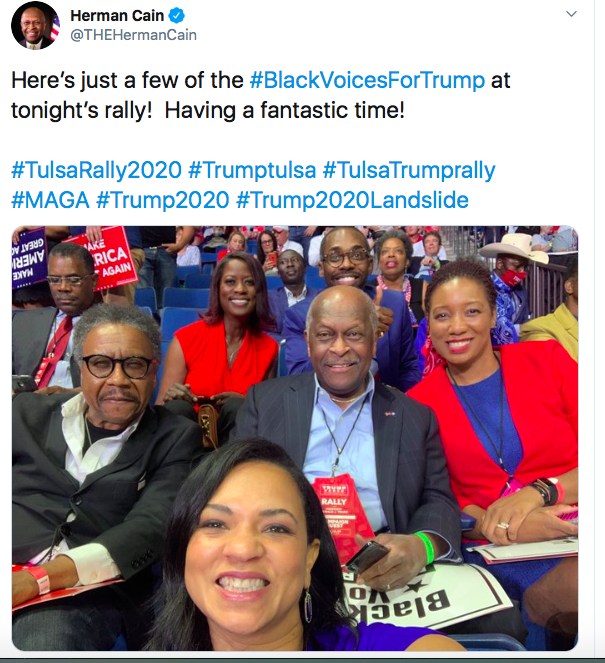
On June 20, Trump surrogate Herman Cain attended the infamous campaign rally in Tulsa where Trump’s staffers hadremoved signs previously placed on auditorium seats to create social distance among mostly unmasked audience members. Cain posted a photo on Twitter:

Less than two weeks later, he was hospitalized with COVID-19. He died on July 30.

Herman Cain was among the most enthusiastic members of Trump’s political base. But the virus is shrinking that base. In counties where deaths from the virus are increasing, voters are moving away from him. It turns out that disastrous pandemic policy is not only bad economic policy, but also bad politics.

During the 2016 campaign, Trump boasted that he could shoot someone on Fifth Avenue and his core supporters would still vote for him. Those supporters now face his ultimate loyalty test: Trump is shooting directly at them. Will they still vote for him?

Herman Cain passed Trump’s test, but along with more than 150,000 Americans who have succumbed to the Trump Virus, and thousands more to come, he won’t be voting in November.

Read all installments of Steven Harper’s Pandemic Timeline.