It’s Not MY Fault — The Governors Did It

This post first appeared at BillMoyers.com on May 18, 2020.

Trump is counting on an economic recovery to salvage his re-election prospects. So when the Centers for Disease Prevention and Control drafted detailed guidelines for reopening businesses in ways that prioritized public health, he rejected them. Instead, Trump issued broad suggestions for loosening state restrictions safely.

Trump then incited mobs to protest against stay-at-home orders, pushed governors to reopen for business immediately, and encouraged leaders to ignore even the vague suggestions he had issued. That is how Trump has set up governors to take the blame for his cascading failures — both in addressing the spread of COVID-19 and in managing the economic fallout from the uncontrolled pandemic.

The Setup

Mar. 24: Trump says he wants the country “back to work” by Easter, Apr. 12. His medical experts later persuade him to extend White House social distancing guidelines through Apr. 30.

Apr. 10: CDC Director Dr. Robert Redfield, sends the White House step-by-step instructions for use by community leaders in reopening child care programs, schools, day camps, churches, workplaces, restaurants, bars, and mass transit systems. The guidance includes decision trees and flow charts advising states when to shut facilities during expected COVID-19 flare-ups. Dr. Redfield receives no response from the White House.

Apr. 14: The International Monetary Fund warns that the world faces the worst economic downturn since the Great Depression. Amid intensifying criticism of Trump’s testing failures, COVID-19 infections in the US surpass 600,000, with more than 25,000 deaths. According to public health experts, testing remains woefully short of the level necessary to reopen the country safely.

After weeks of claiming responsibility for America’s supposedly successful COVID-19 testing,Trump tries to shift the blame for his now widely recognized failure to implement a nationwide testing program. “[T]he governors will use whatever testing is necessary. And if they’re not satisfied with their testing, they shouldn’t open,” he says. “The governors are supposed to do testing. It’s up to the governors… The governors are doing the testing.”

Apr 16: Even as governors and health officials report continuing shortages of swabs, reagents, and other materials necessary for COVID-19 testing, Trump releases his plan for the country’s phased reopening. Compared to the CDC’s proposed guidance, Trump’s plan is both vague and less restrictive. But even under his relaxed standards, no state meets the requirements — which include rigorous testing, extensive contact tracing and surveillance, and downward infection trends.

The Sting

Apr 17: The day after issuing his guidelines, Trump tweets: “LIBERATE MINNESOTA!” “LIBERATE MICHIGAN!” “LIBERATE VIRGINIA and save your great 2nd Amendment. It is under siege!” The governors of those states are Democrats. In response, armed “LIBERATE” protests erupt throughout the country.

Apr 21: Dr. Redfield tells The Washington Post, “There’s a possibility that the assault of the virus on our nation next winter will actually be even more difficult than the one we just went through.” When asked about public protests against stay-at-home orders and Trump’s call for states to be “liberated” from restrictions, Redfield says, “It’s not helpful.”

Apr. 22: Trump opens a COVID-19 press briefing with his response to Dr. Redfield’s Washington Post interview, saying, “He was totally misquoted in the media on a statement about the fall season and the virus. Totally misquoted.”

Trump then says, “You could have some embers of corona…  It may not come back at all… Now, if we have pockets — a little pocket here or there — we’re going to have to put out. It goes out and it’s going to go out fast… It’s also possible it doesn’t come back at all.

Dr. Anthony Fauci, director of the National Institute of Allergy and Infectious Diseases, says, “So, what Dr. Redfield was saying, first of all, is that we will have coronavirus in the fall. I am convinced of that…”

Apr 24: Dr. Redfield again asks senior White House officials to approve the CDC’s 63-page detailed guidance. The CDC hopes to publish its recommendations before May 1 — the day Trump targets for reopening many businesses.

Apr 26: Again Dr. Redfield receives no response.

Apr. 28: As some states lift restrictions, none has come close to Trump’s recommended guideline of a decline in COVID-19 cases over a 14-day period.

Apr 30: A Trump Administration official informs the CDC that its previously submitted detailed guidance “will never see the light of day.”

May 7: The Associated Press breaks the story that the Trump Administration has buried the CDC’s detailed guidance.

The Real Victims

May 7: As states continue to reopen, most still fail to meet even Trump’s vague guidelines. “In more than half of states easing restrictions, case counts are trending upward, positive test results are rising, or both,” according to The New York Times.

Also on May 7: Trump discusses the possibility of more COVID-19 infections as the economy reopens. A reporter notes that 20 states have partially or completely reopened without meeting Trump’s Phase 1 guidelines: “What do you say to those states that haven’t met the guidelines and are already starting that process now?”

Trump responds, “We’ve looked at all of them, and we’ve spoken to many of the governors — most of the governors. As you know, we give leeway to the governors….”

Asked if he could envision a scenario where spikes in COVID-19 infections require renewed stay-at-home restrictions, Trump says, “I hope not. I don’t think so. I think you’re going to have embers, as I say. I think you’re going to have some fires, some — maybe some fairly big fires, by comparison to what people would even think.”

May 11: The White House scrambles to deal with its own COVID-19 outbreak, which includes Trump’s personal valet and Vice President Mike Pence’s spokesperson.

Also on May 11: Like every other state, Pennsylvania has not fully met White House guidelines to reopen. But Gov. Tom Wolf (D-PA) has begun reopening his state in phases. Nevertheless, Trump tweets, “The great people of Pennsylvania want their freedom now, and they are fully aware of what that entails. The Democrats are moving slowly, all over the USA, for political purposes… Don’t play politics. Be safe, move quickly!”

Also on May 11: Dr. Fauci says that the country risks “needless suffering and death” and a setback “on our quest to return to normal” if the economy reopens too quickly.

May 12: Testifying before the Senate, Dr. Fauci warns that if states disregard guidelines for safely reopening, “There is a real risk that you will trigger an outbreak that you may not be able to control.”

Similarly, Dr. Redfield testifies, ”Rapid, extensive and widely available, timely testing is essential to reopening America.” Asked when the CDC will publish the detailed guidelines that the White House buried, Dr. Redfield says, “Soon.”

May 13: Trump says that schools should open in the fall, adding, “It’s up to the governors. It’s the governors’ choice.” He also asserts that Dr. Fauci’s warning about the danger of reopening too early is “not acceptable.”

May 14: Trump visits Allentown, Pennsylvania, where he tells his audience of factory workers that Gov. Wolf is moving too slowly, “We have to get your governor of Pennsylvania to start opening up a little bit. You have areas of Pennsylvania that are barely affected, and they want to keep them closed. Can’t do that.”

Disaster Lurks

Another wave of COVID-19 infections is on the horizon and Trump is hastening its arrival. He views human lives as “embers” in what may develop into “fairly big fires.” With his inflammatory rhetoric, Trump is stoking those fires.

Lose a loved one in the inferno? Blame the governors — they’re the ones who decided to reopen.

Read all installments of Steven Harper’s Pandemic Timeline.

UPDATED — WHERE ARE THE TESTS?

This post first appeared at BillMoyers.com on May 13, 2020 and was updated on May 17, 2020.

Pandemic Timeline: Where Are the Tests?

By June 1, more than 100,000 Americans will have died from COVID-19. Compare that to South Korea’s 262 and Australia’s 98 current fatalities, where unlike Trump, leaders quickly implemented widespread testing and tracing programs. Public health officials isolated infected individuals, traced their contacts with others, followed the potential spread of the virus, and targeted the response.

As Trump failed to implement an effective nationwide testing program, he lied about it. Now he’s shifting the burden to individual states while urging governors to “reopen” in violation of his own testing and tracing standards. Even Trump’s medical experts agree that such a blind push to resume social and economic activity is a fool’s errand.

Lies, False Promises, and Obfuscation

Mar. 6: “Anyone that wants a test gets a test,” Trump says. Politifact labels it a “Pants-on-Fire” lie.

Also on Mar. 6: Vice President Mike Pence says, “[I]n a matter of weeks, the coronavirus tests will be broadly available to the public and available to any American that is symptomatic and has a concern about — about the possibility of having contracted the coronavirus.” Not true.

When a reporter asks FDA Commissioner Stephen Hahn how many people have been tested so far, he suggests checking with the CDC. The answer that Hahn didn’t want to give is that the US has completed 2,983 US tests to date — less than two percent of the 165,000 tests conducted in South Korea, which is isolating, tracing and containing the virus.

Mar. 13: Asked if he takes responsibility for the delay in testing, Trump says, “I don’t take responsibility at all….”

Mar. 18: “If federal officials have shipped millions of tests, as you and your colleagues have said, why, as the federal government says, have only 59,000 tests been processed to this point?” a reporter asks Trump. “We just heard from the Atlanta Public Health director saying that they have fewer than 50 test kits for more than 900,000 citizens. Where are the tests?”

Trump defers to Pence, who defers to Dr. Deborah Birx. “[T]here was backlog,” she says. “There were individuals who had been tested who hadn’t had their specimen run because of the slow throughput. It’s now in a high-speed platform.” She doesn’t mention shortages of swabs and reagents required to administer the tests.

Mar. 19: A reporter asks Trump to “explain the gap” between his claim that plenty of tests are available and reports that people with symptoms can’t get tested. “Well, I can’t — I cannot explain the gap,” Trump answers. “I’m hearing very good things on the ground….”

Mar. 20: “What do you say to the Americans who are scared that they have symptoms and can’t get a test?’ a reporter asks Trump. “Yeah. Well, okay. I’m not — I’m not hearing it,” Trump says.

Mar. 21: Assistant Secretary for Health and Human Services Brett Giroir says that the government has put more than 10 million tests into the US commercial market and that by Mar. 28 more than 27 million will be available. He doesn’t reveal that shortages of swabs and reagents render the tests alone useless.

Mar. 23: A reporter tells Trump that some states report shortages of swabs and reagents: “So what is the administration doing to get all the states the materials that they need?” Trump deflects, saying that the Army Corps of Engineers is building field hospitals.

Late March: Wisconsin Gov. Tony Evers (D) requests 60,000 plastic tips to store reagents and 10,000 testing swabs from the Federal Emergency Management Agency (FEMA), which tells him that it doesn’t have enough supplies.

Shifting Blame and Pivoting to the Economy

Apr. 13-14: Worried about state governors’ stay-at-home orders hurting his re-election prospects that depend on a strong economy, Trump claims falsely that he has “total” authority to overrule the governors and reopen the country. But 24 hours later, he reverses himself. Knowing that governors lack the supplies they need, Trump shifts the burden of testing and tracing onto them:

“[T]he governors will use whatever testing is necessary. And if they’re not satisfied with their testing, they shouldn’t open… [T]he governors are supposed to do testing. It’s up to the governors… The governors are doing the testing. It’s now not up — and it hasn’t been up — to the federal government.”

Apr. 15: Governors and health officials report continuing shortages of swabs, reagents, and other materials necessary for COVID-19 tests.

Apr. 16: Trump announces his plan for the country’s phased reopening, which requires states to have rigorous testing and tracing in place before loosening restrictions.

Apr. 17: Trump tweets: “LIBERATE MINNESOTA!” “LIBERATE MICHIGAN!” “LIBERATE VIRGINIA and save your great 2nd Amendment. It is under siege!” “LIBERATE” protests begin throughout the country.

Also on Apr. 17: “The governors are responsible for testing,” Trump reiterates. “Swabs can be done easily by the governors themselves. Mostly, it’s cotton. It’s not a big deal. You can get cotton easily.”

Apr. 20: The US is conducting only about 150,000 tests per day. But a Harvard panel of health experts concludes that reopening the country safely requires at least five million tests per day by early June, increasing to 20 million tests daily by mid-summer.

Also on Apr. 20: A reporter reminds Trump that on Mar. 21, Giroir promised 27 million tests by the end of March, but so far only four million people have been tested: “So where are the other 23 million or so tests?”

Giroir answers that more than 40 million tests are “in the marketplace,” but there has been a shortage of swabs. “And as simple as a swab is: A swab is not a swab is not a swab,” he says. “And we need to be very careful that when we put something in a person and tell them a test result, that it’s really correct.”

Apr. 21: Pence visits Wisconsin to tout Trump’s response to the pandemic. Of the 60,000 plastic tips that the state had requested from FEMA in late March for COVID-19 testing, it has received only 2,800. Of the 10,000 testing swabs the state requested, it has received only 3,500.

Truth Revealed

Apr. 27: The US is conducting about 200,000 tests per day. A reporter reminds Pence of his promise that the US would have completed four million total tests by mid-March and we “just now got there in the last few days.” What went wrong?

“I appreciate the question,” Pence says, “but it represents a misunderstanding on your part and the — and frankly, the — a lot of people in the public’s part about the difference between having a test versus the ability to actually process the test.” [Emphasis supplied]

The reporter presses, “So when you said four million tests, seven weeks ago, you were just talking about tests being sent out, not actually being — being completed?”

“[P]recisely correct,” Pence answers without missing a beat.

Apr. 28: Responding to the Harvard panel’s recommendation that the US needs five million tests per day to reopen safely in June and 20 million daily by September, Giroir tells Time, there is “absolutely no way on Earth, on this planet or any other planet, that we can do 20 million tests a day, or even five million tests a day.”

At a press briefing later that day, a reporter asks Trump about the five million-per-day testing benchmark: “[C]an you get to that benchmark?” Without explanation, Trump contradicts Giroir, saying, “Well, it will increase it and it’ll increase it by much more than that [five million] in the very near future. 

Apr. 30: Congress’ attending physician tells senior Republican officials that he has insufficient capacity to test all 100 senators for COVID-19 when they return to work on May 4. Tests will be available only for staffers and senators who are ill, even though asymptomatic individuals can infect others.

Apr. 30: Dr. Anthony Fauci, a member of Trump’s COVID-19 task force, warns that states reopening without adequate testing and tracing will suffer outbreaks. Meanwhile, Trump pressures governors to reopen states and encourages protesters to push in that direction.

May 4: An epidemiological model cited frequently by the White House updates its projections. Incorporating rising mobility in most states, as well as the easing of social distancing measures expected in 31 states by May 11, it doubles the number of expected US COVID-19 deaths to nearly 135,000 by early August.

May 6: The US is conducting about 250,000 tests per day. Asked if reopening the country will increase COVID-19 deaths, Trump says, “It could very well be the case.” With respect to testing, he says, “If we did very little testing, we wouldn’t have the most cases. So, in a way, by doing all of this testing, we make ourselves look bad.”

May 7: The White House acknowledges that one of Trump’s personal valets has tested positive for COVID-19. Hours later, it announces that Trump and everyone who comes into contact with him will be tested daily. Shortly thereafter, Trump says that testing for the virus is “somewhat overrated.”

May 11: During a Rose Garden briefing, Trump says, “We’ve prevailed on testing.” Two large posters behind him proclaim falsely, “AMERICA LEADS THE WORLD IN TESTING.” Although the US has the performed highest raw number of COVID-19 tests, more than 30 other nations are ahead in per capita testing.

May 14: Speaking at an event in Allentown, Pennsylvania, Trump says, “We have more cases than anybody in the world. But why? Because we do more testing. When you test, you have a case. When you test, you find something is wrong with people. If we didn’t do any testing, we would have very few cases.”

May 15: Dr. Robert Redfield, director of the CDC, says that forecasting models now predict that total US deaths from COVID-19 will surpass 100,000 by June 1.

As Trump lies and dissembles, remember this fact: The US has only 4 percent of the world’s population. Yet it has one-third of worldwide COVID-19 infections and more than 25 percentof resulting deaths — so far. The US ranks among the top ten nations in most deaths per million of population.

Trump can’t make us look any worse than he already has.


Read all installments of Steven Harper’s Pandemic Timeline.

WHERE ARE THE TESTS?

This post first appeared at BillMoyers.com on May 13, 2020.

By June 1. more than 100,000 Americans will have died from COVID-19. Compare that to South Korea’s 260 and Australia’s 98 current fatalities, where unlike Trump, leaders quickly implemented widespread testing and tracing programs. Public health officials isolated infected individuals, traced their contacts with others, followed the potential spread of the virus, and targeted the response.

As Trump failed to implement an effective nationwide testing program, he lied about it. Now he’s shifting the burden to individual states while urging governors to “reopen” in violation of his own testing and tracing standards. Even Trump’s medical experts agree that such a blind push to resume social and economic activity is a fool’s errand.

Lies, False Promises, and Obfuscation

Mar. 6: “Anyone that wants a test gets a test,” Trump says. Politifact labels it a “Pants-on-Fire” lie.

Also on Mar. 6: Vice President Mike Pence says, “[I]n a matter of weeks, the coronavirus tests will be broadly available to the public and available to any American that is symptomatic and has a concern about — about the possibility of having contracted the coronavirus.” Not true.

When a reporter asks FDA Commissioner Stephen Hahn how many people have been tested so far, he suggests checking with the CDC. The answer that Hahn didn’t want to give is that the US has completed 2,983 US tests to date — less than two percent of the 165,000 tests conducted in South Korea, which is isolating, tracing and containing the virus.

Mar. 13: Asked if he takes responsibility for the delay in testing, Trump says, “I don’t take responsibility at all….”

Mar. 18: “If federal officials have shipped millions of tests, as you and your colleagues have said, why, as the federal government says, have only 59,000 tests been processed to this point?” a reporter asks Trump. “We just heard from the Atlanta Public Health director saying that they have fewer than 50 test kits for more than 900,000 citizens. Where are the tests?”

Trump defers to Pence, who defers to Dr. Deborah Birx. “[T]here was backlog,” she says. “There were individuals who had been tested who hadn’t had their specimen run because of the slow throughput. It’s now in a high-speed platform.” She doesn’t mention shortages of swabs and reagents required to administer the tests.

Mar. 19: A reporter asks Trump to “explain the gap” between his claim that plenty of tests are available and reports that people with symptoms can’t get tested. “Well, I can’t — I cannot explain the gap,” Trump answers. “I’m hearing very good things on the ground….”

Mar. 20: “What do you say to the Americans who are scared that they have symptoms and can’t get a test?” a reporter asks Trump. “Yeah. Well, okay. I’m not — I’m not hearing it,” Trump says.

Mar. 21: Assistant Secretary for Health and Human Services Brett Giroir says that the government has put more than 10 million tests into the US commercial market and that by Mar. 28 more than 27 million will be available. He doesn’t reveal that shortages of swabs and reagents render the tests alone useless.

Mar. 23: A reporter tells Trump that some states report shortages of swabs and reagents: “So what is the administration doing to get all the states the materials that they need?” Trump deflects, saying that the Army Corps of Engineers is building field hospitals.

Late March: Wisconsin Gov. Tony Evers (D) requests 60,000 plastic tips to store reagents and 10,000 testing swabs from the Federal Emergency Management Agency (FEMA), which tells him that it doesn’t have enough supplies.

Shifting Blame and Pivoting to the Economy

Apr. 13-14: Worried about state governors’ stay-at-home orders hurting his re-election prospects that depend on a strong economy, Trump claims falsely that he has “total” authority to overrule the governors and reopen the country. But 24 hours later, he reverses himself. Knowing that governors lack the supplies they need, Trump shifts the burden of testing and tracing onto them:

“[T]he governors will use whatever testing is necessary. And if they’re not satisfied with their testing, they shouldn’t open… [T]he governors are supposed to do testing. It’s up to the governors… The governors are doing the testing. It’s now not up — and it hasn’t been up — to the federal government.”

Apr. 15: Governors and health officials report continuing shortages of swabs, reagents, and other materials necessary for COVID-19 tests.

Apr. 16: Trump announces his plan for the country’s phased reopening, which requires states to have rigorous testing and tracing in place before loosening restrictions.

Apr. 17: Trump tweets: “LIBERATE MINNESOTA!” “LIBERATE MICHIGAN!” “LIBERATE VIRGINIA and save your great 2nd Amendment. It is under siege!” “LIBERATE” protests begin throughout the country.

Also on Apr. 17: “The governors are responsible for testing,” Trump reiterates. “Swabs can be done easily by the governors themselves. Mostly, it’s cotton. It’s not a big deal. You can get cotton easily.”

Apr. 20: The US is conducting only about 150,000 tests per day. But a Harvard panel of health experts concludes that reopening the country safely requires at least five million tests per day by early June, increasing to 20 million tests daily by mid-summer.

Also on Apr. 20: A reporter reminds Trump that on Mar. 21, Giroir promised 27 million tests by the end of March, but so far only four million people have been tested: “So where are the other 23 million or so tests?”

Giroir answers that more than 40 million tests are “in the marketplace,” but there has been a shortage of swabs. “And as simple as a swab is: A swab is not a swab is not a swab,” he says. “And we need to be very careful that when we put something in a person and tell them a test result, that it’s really correct.”

Apr. 21: Pence visits Wisconsin to tout Trump’s response to the pandemic. Of the 60,000 plastic tips that the state had requested from FEMA in late March for COVID-19 testing, it has received only 2,800. Of the 10,000 testing swabs the state requested, it has received only 3,500.

Truth Revealed

Apr. 27: The US is conducting about 200,000 tests per day. A reporter reminds Pence of his promise that the US would have completed four million total tests by mid-March and we “just now got there in the last few days.” What went wrong?

“I appreciate the question,” Pence says, “but it represents a misunderstanding on your part and the — and frankly, the — a lot of people in the public’s part about the difference between having a test versus the ability to actually process the test.” [Emphasis supplied]

The reporter presses, “So when you said four million tests, seven weeks ago, you were just talking about tests being sent out, not actually being — being completed?”

“[P]recisely correct,” Pence answers without missing a beat.

Apr. 28: Responding to the Harvard panel’s recommendation that the US needs five million tests per day to reopen safely in June and 20 million daily by September, Giroir tells Time, there is “absolutely no way on Earth, on this planet or any other planet, that we can do 20 million tests a day, or even five million tests a day.”

At a press briefing later that day, a reporter asks Trump about the five million-per-day testing benchmark: “[C]an you get to that benchmark?” Without explanation, Trump contradicts Giroir, saying, “Well, it will increase it and it’ll increase it by much more than that [five million] in the very near future. 

Apr. 30: Congress’ attending physician tells senior Republican officials that he has insufficient capacity to test all 100 senators for COVID-19 when they return to work on May 4. Tests will be available only for staffers and senators who are ill, even though asymptomatic individuals can infect others.

Apr. 30: Dr. Anthony Fauci, a member of Trump’s COVID-19 task force, warns that states reopening without adequate testing and tracing will suffer outbreaks. Meanwhile, Trump pressures governors to reopen states and encourages protesters to push in that direction.

May 4: An epidemiological model cited frequently by the White House updates its projections. Incorporating rising mobility in most states, as well as the easing of social distancing measures expected in 31 states by May 11, it doubles the number of expected US COVID-19 deaths to nearly 135,000 by early August.

May 6: The US is conducting about 250,000 tests per day. Asked if reopening the country will increase COVID-19 deaths, Trump says, “It could very well be the case.” With respect to testing, he says, “If we did very little testing, we wouldn’t have the most cases. So, in a way, by doing all of this testing, we make ourselves look bad.”

As Trump lies and dissembles, remember this fact: The US has only 4 percent of the world’s population. Yet it has one-third of worldwide COVID-19 infections and more than 25 percent of resulting deaths — so far. The US ranks among the top ten nations in most deaths per million of population.

Trump can’t make us look any worse than he already has.

Read all installments of Steven Harper’s Pandemic Timeline.

TRUMP AND HIS TRAVEL BANS

This post first appeared at BillMoyers.com on May 5, 2020.

With only 4 percent of the world’s population, the US has almost one-third of all reported COVID-19 cases and more than 25 percent of resulting deaths. In just two months, more than 60,000 Americans have lost their lives to the virus, surpassing the total number of military fatalities during the nearly two decades-long Vietnam War.

Those are unambiguous metrics of failure. Whenever pressed on why he didn’t do more to protect the country sooner, Trump reverts to a false talking point — that he was “the first one” to “close off China,” thereby saving “hundreds of thousands” of lives. Trump tells similar lies about later restrictions on travelers from Europe.

The pandemic is not Trump’s fault. Responsibility for America’s failure to respond quickly to the crisis falls squarely on his shoulders. Here are the facts.

January: Trump Ignores Warnings

Jan. 3, 2020: The director of the Centers for Disease Control and Prevention warns Health and Human Services Secretary Alex Azar about a novel coronavirus outbreak in Wuhan. Azar tells his chief of staff to notify Trump’s National Security Council that it’s a very big deal.

Early January: In the first of more than a dozen classified briefings through February, the President’s Daily Brief of Intelligence Matters warns Trump about the dire health and economic dangers that the virus poses.

Jan. 9: Trump holds a campaign rally in Toledo, Ohio

Jan. 14: Trump holds a campaign rally in Milwaukee, Wisconsin.

Jan. 18: Trump plays golf at his club in West Palm Beach. Azar has spent weeks trying to warn Trump personally about the virus and finally gets a call through to him there. Trump interrupts the conversation to criticize Azar’s handling of an aborted federal ban on vaping products.

Jan. 21: The CDC confirms America’s first case of COVID-19 in Washington State. On Jan. 24, it confirms a second case in Illinois.

Jan. 22: “We have it totally under control,” Trump says of the virus. “It’s one person coming in from China, and we have it under control. It’s going to be just fine.”

Jan. 24: The Marshall Islands becomes the first country to issue restrictions on travelers from China, requiring them spend at least 14 days in a country not affected by the virus before entering.

Jan. 27: Hong Kong bans Hubei residents, as well those who have visited that province (which includes Wuhan) within the past 14 days.

Jan. 28: Trump holds a campaign rally in Wildwood, New Jersey.

Jan. 29: Papau New Guinea bans travelers from Wuhan, as well as anyone who has been to China in the past 14 days who doesn’t undergo a medical check. Singapore bans foreign nationals who have traveled to China within the past 14 days and suspends visas for passport holders from China.

Jan. 30: Trump holds a campaign rally in Des Moines, Iowa.

The WHO declares COVID-19 a global health emergency, noting that there are now 98 cases in 18 countries outside of China, including cases of human-to-human transmission in Germany, Japan, Vietnam and the US. It urges all countries to “review preparedness plans, identify gaps and evaluate the resources needed to identify, isolate and care for cases, and prevent transmission.”

Other nations implement China travel restrictions, including: Afghanistan, the Bahamas, Maldives, North Korea, Rwanda, Tajikistan, and Trinidad and Tobago.

Jan. 31: Trump announces China travel restrictions, which he calls a “ban.” But 11 exceptions allow travel to continue between the US from China. Also, since Jan. 1, almost 400,000 passengers have already arrived in the US on unrestricted direct flights from China. 

Trump later claims repeatedly and falsely that he “was the first” to ban travelers from China. But by the time his restrictions become effective on Feb. 2, more than 20 other countries have implemented limitations that are at least as stringent as Trump’s, including the following nations on Jan. 31: Antigua and Barbuda, Brunei, Cook Islands, El Salvador, Guatemala, Guyana, Iran, Italy, Jamaica, Kiribati, Micronesia, Morocco, Philippines, Solomon Islands.

February: Too Little, Too Late 

Feb. 1: As Trump plays golf at his club in West Palm Beach, more countries implement China travel restrictions effective Feb. 1: Armenia, Australia, Egypt, Kyrgyzstan, Palau, St. Kitts and Nevis, Turkmenistan, Uzbekistan, Vietnam.

Feb. 2: Trump’s China travel restrictions become effective at 5:00 pm EST. Trump declares falsely, “Well, we pretty much shut it [COVID-19] down coming in from China.”

Feb. 2 to Apr. 4: Nearly 40,000 additional passengers arrive in the US on direct flights from China.

Feb 10: Trump holds a campaign rally in Manchester, New Hampshire, where he says, “Looks like by April, you know, in theory, when it gets a little warmer, [the coronavirus] miraculously goes away.”

Feb. 15: Trump plays golf at his club in West Palm Beach.

Feb. 19: Trump holds campaign rally in Phoenix, Arizona.

Feb. 20: Trump holds a campaign rally in Colorado Springs, Colorado.

Feb. 21: Trump holds a campaign rally in Las Vegas, Nevada.

Feb. 25: Nancy Messonnier, a senior CDC official, tells reporters that COVID-19 is likely to spread within US communities and that disruptions to daily life could be “severe.” Returning from a trip to India, Trump calls Azar to complain that Messonnier is scaring the stock markets and threatens to oust her.

Feb. 27: “It’s going to disappear,” Trump says. “One day it’s like a miracle, it will disappear.”

Feb. 28: Trump holds a campaign rally in Charleston, SC, where he says that concerns about his handling of the growing COVID-19 crisis is the Democrats’ “new hoax.”

March: Trump Creates Chaos at International Airports

If Trump had taken the pandemic seriously and instituted a comprehensive testing and contact-tracing program, he would have learned that the first COVID-19 cases in New York City — the worst global epicenter of the pandemic — originated in Europe, not China. Because Trump rejected the advice of senior advisers pushing him to close air travel from Europe, the virus reached NYC in February.

Mar. 2: Trump holds a campaign rally in Charlotte, NC. Asked if he has any qualms about attending a large stadium rally in light of the COVID-19 threat, he says, “I think it’s very safe.” 

Mar. 7-8: Trump plays golf at his club in West Palm Beach.

Mar. 10: Trump says, “It will go away, just stay calm. It will go away.”

Mar. 11: Trump announces restrictions on travelers from Europe, but they’re riddled with exceptions and don’t become effective until Mar. 14.

Mar. 13: “Europe was just designated as the hotspot right now, and we closed that border a while ago,” Trump says, although the border remains open and the restrictions he issued two days earlier are not yet in effect. 

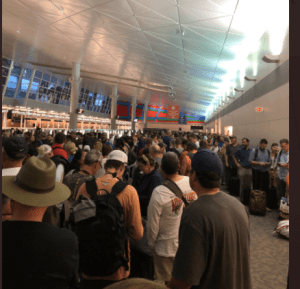
Mar. 14: Trump’s latest restrictions go into effect. But his surprise announcement blindsides European allies, as well as the US Department of Homeland Security, both of which are unprepared for the resulting chaos. Passengers returning to America are funneled through 13 US airports, including JFK, O’Hare, and Dallas/Ft. Worth, where they stand for hours in overcrowded lines, awaiting inconsistent, superficial, and sometimes non-existent health screenings from untrained US customs officers.

Here’s the scene at O’Hare:

https://twitter.com/BrookeGMcDonald/status/1238986272137502720

At JFK:

https://twitter.com/vjake20/status/1239001781243457542

And at DFW:

https://twitter.com/holajefe/status/1238974763503996928

Arriving passengers proceed from customs to their final destinations, often via public transportation or connecting flights. They take with them whatever COVID-19 virus they acquired while waiting in line with thousands of fellow passengers.

Trump Rewrites History

Mar. 31: “[W]e stopped China… But we also stopped Europe very shortly thereafter,” Trump says falsely. “[W]e stopped China really early, and we stopped Europe really early.”

Apr. 20: Trump lies again about the travel restrictions: “[I]n January… we put on a ban of [sic] China, where China can’t come in. And before March, we put on a ban on Europe, where Europe can’t come in. So how could you say I wasn’t taking it seriously?”

When a reporter presses Trump about his campaign rallies in February and March, he doubles down:

“But — no, no,” Trump answers, “Wait. But you can’t say this. Look, I put on a ban. In other words, I stopped China from coming to the United States. I stopped Europe from coming into the United States, long before the March date that you’re talking about. So people should say I acted very early.”

It’s a lie.

Then on Apr. 29, Jared Kushner appears on Fox & Friends and says, “The federal government rose to the challenge, and this is a great success story.”

The more than 65,000 US COVID-19 fatalities, their survivors, and their friends know that’s the biggest lie of all. Sadly, their ranks are growing.

Read all installments of Steven Harper’s Pandemic Timeline.