PANDEMIC TIMELINE: PAGING DR. TRUMP?

The Pandemic Timeline page at BillMoyers.com collects all installments in this series here.

When Trump Plays Doctor, People Die

For years, Trump failed to prepare America for a pandemic. For months after COVID-19 emerged, he downplayed its danger. Now he’s touting a dubious miracle cure.

Facing relentless criticism amid mounting deaths, Trump has been telling first responders, doctors, nurses and the public that hydroxychloroquine and chloroquine will keep them from contracting COVID-19 — something that no infectious disease expert has ever suggested.

“What do you have to lose?” he asks repeatedly.

Trump’s COVID-19 Briefings: A Public Health Menace

Mar. 19, 2020: At a press briefing, Trump says that hydroxychloroquine and chloroquine — drugs that successfully treat malaria, lupus, and rheumatoid arthritis — have been approved by the Food and Drug Administration to treat COVID-19. That’s false. He adds, “The nice part is, it’s been around for a long time, so we know that if it — if things don’t go as planned, it’s not going to kill anybody.” Also false.

FDA Commissioner Stephen Hahn corrects Trump, saying that clinical trials are required to determine whether the drugs are safe and effective in treating COVID-19. Otherwise, it’s impossible to know whether they are better, the same, or worse than doing nothing at all.

Mar. 19-20: In response to Trump’s misinformation, demand for the drugs surges, creating shortages for lupus and rheumatoid arthritis patients who need it.

Mar. 20: A controversial French expert in infectious diseases, Dr. Didier Raoult, publishes his study on the use of hydroxychloroquine combined with azithromycin to treat 26 infected COVID-19 patients. Four (15%) actually got worse: three were transferred to the ICU and one died on the third day of treatment. The study notes the limitations of his work: “a small sample size, limited long-term outcome follow-up, and a dropout of six patients from the study.”

Mar. 20: At a press briefing, Trump continues to promote hydroxychloroquine. Asked whether it is effective for treating COVID-19, Dr. Anthony Fauci, the head of the National Institute of Allergy and Infectious Diseases, responds bluntly: “The answer is no, and the evidence that you’re talking about … is anecdotal evidence.”

Mar. 21: Citing Dr. Raoult’s publication, Trump tweets: “HYDROXYCHLOROQUINE & AZITHROMYCIN, taken together, have a real chance to be one of the biggest game changers in the history of medicine…. Hopefully they will BOTH (H works better with A, International Journal of Antimicrobial Agents) be put in use IMMEDIATELY. PEOPLE ARE DYING, MOVE FAST.”

Mar. 23: An otherwise healthy Arizona man dies and his wife is hospitalized in critical condition after drinking a small amount of veterinary chloroquine phosphate. Concerned about catching COVID-19, they recognized the name “chloroquine” from Trump’s press briefings and took it based solely on his recommendation.

Mar. 24: Nationwide shortages of hydroxychloroquine and chloroquine worsen as doctors hoard the drugs by prescribing them to themselves and family members, ProPublica reports.

Mar. 25: The head of the Mayo Clinic’s Sudden Death Genomics Lab issues public guidance to physicians warning that some patients taking hydroxychloroquine as an experimental COVID-19 treatment are at increased risk for sudden cardiac death.

Mar. 28: Trying to replicate Dr. Raoult’s study, French infectious disease experts apply his protocol to 11 patients: one dies, two are transferred to the ICU and a fourth patient suffers adverse cardiac effects requiring discontinuation of the drugs. The study finds no evidence of a clinical benefit in using hydroxychloroquine and azithromycin to treat patients with severe COVID-19.

Mar. 28: The FDA authorizes emergency use of hydroxychloroquine and chloroquine, allowing doctors to prescribe them on a limited basis to certain COVID-19 patients. But the FDA emphasizes that the untested drugs have not been approved for general use to treat the virus.

Mar. 30: At a press briefing, Trump again touts hydroxychloroquine and chloroquine as COVID-19 treatments.

Mar. 31: “[D]ue to a significant surge in demand,” the FDA adds hydroxychloroquine and chloroquine to its drug shortages list.

Apr. 3: The International Society of Antimicrobial Chemotherapy — publisher of the medical journal where Dr. Raoult’s study appeared — issues an unusual statement expressing “concerns” that the study “does not meet the Society’s expected standard, especially relating to the lack of better explanations of the inclusion criteria and the triage of patients to ensure patient safety.”

Apr. 4: During a meeting in the White House Situation Room, Trump’s trade adviser Peter Navarro says that studies of hydroxychloroquine and chloroquine show “clear therapeutic efficacy.” Dr. Fauci disagrees, saying that the evidence is only anecdotal. Navarro raises his voice, and Jared Kushner turns to him saying, “Peter, take yes for an answer.”

At a later press briefing, Trump says he is placing millions of doses of hydroxychloroquine in the federal stockpile of emergency supplies. Asserting that he might take the drug himself, he adds, “What do you have to lose? Take it. I really think they should take it. But it’s their choice. And it’s their doctor’s choice or the doctors in the hospital. But hydroxychloroquine. Try it, if you’d like.”

Apr. 5: No medical evidence supports using hydroxychloroquine to prevent COVID-19. Nevertheless, Trump suggests that doctors, nurses, first responders, and medical personnel going into hospitals should take the drug prophylactically. Again he says, “What do you have to lose?”

Although the FDA has not approved the drug for general use in treating COVID-19, Trump also repeats his earlier lie that “[the FDA] gave it rapid approval.” When a reporter asks Dr. Fauci about the drug’s effectiveness, Trump interrupts and physically interposes himself between the doctor and the microphone before he can answer.

Also on Apr. 5: Responding to Trump’s question —“What do you have to lose?” — the president of the American Medical Association tells CNN, “You could lose your life.”

Apr. 6: Following reports that the drug is causing severe adverse side effects, including seizures and vision loss, several hospitals in Sweden stop administering chloroquine to COVID-19 patients.

Also on Apr. 6: At a press briefing, a reporter asks Trump if there is a system in place to track the side effects of hydroxychloroquine. Trump answers, again falsely, “The side effects are the least of it. You have people dying all over the place. And generally, the side effects are really with the Z-Pak having to do with the heart. The Z-Pak — that’s the antibiotic. Not with the hydroxychloroquine… And I say, ‘Try it.’”

Apr. 7: The head of cardiology at Nice University Hospital in France says he restricted treating patients with hydroxychloroquine combined with azithromycin because of side efffects including heart issues.

Apr. 8: At a press briefing, Trump continues pushing hydroxychloroquine and azithromycin as COVID-19 treatments saying, “[Z]inc — they say zinc — they say you should add zinc.”

Apr. 12: A study in Brazil is halted early for safety reasons after COVID-19 patients taking higher doses of chloroquine develop irregular heart rates that increased their risk of a potentially fatal heart arrhythmia. Of 81 patients in the study, 11 (14%) died by the sixth day of treatment.

Apr. 14: Medical researchers in China publish a study of 150 patients, concluding that hydroxychloroquine does not help outcomes and produces adverse side effects in some patients.

Also on Apr. 14: Medical researchers publish a study involving 181 COVID-19 patients in four French hospitals, 84 of whom received hydroxychloroquine within 48 hours of admission. The drug did not significantly reduce transfers to the ICU or death.

Apr. 21: A study of 368 patients in VA hospitals “finds no evidence that use of hydroxychloroquine, either with or without azithromycin, reduced the risk of mechanical ventilation in patients hospitalized with COVID-19. An association of increased overall mortality was identified in patients treated with hydroxycholoroquine alone.”

Also on Apr. 21: A panel of experts convened by the National Institute of Allergy and Infectious Diseases (NIH) that Dr. Anthony Fauci directs recommends against using a combination of hydroxychloroquine and azithromycin to treat COVID-19 patients because of potential adverse heart effects. The panel says that there is “insufficient clinical data to recommend either for or against.”

Apr. 23:  Undeterred by the growing body of medical evidence against hydroxychloroquine as a viable treatment for COVID-19, the president seeks another miracle cure. In a coronavirus task force briefing President Trump suggests that powerful light brought inside the body could combat the virus.The president goes on to say that ingesting disinfectant could be a possible magic bullet: “[D]isinfectant, where it knocks it out in a minute. One minute. And is there a way we can do something like that, by injection inside or almost a cleaning. Because you see it gets in the lungs and it does a tremendous number on the lungs. So it would be interesting to check that.”

Apr. 24: The FDA “cautions against the use of hydroxychloroquine or chloroquine for COVID-19 outside of the hospital setting or a clinical trial due to risk of heart rhythm problems.” It notes the increased use of the drugs through outpatient prescriptions and reminds health care professionals and patients of the known risks associated with the drugs, which “have not been shown to be safe and effective for treating or preventing COVID-19.”

Industry members. including Lysol, issue warnings and doctors around the world are quick to contradict the president’s suggestions.

What Do You Have to Lose?

Your health, your eyesight, your life, and the wellbeing of chronically ill fellow citizens who need hydroxychloroquine and chloroquine to survive. That’s what you have to lose.

Here are links to: Part I, Part II, Part III, and Part IV of this series on Trump’s Lies and Deceptions. An earlier background piece is here.
PANDEMIC TIMELINE: FUDGING THE NUMBERS

This post first appeared at BillMoyers.com on Apr. 16, 2020.

Here are links to Part I, Part II, and Part III of this series. An earlier background piece is here.

Trump’s Lies and Deceptions: Pandemic Timeline Part IV

The lack of early widespread testing for COVID-19 not only crippled America’s response to the virus, but also contributed to a vast undercounting of the resulting infections and deaths. That’s fine with Trump.

Understating the actual US numbers helps Trump in two ways: It masks the magnitude of his failures, and it aids his current effort to convince Americans that he can “reopen the economy” without a comprehensive testing program that would reveal the virus’ continuing danger to public health.

Fewer Tests Given = Fewer Cases Confirmed = Fewer Deaths Counted

Jan. 20, 2020: On the same day, the US and South Korea confirm their first cases of COVID-19. Immediately, South Korea ramps up an aggressive testing and contact-tracing program.

For the next six weeks, the US does virtually no testing as Trump ignores repeated warnings from his advisers and tells the public that the virus is under control.

Mar. 6: The Grand Princess cruise ship remains in limbo off the San Francisco coast. Trump says he doesn’t want infected passengers taken off the ship because it will raise the total case count in the US:

“I like the numbers being where they are. I don’t need to have the numbers double because of one ship that wasn’t our fault.”

Total US tests to date: 1,982 [Note: Data was updated after original submission]

Total South Korea tests to date: 164,740

Mar. 24: As expected, the number of confirmed cases in the US increases as testing increases:

Total US tests to date: 353,809 [Updated data]

Total US confirmed cases: 57, 224 (16% positive)

Data show that South Korea’s widespread early testing and contact-tracing efforts are working:

Total S. Korea tests to date: 348, 582 (more than six times the US per capita rate)

Total S. Korea confirmed cases: 9,037 (3% positive)

Apr. 3: As the number of US deaths surpasses 7,000, the CDC issues new guidance that a laboratory test should be used to confirm COVID-19 as the cause of death. If the deceased wasn’t tested prior to death, “it is acceptable to report COVID–19 on a death certificate without this confirmation if the circumstances are compelling within a reasonable degree of certainty.” Despite this high standard, the death toll continues to rise.

Apr. 5: Even as the total number of reported US deaths from COVID-19 more than doubles in one week to exceed 9,500, a CDC spokesperson admits, “We know that it is an underestimation.” 

The undercounting of US COVID-19 deaths results directly from early and ongoing testing and case-tracing failures:

  • Prior to late March, many deaths were reported incorrectly as influenza, pneumonia, or respiratory illness because tests weren’t available.
  • Although the CDC recommends the use of a positive COVID-19 test to confirm cause of death, the tests have been in short supply so they’re not wasted on the deceased.
  • From its first COVID-19 death on Mar. 14 and continuing through Apr. 13, New York City’s official total included only victims who had a tested positively while they were still alive.

On Apr. 14, NYC added 3,778 victims to its death toll who were presumed to have died from the virus but had never been tested — raising the city’s total COVID-19 deaths from 6,589 to 10,367.

  • In NYC alone, the outbreak may have contributed to another 3,000 “excess deaths” (compared to the same period in prior years), including individuals who died because COVID-19 cases overwhelmed the city’s health care system and crowded out treatment for other serious conditions.
  • Many untested individuals are dying in long-term senior care facilities and some states don’t track those deaths at all.
  • Hospital data drive the official COVID-19 death counts. But at-home deaths have also spiked dramatically in many places. Experts believe that the virus is a contributor, as many people who later died of the disease were “presumed positive” patients sent home to shelter in place.
  • Researchers estimate that the COVID-19 test has a false negative rate of 15 to 30 percent. Those infected patients (and their doctors) mistakenly believe they don’t have the virus. When such individuals later die from the disease, often they don’t count as COVID-19 deaths.

Apr. 7: Asked about recent media reports on the undercounting of COVID-19 deaths, Trump says, “[T[he death counts, I think they’re very, very accurate,” adding, “I do say this: I think if you look at China and if you look at some of these very large countries, when you talk about cases — number of cases — I would be willing to bet they have more cases than we do, but they don’t do the testing like we do.”

Apr. 9: Asked whether the US needs an expanded nationwide COVID-19 testing program before the economy can restart, Trump says, “We want to have it and we’re going to see if we have it. Do you need it? No. Is it a nice thing to do? Yes.”

Apr. 10: On a per capita basis, US testing still lags far behind other countries, including South Korea and Italy. But at a press briefing, Trump says, “We’re leading the world now in testing, by far, and we’re going to keep it that way.”

A reporter asks Trump how Americans will know that the virus has been defeated without a comprehensive nationwide testing and contact-tracing program. “We’ll know because people aren’t going to go to the hospital, people aren’t going to get sick,” he says. “[Y]ou’re going to see nobody’s getting sick anymore. It will be gone, and it won’t be that much longer.”

Apr. 15: Asked why the US has 20 percent of the world’s COVID-19 deaths but only four percent of the world’s population, Trump suggests that other countries aren’t reporting all deaths, saying, “We report everything. We’re reporting the cases, and our reporting is good. We’re reporting every death… We have more cases because we do more reporting.”

Public Health: Numbers Matter Only When They Drive Policy

Trump’s former FDA Commissioner Scott Gottlieb and a team of experts have estimated that the US must perform a minimum of 750,000 tests per day and create the medical infrastructure necessary to provide same-day results. Only then can the country trace infected individuals and move safely away from community-wide interventions (i.e. stay-at-home orders) to a case-based approach. Currently, the US averages fewer than 150,000 tests per day and obtaining results can take a week or more.

The US also requires 100,000 contact tracers to follow up on confirmed cases. In early April, Massachusetts became the first state to launch such a program, which will employ 1,000 tracers. San Francisco announced its pilot program on Apr. 15.

Trump: “We have to get our country open.”

Question: “Will you say, sir, what metrics you will use to make that decision?”

Trump: “The metric’s right here.” [Points to head] “The metric’s right here. That’s my metric.”

Trump is lying about his testing failure. He’s lying about the tragic consequences of that failure as measured in infections and deaths. And he’s lying that he can “reopen the economy” safely without an adequate testing and contact-tracing regime in place.

Americans will keep paying for his lies with their lives.

Here are links to: Part I, Part II, and Part III of this series on Trump’s Lies and Deceptions. An earlier background piece is here.

PANDEMIC: THE OBAMA BLAME GAME

This post first appeared at BillMoyers.com on Apr. 16, 2020.

Pandemic Timeline III

Trump claims that no one could have expected the COVID-19 outbreak and that President Obama is responsible for the “obsolete, broken system” of pandemic response — “the empty shelf” — that Trump inherited.

Here are the facts that refute both lies simultaneously.

Were There Warnings About the Threat of a Global Pandemic?

Jan. 13, 2017: A week before the inauguration, at least 30 members of Trump’s transition team attend a briefing where top Obama administration officials describe an exercise simulating what could be the worst global flu pandemic since 1918. Obama’s homeland security adviser Lisa Monaco and her incoming counterpart, Tom Bossert, lead the discussion.

In the simulation, the virus quickly overwhelms medical systems across parts of Asia. Experts anticipate that its arrival in the US will produce global shortages of key medical resources, including personal protective equipment for medical workers and ventilators.

Among the key lessons:

  • Bringing decision-makers to the table early is paramount — collective understanding of the science and the disease must drive response decisions
  • Transportation and containment issues are a key concern
  • A coordinated, unified national response and message is paramount
  • In a pandemic response scenario, days — and even hours — can matter

Inauguration Day, Jan. 20, 2017: Trump inherits the National Security Council’s global health security office — the pandemic response team — that Obama had created after the 2014-2016 Ebola outbreak.

July 20, 2017: Trump’s homeland security adviser at the time, Bossert, initiates the development of a comprehensive biodefense strategy to protect Americans in the event of a pandemic or biological attack. Former Navy Adm. Tim Ziemer becomes the senior director for the NSC’s pandemic response team.

Feb. 13, 2018: The US intelligence community’s annual “Worldwide Threat Assessment” warns, “A novel strain of a virulent microbe that is easily transmissible between humans continues to be a major threat….” (Emphasis in original, p. 17)

How Did Trump Protect Americans From the Predicted Threat?

Apr. 10, 2018: Trump fires Bossert, who resigns at the request of incoming National Security Advisor John Bolton.

May 10, 2018: Trump dissolves the NSC’s pandemic response team and its director, Ziemer, leaves the administration. “The abrupt departure of Rear Adm. Timothy Ziemer from the National Security Council means no senior administration official is now focused solely on global health security,” according to The Washington Post.

Jan. 29, 2019: The US Intelligence community annual “Worldwide Threat Assessment” again warns that the US and the world are vulnerable to the next flu pandemic, which could lead to massive death rates. (p. 21)

July 2019: Trump administration eliminates the position held by an American epidemiologist embedded in China’s disease control agency. Her job is to train “Chinese field epidemiologists who [are] deployed to the epicenters of outbreaks to help track, investigate, and contain diseases.”

Jan. 3, 2020: By the time the CDC hears from its Chinese counterpart agency about the COVID-19 outbreak, two-thirds of Trump’s representatives at the January 2017 pandemic briefing, including Bossert, are no longer in the administration.

Who is Responsible for America’s Tardy and Mismanaged Response to the Pandemic?

Jan. 10, 2020: Recognizing the national security issues at stake, Bossert tweets: “[W]e face a global health threat. Wuhan disease now identified as a *new* kind of coronavirus… Coordinate!”

Jan. 18, 2020: After trying numerous times to speak with Trump about the virus, Health & Human Services Secretary Alex Azar finally reaches him by phone. Trump interjects questions about vaping, wondering when flavored vaping products would be back on the market.

Late January and early February: US intelligence agencies and health officials warn Trump that COVID-19 poses a global danger. Through mid-March, he dismisses these concerns and repeatedly lies to the public about the seriousness of the threat.

Feb. 7, 2020: The Trump administration ships almost 18 tons of medical equipment to China, including masks, gowns, gauze, respirators and other vital materials.

Feb. 25, 2020: Nancy Messonnier, a senior CDC official, tells reporters that COVID-19 is likely to spread within US communities and that disruptions to daily life could be “severe.” Returning from a trip to India, Trump calls Azar to complain that Messonnier is scaring the stock markets.

Feb. 26, 2020: Trump announces that Vice President Mike Pence, who is avowedly anti-science, is leading the COVID-19 task force. “Because of all we’ve done, the risk to the American people remains very low,” Trump says. “When you have 15 people and the 15 within a couple of days is going to be down to close to zero, that’s a pretty good job we’ve done.”

Mar 12, 2020: Jared Kushner joins Trump’s coronavirus effort to focus on two areas of intense public criticism: insufficient testing and inadequate supplies of medical equipment.

Mar. 13, 2020: Trump calls a reporter’s question about the disbanding of the pandemic response team “nasty” and claims to know nothing about it.

Mar. 19. 2020: Trump says, “Nobody knew there’d be a pandemic or an epidemic of this proportion… [W]e had to break a system — like breaking an egg — because the system we had was obsolete and didn’t work, and that was a system we inherited.”

Mar. 25, 2020: “We’ve come a long way from an obsolete, broken system that I inherited,” Trump says again.

Mar. 29, 2020.  Trump says “think of the number: 2.2 — potentially 2.2 million people if we did nothing. If we didn’t do the distancing, if we didn’t do all of the things that we’re doing.” Trump goes on to say that if the US death toll remains at or below 100,000 lives — more Americans than died in the Vietnam and Korean Wars combined — it would mean that his administration will have done “a very good job.”

Mar. 31, 2020: Trump says that even with aggressive mitigation efforts, the US could suffer 240,000 deaths — a number that puzzles health experts. As The Washington Post reports, “Among epidemiologists, the estimate raised more questions than it answered — not just about methodology and accuracy but, perhaps more importantly, about purpose. The primary goal of such models amid an outbreak is to allow authorities to game out scenarios, foresee challenges and create a coherent, long-term strategy — something some experts worry doesn’t exist within the White House.”

Apr. 3, 2020: A reporter asks Trump, “Who dropped the ball?” After asserting falsely that no one anticipated the pandemic, Trump blames Obama: “The previous administration. The shelves were empty. The shelves were empty… the shelves were empty.”

How Many People Can Trump Kill on Fifth Avenue?

Obama’s team briefed Trump’s transition team on a simulation that anticipated the very type of outbreak now blanketing the earth, but Trump ignored its lessons. Trump inherited a White House pandemic response team, but he disbanded it. For three years, the leaders of the US intelligence community sounded pandemic alarm bells, but Trump paid no attention to them.

When the specific COVID-19 virus emerged in January 2020, Trump wasted precious weeks ignoring the warnings from the international health community while simultaneously lying to the public about its likely impact. To avoid responsibility for his failures, he now lies again in an attempt to shift the blame. Meanwhile, he keeps moving the goalposts for no reason other than to manage public expectations of what will qualify as his personal “win.”

Trump once said that he could shoot someone on Fifth Avenue and his supporters would still love him. He’s now testing that hypothesis. But he hasn’t limited his victims to New York City.

Trump’s lies are like zombies. Fact-checkers keep killing them, but he keeps bringing them back to life — and repeating them over and over again. The only antidote is the truth — repeated over and over again. Here are links to: Part I and Part II of this series. An earlier background piece is here.

PANDEMIC: THE SOUTH KOREAN CASE

As Trump repeats lies, others must repeat truth. This post first appeared at BillMoyers.com on Mar. 31, 2020. Because Trump keeps lying about America’s COVID-19 testing failure, I’m re-running the post in its entirety here.

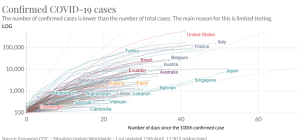
Every American needs to understand the chilling implications of the graph below. Click on a country to see the different rates at which COVID-19 infections are increasing:

https://ourworldindata.org/grapher/covid-confirmed-cases-since-100th-case

Look at line on the graph for the US. It’s steeper than that of any other nation at this point in its pandemic experience — worse than China, worse than Spain, worse than Italy.

Hospitals in New York City are already overwhelmed and the worst is yet to come. New Orleans is probably next, unless Florida wins that dubious prize. As the US infection trend line shoots upward toward an unknown peak, some hospitals are considering universal “Do Not Resuscitate” (DNR) policies for all COVID-19 patients because there’s an insufficient supply of required medical gear to protect healthcare workers from infected patients.

Now look at the line on the graph for South Korea. So far, that country is an international success story reflecting President Moon’s efforts to flatten the curve and control COVID-19. America, on the other hand, is a case study in Trump’s catastrophic failure to do so. Now he’s suggesting that the US is somehow doing better than South Korea at managing the pandemic. The facts prove otherwise.

The Truth and the Timeline

Jan. 20: On the same day, South Korea and the US confirm their first COVID-19 cases.

Jan. 27: South Korean officials meet with medical company representatives, urging them to develop COVID-19 test kits immediately for mass production and promising emergency approval.

Jan. 31: Trump announces what he touts as a “travel ban” that is actually just a policy prohibiting non-US citizens who have traveled to China within the last two weeks from entering the US. There is no process to screen, test, or quarantine US citizens, permanent residents, or their relatives still arriving legally from China in order to determine if they are carrying the virus. For the next six weeks, Trump downplays the seriousness of the growing pandemic.

Feb. 5: Although the total number of confirmed cases of COVID-19 in South Korea remains low, thousands of test kits ship daily throughout that country. In America, the CDC is also shipping thousands of test kits to state, city, and county public health laboratories.

Feb. 8: The CDC receives reports that its test kits are flawed and, therefore, useless. As a result, testing in the US comes to a virtual halt and the CDC must provide and process the relatively few tests that are administered. Confirming the infection in any individual patient can take days.

Feb. 23: A surge of 169 new confirmed cases, the majority of which are traced to a religious sect, brings South Korea’s total to 763. Previously, the government had already shut down day care centers, banned outdoor rallies, and postponed opening schools. Even so, South Korean President Moon raises the virus threat to its highest alert level, thereby allowing the government to allocate more money for fighting it, permitting health officials to acquire the personal data of individuals suspected of infection, outlawing religious and other mass gatherings, and controlling air, train and other public traffic around the country.

Feb. 28: The CDC announces a new fix to its COVID-19 test kits and testing resumes in the US, but only on a slightly larger scale. Trump’s response to the virus: “It’s going to disappear. One day it’s like a miracle, it will disappear.” At a campaign rally, he dismisses concerns about his handling of the pandemic as a Democratic “hoax.”

Mar. 4: By now, South Korea — a country of 51.8 million people — has performed more than 136,000 tests. The US, with a population of 329 million, has performed fewer than 1,000.

Mar. 5: South Korea has drive-through testing clinics that can detect COVID-19 cases in just 10 minutes. Overall, the country has performed 146,000 tests and confirmed the infection in 6,000 patients, 35 of whom have died — a mortality rate of 0.6 percent. The US has performed about 1,300 tests and doctors are contending with severe shortages of test kits.

Mar. 6: In response, Trump says, “Anybody right now and yesterday, anybody that needs a test gets a test. They’re there. They have the tests and the tests are beautiful.” Politifact labels it a “pants on fire” lie.

Mar. 10: Discussing COVID-19, Trump says, “It will go away, just stay calm. It will go away.”

By Mar. 17: This video clip tells the comparative story of COVID-19 testing in the US and South Korea up to this date:

https://www.youtube.com/watch?v=wkDYkYpY8H0

Mar. 19: The US finally reaches the 100,000 mark in total tests to date. South Korea’s total exceeds 300,000. 

Eight Weeks versus Eight Days

Mar. 23: With another week to go in his 15-day “stop the spread” promotion, Trump says that he hopes to get everyone back to work by Easter Sunday, Apr. 12.

Also on Mar. 23: The New York Times publishes a comprehensive article explaining how South Korea succeeded where America failed — flattening the curve so that COVID-19 cases don’t overwhelm the nation’s hospital system. The secrets to South Korea’s success were immediate government intervention to produce test kits on a massive scale, engaging early in widespread testing, isolating affected groups, and conducting extensive messaging to keep the public educated and informed. Trump did none of those things.

Mar. 24: At a Fox News virtual town hall meeting, Trump responds. “In the last eight days, we’ve done more testing than South Korea has done in eight weeks,” he says. At a press briefing that evening, he repeats the claim. It becomes a standard Trump talking point.

Fact check: According to the COVID tracking project, during the eight-day period to which Trump refers (Mar. 15 – 24), the US conducted about 338,000 tests. During the eight weeks prior to Mar. 24, South Korea had run 348,000. In raw numbers alone, that’s 10,000 more tests for South Korea. But the US has approximately 329 million people, compared to 51.8 million for South Korea. On a per capita basis, South Korea has tested at a rate nearly seven times greater than the US. And critically, South Korea began aggressive testing weeks earlier than the US.

Consequences

Early testing enabled South Korea to pinpoint specific sources of the outbreak and target them for treatment, quarantine, and emergency alerts to affected communities. Trump’s early indifference, coupled with his desire to keep the number of US COVID-19 cases down to protect the stock market, prevented rapid identification and containment of the virus.

When Trump says he has proceeded in an unprecedented way on COVID-19 testing, he’s right — but not in a good way. His self-congratulatory lies fill Americans with a false sense of security that now makes it more difficult to promote social distancing, which is the only way to flatten the US infection curve.

South Korean President Moon told his citizens the truth, followed the advice of scientific experts, and used his executive power to protect people’s health rather than financial markets. He treated the crisis with the urgency it deserves, rather than as a public relations problem. Trump did none of that and his continuing lies, reckless disregard of experts’ advice, and obsession with economic indicators are taking a very bad situation and making it worse.

This is part of a continuing series on Trump and the Pandemic. You can read Part I here.